COOPERATION MODEL
ARTIFICIAL INTELLIGENCE
PRODUCT ENGINEERING
DevOps & Cloud
LOW-CODE/NO-CODE DEVELOPMENT
INDUSTRY
FRONTEND DEVELOPMENT
CLOUD DEVELOPMENT
MOBILE APP DEVELOPMENT
LOW CODE/ NO CODE DEVELOPMENT
EMERGING TECHNOLOGIES



 4 mins read
 Last updated January 20, 2026
AI, agents, and agentic AI. terms like are constantly showing up in our social feeds, newsletters, and digital world. But knowing these terms is far less important than actually understanding what they mean, whether you’re a developer, a startup owner, or a solo founder.
In practice, I can often interchange these terms. They are related. But the differences between them are subtle but important. Agents and agentic systems do overlap, but when you look at how they are applied in real life, they have different purposes.
An AI agent is a software program designed to process information, understand context, and decide what actions to take across different scenarios. An agent can be simple, handling a narrowly defined task, or more advanced, as seen in modern AI systems, where agents are built in to execute complex tasks using logical reasoning.
Agents can operate independently or work together. For example, one agent might answer questions using a knowledge base, another might understand a codebase and suggest improvements, while a third could automate workflows by executing a sequence of events without manual intervention.
In an agentic system, multiple agents are orchestrated together to handle complex processes. From a developer’s perspective, modern IDEs and tools can be understood as environments where AI agents are already embedded. Tools like Cursor, Claude Code, and GitHub Copilot function as agents that assist with tasks ranging from code suggestions to debugging and deployment.
When you examine these closely, you see these agents execute tasks based on developers’ instructions, as discussed in detail in the article AI agents for developers, which explores the role of AI agents in development.
Agents take different forms. For example, some focus on code generation, others on execution, and more advanced ones coordinate multiple agents together to work within a complex workflow.
Simple agents are the most basic form of artificial agents. They operate without memory (learning capabilities) and are governed by predefined conditions–action rules. A common example is an email auto-responder, which reacts to incoming messages based on fixed rules.
Model-based reflex agents maintain an internal representation of the current environment, then apply condition–action rules accordingly. These agents are commonly used in smart home systems, self-driving cars, and other environments where the agent must respond based on both current input and past state.
Goal-based agents are designed to achieve a specific objective. They plan actions by evaluating how different states move them closer to their goal. Personal assistants like Siri and Google Assistant are goal-based agents, as they can evaluate commands and then take appropriate action.
Learning agents improve their performance over time by learning from experience. These agents are commonly encountered in everyday applications. For example, recommendation systems used by platforms like Netflix rely on learning agents to personalize content based on user behavior.
Utility-based agents evaluate multiple possible actions and choose the one that maximizes a defined utility function. In the fintech industry, these agents are used for tasks such as financial recommendations, market analysis, and algorithmic trading. Stock-trading bots are a typical example of utility-based agents in practice.
Hierarchical agents handle complex tasks by breaking them down into smaller subtasks. High-level agents manage planning and coordination, while lower-level agents execute specific actions.
Multi-agent systems consist of multiple autonomous agents working together, often coordinating or competing, to perform tasks that resemble human-like activities. These systems are especially useful in large-scale automation scenarios.
Agentic AI refers to a program where multiple AI systems work in tandem to accomplish a specific task with minimal human supervision. Such systems may combine AI agents, machine-learning models, and other sets of technologies.
This can be understood through the example of generative AI. While generative systems appear to produce original output without predefined logic, in reality, they operate by stacking and recombining patterns. The system isn’t creative in the real sense; it recombines learned patterns at such a scale that the result no longer looks procedural.
Agentic AI systems extend this capability further, which we have already discussed in generative AI vs agentic AI. When agentic AI systems fail to complete a process, they employ self-correcting mechanisms, adjusting actions, and re-executing tasks.
Although the two terms are often used interchangeably, the distinction becomes clear when you look at their technical nuance. The difference between an agent and agentic AI is similar to the difference between a tool and a system.
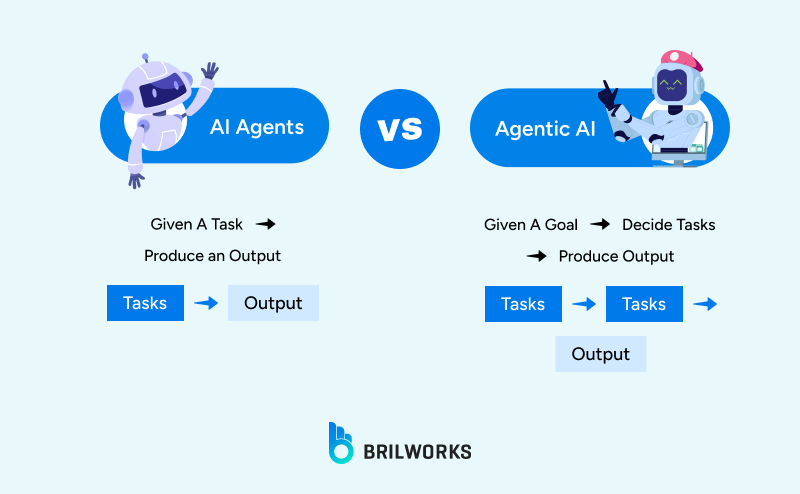
Agentic AI systems are gradually becoming visible even in smaller companies, especially after the rise of generative AI.
In enterprise, agentic AI is increasingly being deployed to automate complex tasks and streamline routine operations. In customer-facing applications, these systems are now being embedded into other digital products, where they are used to handle logical execution and decision-driven workflows rather than simple automation.
Agentic AI also supports a more programmatic approach to development and helps smooth the learning curve.
This can be understood through a practical example. A front-end developer may be required to work on backend-related tasks within a project, even without deep expertise in backend system design.
In such cases, an agentic AI system can assist with backend connections, integrations, codebase synchronization, and even support product execution end-to-end. In some scenarios, the system can autonomously take ownership of multiple tasks rather than merely assisting the developer.
|
AI Agents |
Agentic AI Systems | |
|
Scope |
Narrow, task-specific |
Broad, system-level |
|
Primary Role |
Execute a defined function |
Orchestrate execution across tasks |
|
Autonomy |
Limited autonomy |
High autonomy with minimal supervision |
|
Decision-Making |
Rule-based or model-driven for a single task |
Continuous decision loops across processes |
|
Context Handling |
Local or short-term context |
Global, long-term, cross-system context |
|
Learning & Adaptation |
Optional, often static |
Built-in self-correction and adaptation |
|
Execution Style |
Single-step or linear |
Iterative (observe → decide → act → evaluate) |
|
Composition |
Usually a single agent |
Multiple agents, models, and sub-systems |
|
Failure Handling |
Stops or escalates to humans |
Detects failure, adjusts, and retries |
|
Typical Examples |
Email responder, code suggestion agent, chatbot |
Autonomous dev environments, workflow orchestration systems |
|
Developer Interaction |
Tool-like usage |
Supervisor / intent-giver role |
|
Mental Model |
“An intelligent tool” |
“An intelligent system” |
Streamlining professional and personal workflows
Improve and unlock advanced automation
Security enhancement
Technical tasks such as coding
From a daily user’s perspective, agentic AI and AI agents can be understood through task-level applications. Simple agents can be built using tools and integrations such as LangChain, Zapier, and Make.
A basic example is using agents to manage an email inbox, like automatically flagging actionable messages, scheduling meetings, and handling routine follow-ups.
In content creation, agents can go beyond simple post scheduling. Based on predefined sources and rules, they can generate, format, and publish content across platforms with minimal human intervention.
A personal agent can be configured to handle recurring professional or personal communication. If emails follow predictable patterns or templates, these agents can be trained with the relevant data and used to automate the entire process at scheduled intervals.
While these are basic examples, chaining such agents together enables the creation of far more complex agentic AI systems. At the enterprise level, AI assistants often execute complex workflows in loops, continuously evaluating outcomes and triggering multiple processes to completion.
Get In Touch
Contact us for your software development requirements
Get In Touch
Contact us for your software development requirements

Hello, we are BRILLIAN’S. Trying to make an effort to put the right people for you to get the best results. Just insight !

 503, Fortune Business Hub, Science City Road, Sola, Ahmedabad, Gujarat, India Pincode- 380060
 + 91 9313644148
 sales@brilworks.com


