COOPERATION MODEL
ARTIFICIAL INTELLIGENCE
PRODUCT ENGINEERING
DevOps & Cloud
LOW-CODE/NO-CODE DEVELOPMENT
INDUSTRY
FRONTEND DEVELOPMENT
CLOUD DEVELOPMENT
MOBILE APP DEVELOPMENT
LOW CODE/ NO CODE DEVELOPMENT
EMERGING TECHNOLOGIES



 5 mins read
 Last updated March 26, 2026
AI-assisted software development has fundamentally changed how we build applications. According to recent surveys, roughly 85% of developers now use AI tools regularly in their daily work. They've become essential teammates that analyze millions of lines of code, spot patterns humans would miss, and even write functional code from simple descriptions. What used to take a full development team weeks can now happen in days, sometimes hours.
Let's rewind to what software development looked like just a decade ago. Code was written by hand. Developers would spend hours testing their work. Back then, building software meant having big teams and accepting that projects would take months or years. The traditional waterfall model was standard. As software systems got bigger, this manual approach started showing cracks. One developer couldn't possibly understand an entire codebase anymore.
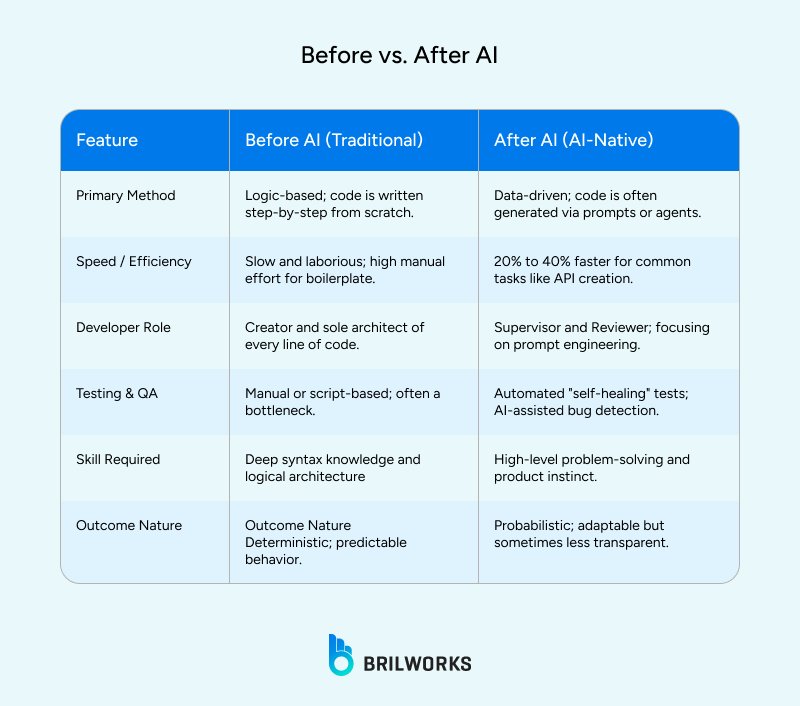
Software development hasn’t followed a clean plan. It has mostly been a series of fixes. Something works for a while, teams grow, code grows, and suddenly the old approach feels heavy. New methods show up not because they’re better in theory, but because the previous ones stop holding up.
The chart below shows how those shifts played out over time.

AI brings genuine intelligence to development tools. These systems can learn from experience and get smarter over time.
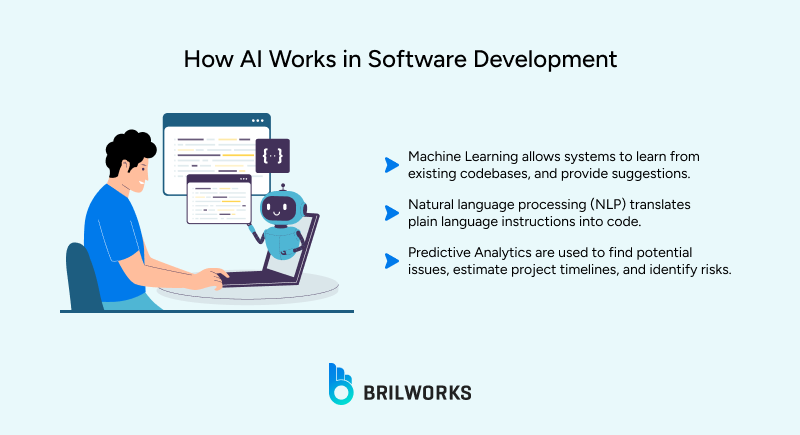
Machine learning algorithms digest thousands of existing code repositories. They study how experienced developers structure their code. When you're working on a new feature, these systems can suggest optimized approaches. The more code they analyze, the better their suggestions become.
For instance, if you're building an authentication system, the AI has already studied hundreds of authentication implementations. It knows the common security pitfalls, the edge cases developers usually forget.
Natural language processing is probably the most revolutionary technology currently. Developers can describe what they want in everyday language, "create a function that validates email addresses and returns true if valid," and the AI translates that into working code. It understands context, and coding conventions. Someone with a great idea but limited coding experience can now prototype and learn as they go.
AI predictive analytics can now warn you that based on your current velocity, you're likely to miss your deadline. They spot code patterns. They identify which parts of your codebase are most likely to cause issues. Some tools even predict how long specific features will take to build.
AI hasn’t made teams magically better at software. What it has done is change where time gets wasted. Less effort goes into chasing syntax, boilerplate, and dead ends. More time goes into deciding what to build, what to cut, and what’s not worth engineering at all.
Here are real benefits, written the way engineers actually talk about them:
You don’t start from zero anymore
Reading old or messy code is easier
Less googling
Refactors stop getting delayed
Basic mistakes get caught earlier
Tests exist where they usually don’t
Trying ideas is cheaper
Docs writing is no longer painful.

Modern AI code generators can write entire functions, complete with error handling and comments. You type a function name and the AI generates the logic. You review it, maybe tweak a few lines, and move on.These tools handle the tedious boilerplate work.
Automated testing by AI is transforming quality assurance. Traditional automated tests only check what developers explicitly tell them to check. AI-powered testing explores your application like a curious user would. What’s unique about this technology is that these systems can learn from bugs.
AI tools are used to scan code as developers write it. It works like an assistant constantly reviewing your work. If you're about to create a SQL injection vulnerability, the AI flags it immediately with an explanation.
AI has made DevOps teams' lives somewhat easier. Deployment pipelines can now predict which builds are likely to fail before running them. Systems automatically can roll back problematic deployments. Monitoring tools now leverage AI to distinguish between normal fluctuations and actual problems.

AI isn't magic, and adopting it comes with real hurdles. Enterprise-grade AI tools cost tens of thousands of dollars annually for larger teams. That's a tough sell to management, especially if they don't understand the ROI yet.
Data privacy is another concern with AI. When your AI tool analyses your proprietary code, where does that data go? Who has access? For companies in regulated industries like healthcare or finance, these aren't trivial questions.
There's also a talent gap. Not every developer knows how to work effectively with AI tools. Some resist them entirely, worried about job security or skeptical of the technology. Training teams takes time and money.
The quality problem is real too. AI tools are only as good as the data they learn from. If they're trained on mediocre code, they'll suggest mediocre solutions. Garbage in, garbage out still applies.
There's also a subtle danger: developers who rely too heavily on AI might stop developing their own problem-solving skills. You still need to understand what the code does and why it works. AI should amplify your abilities, not replace your thinking.
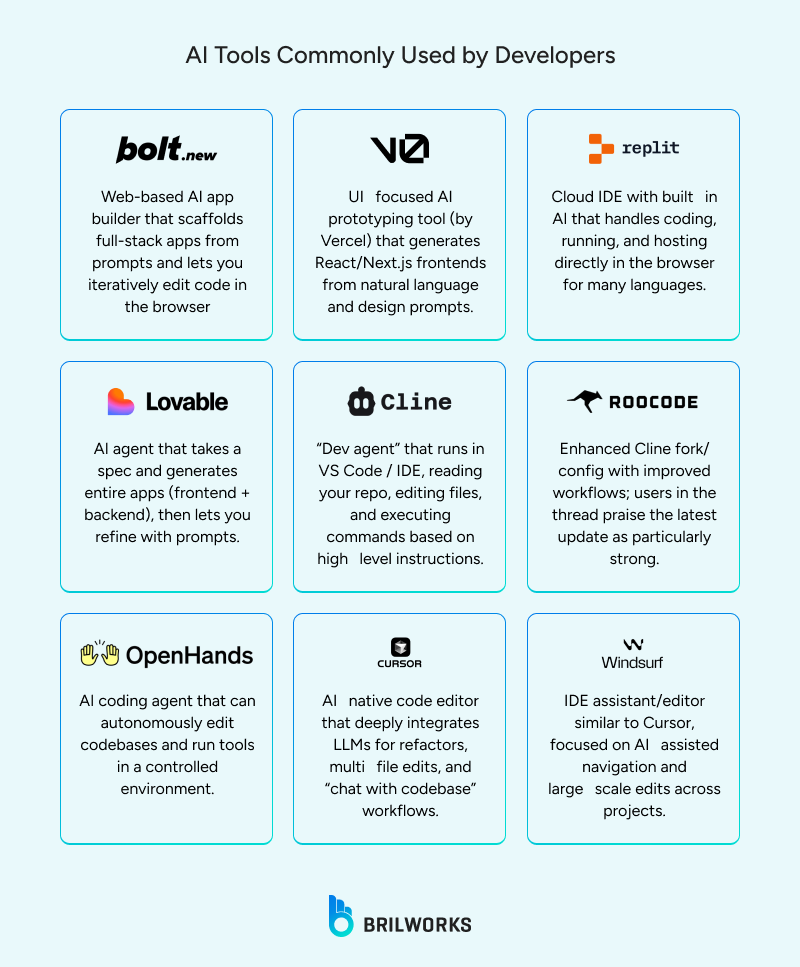
The enterprise AI tool landscape changes fast, but certain names keep coming up. GitHub Copilot has become almost ubiquitous. It's the AI pair programmer that suggests code as you type. TensorFlow and PyTorch power machine learning applications. Tabnine offers AI-powered code completion across multiple IDEs.
For testing, tools like Testim and Mabl use AI to create and maintain automated tests. DevOps teams rely on platforms like Harness for AI-driven deployment strategies. Even code review tools leverage AI to catch issues. Many developers combine multiple tools, using AI assistants for writing code, separate AI tools for testing, and another set for monitoring production systems.
Here's the part everyone worries about: will AI take developer jobs?
The short answer is no, but the job is definitely changing.
AI handles the repetitive, boring stuff: the tenth REST API endpoint that works exactly like the previous nine. The role is shifting toward being more strategic. Developers are becoming problem solvers and systems thinkers rather than code typists.
You need to understand what you're building and why, then orchestrate AI tools to build it efficiently. New jobs are emerging too. AI engineers who specialize in training and fine-tuning models for development use cases.
Prompt engineers who know how to get the best results from AI tools. ML operations specialists who maintain AI systems in production.
AI in software development raises ethical questions we're still figuring out. If an AI was trained on open-source code, does the code it generates inherit those licenses? Who's responsible when AI-generated code has a security vulnerability, the developer who accepted the suggestion, the company that built the AI, or the AI itself?
Bias is another concern. If AI tools are trained primarily on code written by one demographic group, they might suggest solutions that work well for that group but poorly for others. Accessibility features might get deprioritized. Security practices from certain cultures might be overlooked.
Transparency matters too. When AI makes a decision developers need to understand why. Black-box AI that can't explain its reasoning is hard to trust and harder to improve.
Companies need clear policies about responsible AI use. Regular audits of AI systems. Diverse training data. Human oversight of critical decisions.

The future of AI in software development looks wild. Self-healing software isn't fiction anymore. Fully autonomous testing without human intervention is getting closer.
Development environments are becoming genuinely intelligent. Imagine an IDE that understands your project's architecture deeply enough to suggest refactoring entire modules, or that automatically optimizes database queries based on production performance data.
We're moving toward AI that can understand business requirements in plain language and generate not just code but entire applications. The developer's role becomes validating the AI's interpretation and guiding the overall strategy.
Some researchers are working on AI that learns your personal coding style and adapts its suggestions to match. Others are building systems that can read documentation for third-party libraries and immediately use them correctly.
AI in software development isn't coming, it's already here and changing. Teams that embrace these tools are building better. The technology amplifies what good developers can do while making software development more accessible to newcomers.
Yes, there are challenges. Implementation takes work, costs can be significant, and teams need time to adapt. Ethical considerations require ongoing attention. But the benefits make AI adoption less of a question of "if" and more about "how quickly."
The developers who thrive in this new landscape won't be those who resist AI or those who blindly depend on it. They'll be the ones who thoughtfully integrate AI into their workflow, using it to handle grunt work while focusing their human creativity on problems that actually matter. That's where software development is headed, and honestly, it's an exciting place to be.
Get In Touch
Contact us for your software development requirements
Get In Touch
Contact us for your software development requirements

Hello, we are BRILLIAN’S. Trying to make an effort to put the right people for you to get the best results. Just insight !

 503, Fortune Business Hub, Science City Road, Sola, Ahmedabad, Gujarat, India Pincode- 380060

 + 91 9313644148
 sales@brilworks.com


