COOPERATION MODEL
ARTIFICIAL INTELLIGENCE
PRODUCT ENGINEERING
DevOps & Cloud
LOW-CODE/NO-CODE DEVELOPMENT
INDUSTRY
FRONTEND DEVELOPMENT
CLOUD DEVELOPMENT
MOBILE APP DEVELOPMENT
LOW CODE/ NO CODE DEVELOPMENT
EMERGING TECHNOLOGIES



 4 mins read
 Last updated January 16, 2026
![Everything-You-Need-to-Know-About-AI-MVP-Development-[-Founder-Guide]-banner-image](https://d14lhgoyljo1xt.cloudfront.net/assets/Mobile_Banner_Image_-_Everything_You_Need_to_Know_About_AI_MVP_Development_-1768483438642.webp)
AI MVPs are becoming the starting point. More products are being built with AI at their core. For startups, this opens the door to building modern software for real business problems. An AI MVP follows the same thinking as a traditional MVP, but they also leverage language models.
Nearly every AI report points to the same conclusion: AI is moving from “nice-to-have” to must-have. Many organizations are already experimenting with it, not just for short-term gains, but as a step toward more advanced and autonomous systems over time.
Many tasks that once required significant manual effort can now be handled by AI at a scale that wasn’t possible before. Industries such as finance, healthcare, and many others are now actively focusing on leveraging AI. Below are some of the industries where an AI MVP is quickly becoming the new baseline rather than an experiment.
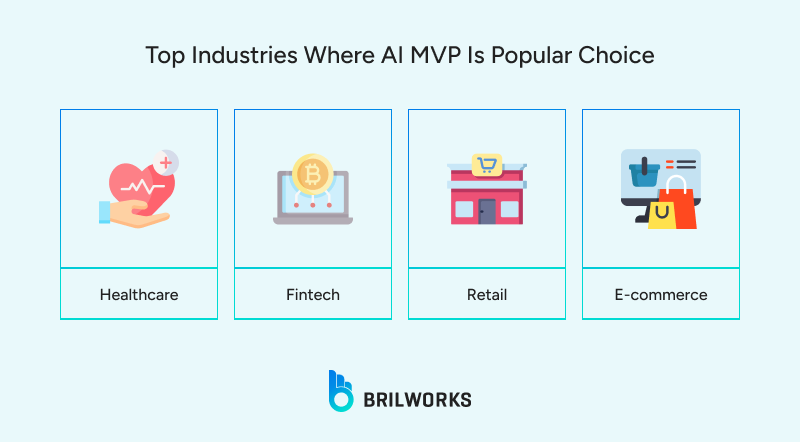
AI MVPs in healthcare help manage review patient data and provide suggestions. They are also used in various healthcare operations such as diagnosis, helping doctors spot issues.
In finance, AI MVPs are used to speed up lending checks, simplify payments, and for compliance. They also help companies understand talent needs better by mapping career paths and automating hiring tasks, turning basic job platforms into smarter decision tools.
Retail and e-commerce teams use AI MVPs to automate operations, understand customer behavior, and identify problems in product flows. AI is also used to create personalized shopping experiences.
In manufacturing, AI MVPs help move materials within factories, improve product design, and catch quality issues early. By analyzing sensor data and video feeds, these systems can detect defects faster and more consistently than manual inspection.
In addition to this, in EdTech, AI is being used in adaptive learning and content personalization.
Building an AI MVP typically requires a small team, 1 to 5 professionals, including a founder, developers, and possibly a data specialist. These MVPs are built with a narrow focus. They aim to solve specific problems. For example, an AI MVP might handle reminders, or send reports at scheduled times.
Behind the scenes, an LLM does the initial heavy lifting. Over time, the logic around it is refined, guardrails are added, and feedback is used to improve results. Later, the systems are made more tailored.
Good data is the foundation of any AI product. Poor or biased data causes most AI failures. Start small by using datasets, user logs, or synthetic data. Focus on data that is representative of the real problem, not just large in volume. Clean, well-labeled, and domain-specific data will save time and improve model performance as you scale.
A small, versatile team can move fast. Typically this includes:
1–2 developers
A data specialist
A designer
Everyone should have some AI literacy.
Start by defining what the MVP should do. Use frameworks like MoSCoW (Must, Should, Could, Won’t). Focus on solving the core problem first, before adding secondary features.
Start by defining measurable outcomes. Think about what success looks like, whether it’s the model’s accuracy, or model predictions, or user engagement. By defining these, you can find out whether your MVP is delivering real value or not.
An AI MVP is never “finished” at launch. Start simple, gather feedback, and refine the model and logic over time. As the system learns from real usage, it moves beyond generic outputs toward domain-specific, reliable results.
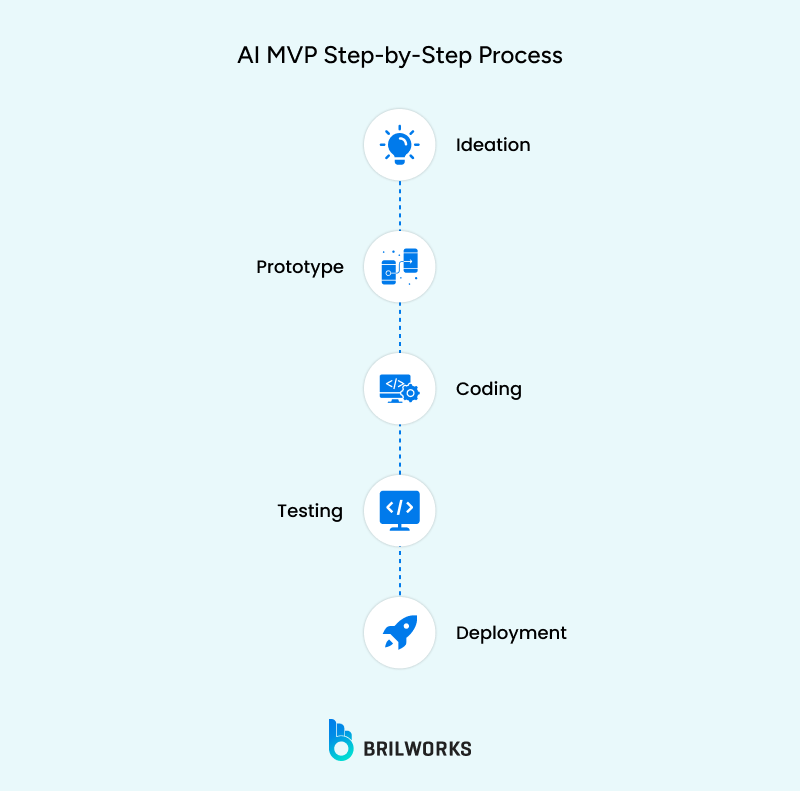
Start by understanding the real user problem. Research your target users, analyze competitors, and map out user journeys.
Collect high-quality datasets that are representative of the problem. Clean the data to remove bias and ensure diversity. Good data preparation is critical.
Build a minimal interface or API. Use lightweight models and keep the design simple. Include human-in-the-loop checks.
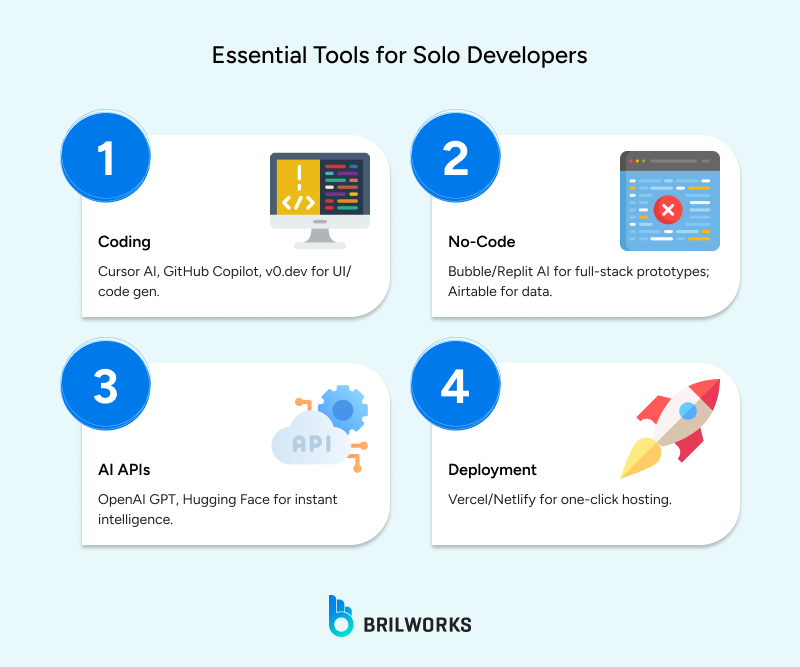
Choose tools that accelerate development, for example; frameworks like PyTorch or Scikit-learn, pre-trained APIs from OpenAI or Hugging Face, and cloud platforms like AWS SageMaker for deployment.
Deploy the MVP to a small group of users and gather real-world feedback. Monitor performance, retrain models as needed, and refine both AI logic and the user experience.
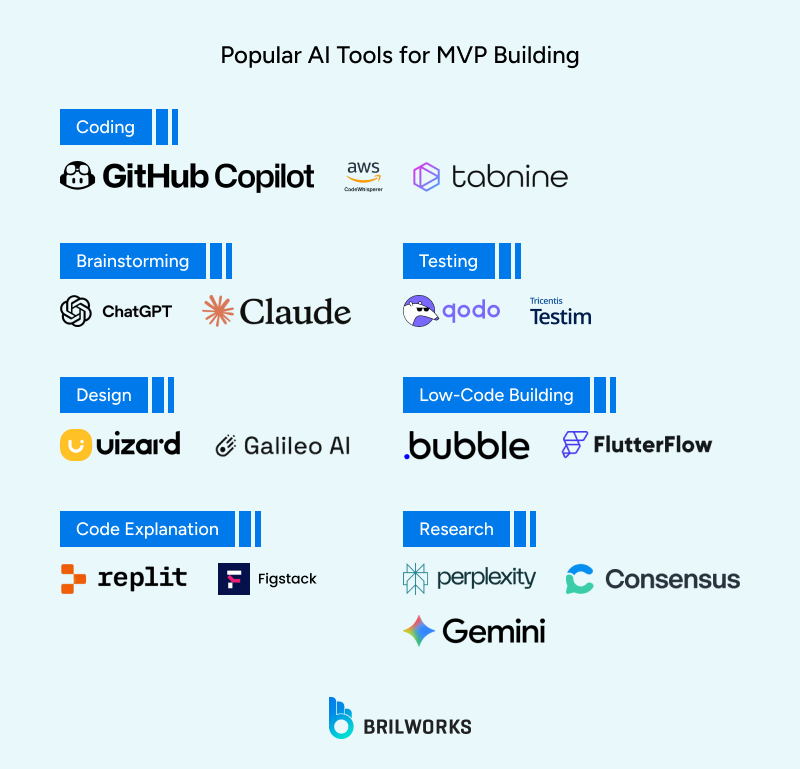
1. Coding & Development
GitHub Copilot, AWS CodeWhisperer, Tabnine
2. Brainstorming & Idea Generation
ChatGPT, Claude to generate content ideas.
3. Design & Prototyping
Uizard, Galileo AI for UI prototypes.
4. Code Explanation & Understanding
Replit, Figstack to debug, or optimize code.
5. Testing & QA
Qodo, Tricentis Testim to automate test.
Bubble, FlutterFlow for building prototypes.
7. Research & Insights
Perplexity, Consensus, Gemini to research and market intelligence.
Yes. A solo founder with technical skills can build a working AI MVP in 1–4 weeks using no-code/low-code tools and AI assistants. Simple prototypes, like chatbots, image analyzers, or recommendation engines, are achievable solo.
Complex, data-heavy products need collaboration, but your experience in AI programming languages and frameworks, Node.js, and SaaS gives you an edge.
An effective AI MVP focuses on a handful of must-have features. At its core, it includes a single AI task (such as answering FAQs or providing recommendations).
A data input pipeline is a must for accurate performance. Always have a human-in-the-loop. An engaging UI/UX is non-negotiable. Understand what is the industry standard. For example, if accuracy, response time, and task completion rates on-par industry standards.
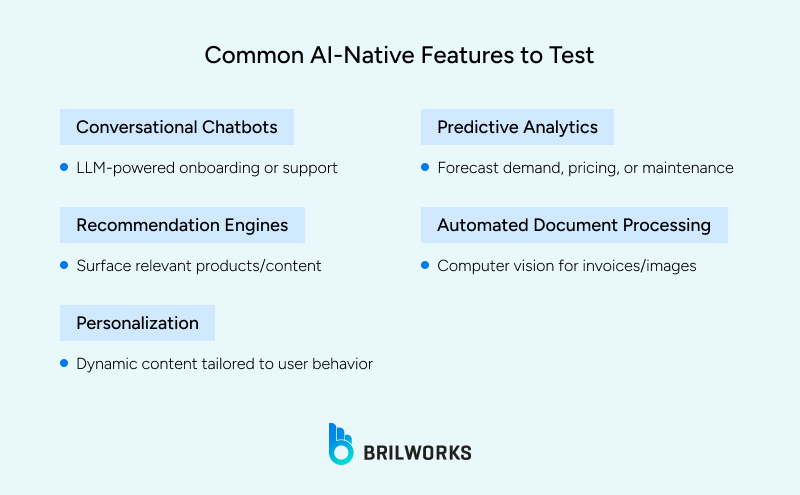
In the first version of your AI MVP, it’s crucial to avoid unnecessary complexity. Features like multilingual support, AR previews, complex integrations, or full automation can cause scope creep and slow down validation.
Focus on what truly proves your concept, and leave these “nice-to-haves” for later. Using MoSCoW prioritization helps you ruthlessly cut anything non-essential, keeping the MVP lean and fast to launch.
Building a successful AI application requires focus, experience and problem-solving skills. AI MVP is a starting point to solve challenges by building small. To avoid overspending,keep the team lean, leverage AI tools and pre-trained models. Avoid overcomplicating with extra features. With clarity, discipline, and the right stack, even a solo founder can move from idea to working AI product in weeks.
Get In Touch
Contact us for your software development requirements
Get In Touch
Contact us for your software development requirements

Hello, we are BRILLIAN’S. Trying to make an effort to put the right people for you to get the best results. Just insight !

 503, Fortune Business Hub, Science City Road, Sola, Ahmedabad, Gujarat, India Pincode- 380060
![Everything-You-Need-to-Know-About-AI-MVP-Development-[-Founder-Guide]-banner-image](https://d14lhgoyljo1xt.cloudfront.net/assets/Banner_Image_-_Everything_You_Need_to_Know_About_AI_MVP_Development_-1768483429031.webp)
 + 91 9313644148
 sales@brilworks.com


