COOPERATION MODEL
ARTIFICIAL INTELLIGENCE
PRODUCT ENGINEERING
DevOps & Cloud
LOW-CODE/NO-CODE DEVELOPMENT
INDUSTRY
FRONTEND DEVELOPMENT
CLOUD DEVELOPMENT
MOBILE APP DEVELOPMENT
LOW CODE/ NO CODE DEVELOPMENT
EMERGING TECHNOLOGIES



 3 mins read
 Last updated January 7, 2026
In 2025, AI crossed an important threshold. It becomes a solution to real-world issues, helping industries improve their operations, services, and innovate with limited resources.
The data backs this up. According to Stanford’s 2025 AI Index, enterprise AI adoption jumped from 55% to 78% in just one year. At the same time, advanced language models improved on reasoning and coding tests. Now, agentic AI tools can handle tasks on their own that used to require a specialist.
Tech titans are already repositioning for this reality. Microsoft frames agents as coworkers. Expert knowledge is being compressed into these so-called “intelligent” systems. AI is going to be the most-hyped technology in 2026, too. This article looks at seven AI trends for 2026.
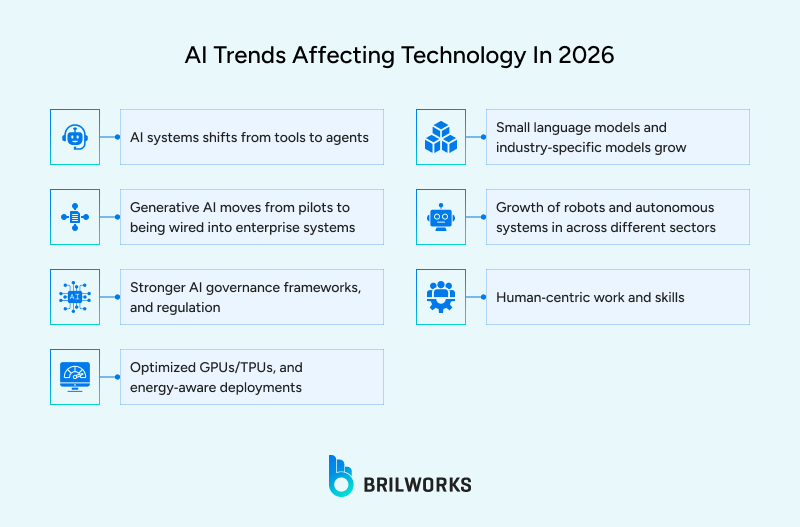
The primary trend in 2026 isn’t a new class of AI products. It’s those familiar tools that finally work inside email tools, CRMs, software, etc.
The rise of smaller, cheaper AI tools supports this shift. Advanced features are moving into MSME-friendly SaaS plans. One professional can now handle more tasks because drafting, summarizing, and data cleanup are increasingly handled by default.
By 2026, agentic AI systems are quickly being used in complex production processes and can now handle multi-step tasks. These agents can plan work, use different tools, and carry out both technical and non-technical actions. As these tools get stronger, teams spend less time coordinating work between systems.
Most attention has focused on large, general-purpose models, but in 2026, smaller and industry-specific software are becoming more important. Analysts see more models tailored for fields like healthcare, finance, and manufacturing, as well as more efficient small language models.
First, industry‑specific models generally give more accurate and relevant answers. Second, smaller models are economical to run on; as a result, SaaS vendors can offer AI features without passing on high costs.
Gen‑AI will be increasingly embedded in enterprise systems for content generation, code assistance, documentation, and knowledge search rather than running as a separate “AI project. 78% of organizations already use AI, and more than 80% are expected to run generative models or APIs by 2026.
There are now more than 4 million industrial robots working in factories worldwide, roughly double the number from a decade ago. In 2024 alone, about 542,000 new industrial robots were installed.
Surveys show that 53% of manufacturers are already using new industrial robot hardware, and another 19% plan to add robots in the next five years. AI-powered vision, planning, and predictive models are central to how these robots work. AI now helps them adapt more easily than ever before.
The EU's AI Act will begin to apply to high-risk systems, with most rules taking effect on August 2, 2026. This is the first wide-ranging AI law of its kind. Other regions are also introducing regulations.
The 2025 Stanford AI Index notes that U.S. federal agencies issued 59 AI‑related rules and directives in 2024, more than double the number from 2023.
At the same time, frameworks like NIST’s AI Risk Management Framework and new enterprise governance guides from 2025 are encouraging organizations to track their AI systems. For many teams, 2026 is seen as a transition year as regulations change.
In 2026, AI growth depends as much on infrastructure limits as on model design. Large cloud providers are investing in new accelerators and connections. Companies like NVIDIA and Google are developing optimized GPUs and TPUs for inference, along with methods like quantization and sparsity to reduce computing needs.
A good first step is to find out where AI is already used in your current tools. In the past 12 to 18 months, many AI SaaS platforms have quietly added AI features like email suggestions, meeting summaries, AI search, report explanations, and ticket summarization. Making a list of what’s available and what you can turn on is the key to quick results.
Next, pick one or two workflows where agentic or generative AI features could save time on manual work. Good places to start include lead follow-ups, basic support questions, and regular reporting.
AI in 2026 is not about one major breakthrough, but a series of ongoing improvements. Instead of seeing these seven trends as predictions, use them as a checklist: where are your tools already getting smarter, where could agents soon handle workflows, which domain models can you use, how prepared are you for governance, and where can AI at the hardware or platform level give you an advantage instead of catching you off guard.
Businesses that address these questions early will appear more responsive and reliable, not just because they use AI, but because they have quietly rebuilt their operations around it.
Get In Touch
Contact us for your software development requirements
Get In Touch
Contact us for your software development requirements

Hello, we are BRILLIAN’S. Trying to make an effort to put the right people for you to get the best results. Just insight !

 503, Fortune Business Hub, Science City Road, Sola, Ahmedabad, Gujarat, India Pincode- 380060
 + 91 9313644148
 sales@brilworks.com


