COOPERATION MODEL
ARTIFICIAL INTELLIGENCE
PRODUCT ENGINEERING
DevOps & Cloud
LOW-CODE/NO-CODE DEVELOPMENT
INDUSTRY
FRONTEND DEVELOPMENT
CLOUD DEVELOPMENT
MOBILE APP DEVELOPMENT
LOW CODE/ NO CODE DEVELOPMENT
EMERGING TECHNOLOGIES



 4 mins read
 Last updated December 16, 2025
Automation is now at the center of business conversations, boosted by the emergence of Generative AI. In 2025, more than 85% of business leaders believe automation is critical to gain a competitive edge.
Technologies such as generative AI and agentic AI have next-level capabilities that unlock a new level of sophisticated, autonomous operations.
In our own projects, advanced automation has saved us hundreds of operational hours for our clients and us. BulkDM, an automation platform we built, saves hours of work every week by automating responses on Instagram.
Automation is indeed critical, but it can be ineffective in many cases, just because the system on which you are running it doesn't allow advanced customisation. Consequently, understanding the difference between automation tools and custom systems is indeed critical.
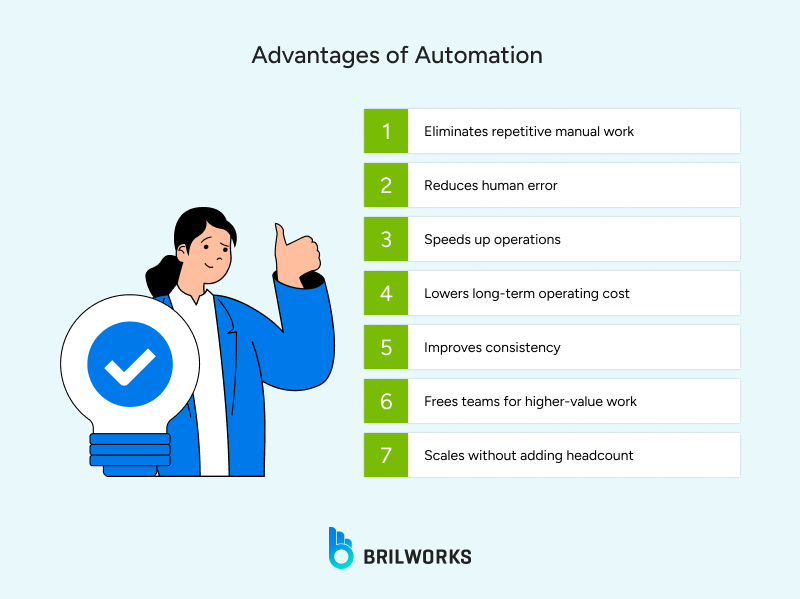
The impact of automation goes beyond speed. Let's take a look at the benefits of automation and why it is crucial to adopt it.
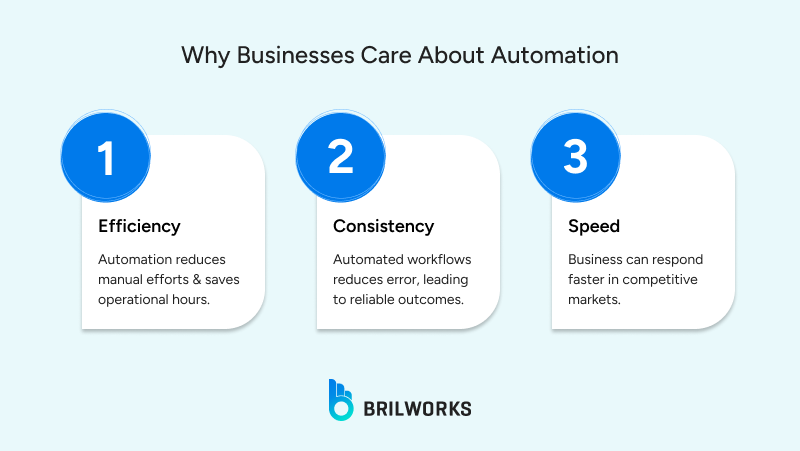
Automation has operational leverage that, once requiring additional staff, can now be handled by modern systems. This allows companies to scale growth and operational volume without a proportional increase in human capital.
Automated workflows eliminate human variability. Tasks are executed the same way every time, ensuring enhanced reliability, compliance, and a uniformly high-quality customer experience across all touchpoints.
Markets move quickly. Competitors adopt new tools fast, and customers expect seamless, instant experiences. Businesses that fail to implement advanced automation risk falling behind, not due to lack of talent, but because their core processes remain manual, slow, and structurally unable to meet modern demands.
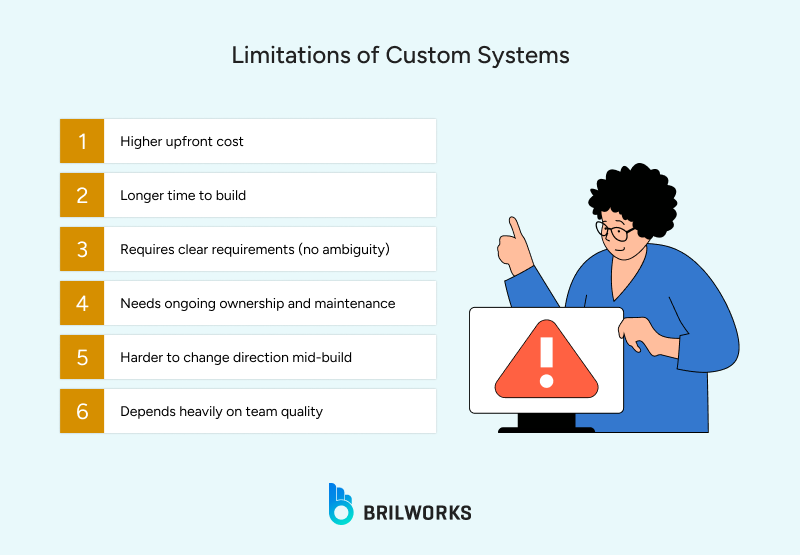
Custom systems are bespoke software solutions built from scratch to meet highly specific business needs. They are designed with a company’s precise workflows, data architecture, and strategic goals in mind. Unlike generic platforms, they provide granular, absolute control over every functional feature.
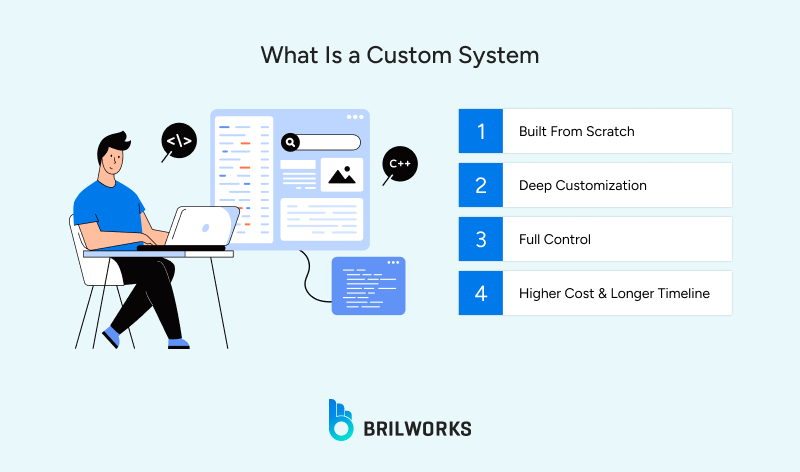
Being built for unique, proprietary processes and complex requirements.
The ability to allow deep customization and the embedding of proprietary business logic.
A longer development timeline and a significantly higher initial investment (Capital Expenditure or CAPEX).
A reliance on dedicated technical expertise, either in-house or through specialized vendors, for maintenance and evolution.
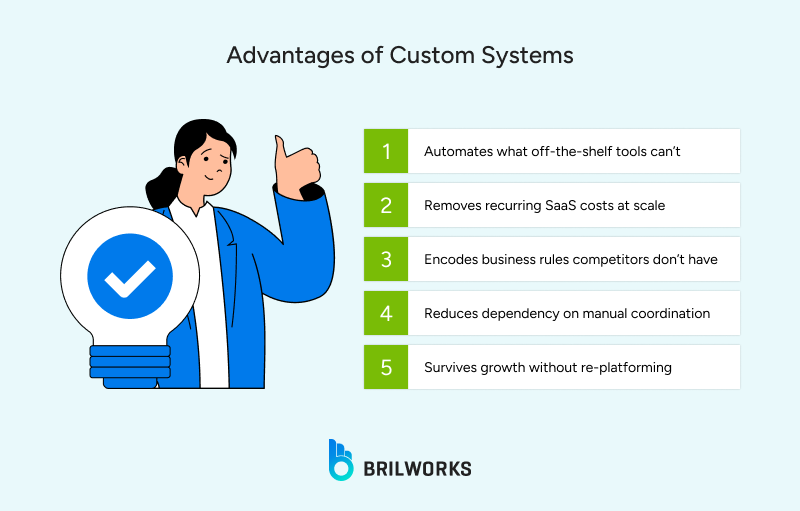
Custom systems create a defensible competitive advantage. They encapsulate the company’s unique methodology directly into the software, making them difficult for competitors to replicate. Crucially, they provide full control over architecture, security, integrations, data sovereignty, and the future development roadmap.
The trade-offs are significant: high upfront costs, longer deployment times, and the necessity of ongoing maintenance and technical debt management. For smaller companies or for non-core, standardized processes, this capital investment is often neither justified nor necessary.
Automation tools are commercial, off-the-shelf platforms like Zapier, Make, or UiPath. They connect existing applications and services, allowing businesses to orchestrate workflows without the need for bespoke software development.
Automation tools are characterized by:
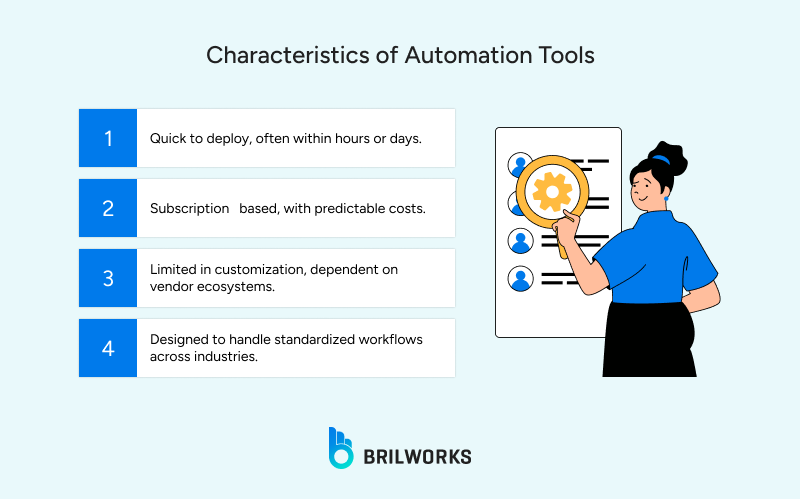
Quick deployment, often becoming functional within hours or days.
Subscription-based pricing, offering low barriers to entry and predictable Operating Expense (OPEX).
Inherent limitations in customization, being dependent on the vendor's API connectors and existing ecosystem.
A design focused on handling standardized workflows common across various industries.
Automation tools provide immediate gains in speed and cost efficiency (Time-to-Value or TTV). They are ideal for early-stage companies or for automating non-core processes, allowing teams to experiment, validate processes, and adapt quickly without heavy capital risk.
They rarely provide strategic differentiation, as competitors have equal access to the same platforms. Businesses also face commercial vendor lock-in, remaining dependent on the vendor’s roadmap, pricing, and functional limitations. Complex, multi-step, or truly proprietary workflows may often hit the functional ceiling of these platforms.

|
Dimension |
Custom Systems |
Automation Tools |
|
Fit |
Exact, proprietary workflows |
Generic, standardized workflows |
|
Cost |
High upfront, ongoing maintenance |
Subscription, lower entry cost |
|
Speed to Deploy |
Slow (months) |
Fast (hours/days) |
|
Scalability |
Unlimited, but dev‑dependent |
Limited to vendor ecosystem |
|
Control |
Full (architecture, data, roadmap) |
Partial (vendor‑defined) |
|
Differentiation |
High (unique IP, competitive edge) |
Low (same tools competitors use) |
Early‑stage companies often prioritize speed. Automation tools allow them to move quickly, test ideas, and keep costs low. As they grow, the need for differentiation increases, making custom systems more attractive.
For non‑core processes, tasks that do not define the company’s competitive edge, automation tools are sufficient. For core workflows that shape customer experience or product delivery, custom systems provide lasting value.
Companies with strong technical teams may lean toward custom systems. Those without in‑house expertise often rely on automation tools, at least initially.
The decision is not only about current needs. Businesses must consider where they want to be in five years. If automation is central to their strategy, investing in custom systems early can pay off.
Most companies adopt a hybrid approach. They start with automation tools to gain immediate efficiency. As they scale, they migrate critical workflows into custom systems. This balance allows them to move fast without sacrificing long‑term differentiation.
For example, a startup might use Zapier to connect its CRM and email platform. As customer engagement becomes a core differentiator, it may build a custom system that integrates data, manages conversations, and fine‑tunes responses, similar to how BulkDM was developed.
Agentic AI will blur the line between tools and systems. Automation platforms will become more customizable, while custom systems will increasingly leverage AI components. Businesses will need to rethink what automation means in practice.
Future automation will not only connect apps but also manage context. Systems will understand workflows, adapt to changes, and provide insights. This requires deeper integration than most current tools offer.
Automation will shift from being a support function to a core strategy. Companies that treat automation as central to their business model will outpace those that see it only as efficiency.
Automation is no longer optional. The real question is whether businesses want speed and convenience, or control and differentiation. Automation tools provide quick wins, while custom systems build long‑term value. The answer depends on whether automation is a support function or a core moat in the business.
For most companies, the path forward is hybrid: start with automation tools, then invest in custom systems as scale and strategy demand. The decision is not just technical, it is strategic, shaping how businesses grow, compete, and deliver value in an AI‑driven world.
Get In Touch
Contact us for your software development requirements
Get In Touch
Contact us for your software development requirements

Hello, we are BRILLIAN’S. Trying to make an effort to put the right people for you to get the best results. Just insight !

 503, Fortune Business Hub, Science City Road, Sola, Ahmedabad, Gujarat, India Pincode- 380060
 + 91 9313644148
 sales@brilworks.com


