COOPERATION MODEL
ARTIFICIAL INTELLIGENCE
PRODUCT ENGINEERING
DevOps & Cloud
LOW-CODE/NO-CODE DEVELOPMENT
INDUSTRY
FRONTEND DEVELOPMENT
CLOUD DEVELOPMENT
MOBILE APP DEVELOPMENT
LOW CODE/ NO CODE DEVELOPMENT
EMERGING TECHNOLOGIES



 3 mins read
 Last updated December 26, 2025
You are likely building your team in a specific climate. Large tech firms are cutting tens of thousands of jobs, while early-stage startups continue to grow. The difference is in how they hire. Your hiring is probably intentional and slow. You are not alone, for early-stage startups managing tasks like onboarding, offers, tax forms is a headache.
And this friction makes it hard to scale operations, where there is a limited capacity. HR software removes this growing, ever-present friction.
Your work changes when you hire your first employee. The focus expands from building a product to building a team. In the U.S., most new companies hire within their first year, but they do not hire an HR person until there are 25 or 50 people. Until then, you manage everything yourself.
The practical reality is simple. Information lives everywhere. An offer letter sits in an email. A signed agreement is in a shared drive. A tax form is on your computer. Questions about time off or expenses get answered in chat. This works fine at first. You know where everything is.
But when you hire a third person, or a fifth, this system begins to strain. This is also the moment to consider structure. Not a complex system, but a single, reliable place for the details.
For early-stage founders, every purchase is a question: does the cost of the tool outweigh the cost of the problem it solves? This is how to evaluate HR software.
Basic HR platforms for startups typically range from $4 to $30 per employee, per month. For a core team of ten people, this means a monthly cost between $40 and $300. This is a measurable line item, but it is not enterprise-level pricing.
Users of these systems report measurable perceptions of time saved, reduced administrative overhead, and better support for decisions.
The evidence does not promise a specific return, but it consistently links the adoption of structured systems to gains in operational efficiency, exactly the area where early-stage teams begin to struggle.
The question shifts from "is this software good?" to a concrete comparison:
Is the monthly subscription fee greater than the current cost of your manual process?
To calculate your current cost, account for:
The hours you or a lead spend collecting documents, answering policy questions, etc.
The cumulative distraction from core work occurs as these tasks repeat with each new hire.
By using a software system, how many hours could you have saved? If you can answer this, this is the time to make a decision. A practical way to reach this conclusion is to identify specific tasks an HR system can automate today. In most organisations, an HR system can manage processes like:
Collecting and storing onboarding documents (IDs, tax forms, contracts)
Generating and sending offer letters and employment agreements
New-hire onboarding workflows and checklists
Employee data updates (role, salary, department changes)
Time-off/leave requests, approvals, and balance tracking
Attendance and timesheet collection
Payroll inputs and sync (hours, deductions, benefits)
Expense submission, approvals, and reimbursement tracking
Performance review reminders and form collection
Policy acknowledgment tracking (handbooks, updated policies)
Compliance reminders (expiring documents, mandatory trainings)
Benefits enrollment and change requests
How many hours does it save? If the time lost to coordination and correction surpasses the cost of the system, the investment is a practical option. The data suggests this point often arrives sooner than founders expect, once hiring moves beyond a handful of people.
These advantages only matter once managing people begins to distract from the work itself. They are not theoretical improvements, but solutions to specific, recurring friction points.
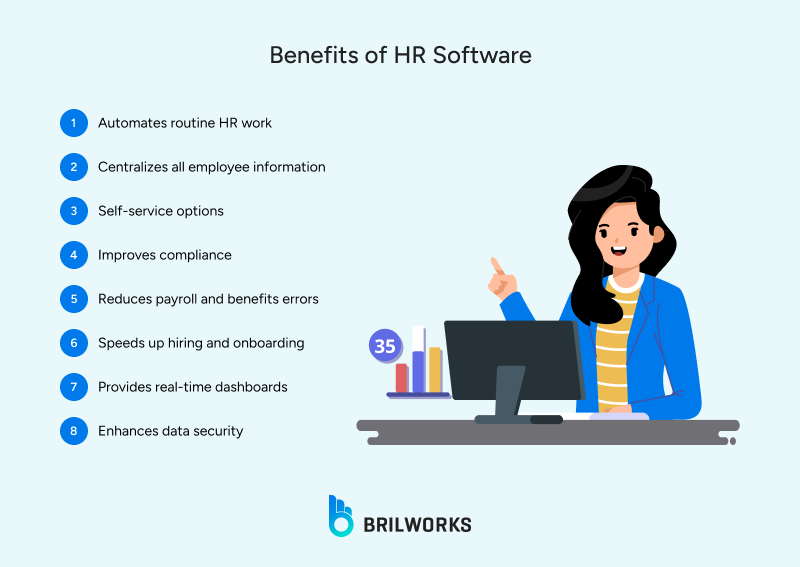
Software handles repetitive administrative work such as documentation, approvals, and data updates. By automating routine tasks like reminders and follow-ups, these systems save days of manual effort and free teams to focus on substantive work.
Employee information is not scattered across different drives. A role-based centralised system makes is easy to add rule-based access, ensuring data is centralised yet safe and private.
Self-service features enables employees find their payslips, documents, and policies anytime, without reaching out again and again.
The software tracks required documents and deadlines systematically. It helps avoid compliance issues stemming from forgotten forms or inconsistent processes, which is critical during audits or due diligence.
By syncing data across systems, it reduces manual entry mistakes that lead to incorrect payments or benefit enrollments, saving the time spent correcting them.
It turns ad-hoc setup into a repeatable process. New hires complete the same steps and receive the same information, reducing time-to-productivity and managerial oversight.
Dashboards provide answers to basic questions like headcount, open roles, leave balances, without requiring manual data compilation from multiple sources.
It keeps personal employee information out of general inboxes and shared folders, controlling access and creating an audit trail.
These benefits are functional. They address the growing inefficiency of managing people through makeshift tools, replacing variable administrative cost with predictable operation.
If the friction described looks familiar, if you feel managing people is a major barrior to focusing on your important tasks, your next step is practical. You need a HR software that removes administrative weight. It should work quietly in the background, turning scattered processes into clear and reliable workflows.
This is what we build. A straightforward HR software built for startups looking to improve the hiring, onboarding process without a significant investment. It has no unnecessary features and no enterprise bloat. It is simply a single place to organize the people work that has become repetitive. If this aligns with where you are, we can help. We replace that friction with function.
Get In Touch
Contact us for your software development requirements
Get In Touch
Contact us for your software development requirements

Hello, we are BRILLIAN’S. Trying to make an effort to put the right people for you to get the best results. Just insight !

 503, Fortune Business Hub, Science City Road, Sola, Ahmedabad, Gujarat, India Pincode- 380060
 + 91 9313644148
 sales@brilworks.com


