COOPERATION MODEL
ARTIFICIAL INTELLIGENCE
PRODUCT ENGINEERING
DevOps & Cloud
LOW-CODE/NO-CODE DEVELOPMENT
INDUSTRY
FRONTEND DEVELOPMENT
CLOUD DEVELOPMENT
MOBILE APP DEVELOPMENT
LOW CODE/ NO CODE DEVELOPMENT
EMERGING TECHNOLOGIES



 4 mins read
 Last updated February 23, 2026
Your app idea deserves more than a template. Off-the-shelf solutions might get you to market faster, but they rarely scale with your business or differentiate you from competitors. That's where custom mobile app development services come in, giving you full control over features, user experience, and long-term technical direction.
Choosing the right development partner isn't straightforward, though. You need to understand what's actually involved: the scope of work, the development process from concept to launch, and the cost factors that shape your investment. Getting clarity on these elements can mean the difference between a product that drives revenue and one that drains resources.
This guide breaks down everything you need to know before engaging a development team. We'll cover what custom mobile development actually includes, walk through the typical process stages, and give you a realistic view of pricing. At Brilworks, we've built custom iOS, Android, and cross-platform applications using React Native and Flutter for startups and enterprises across Fintech, Healthcare, and E-commerce, so we're sharing what we've learned from real projects, not theory.
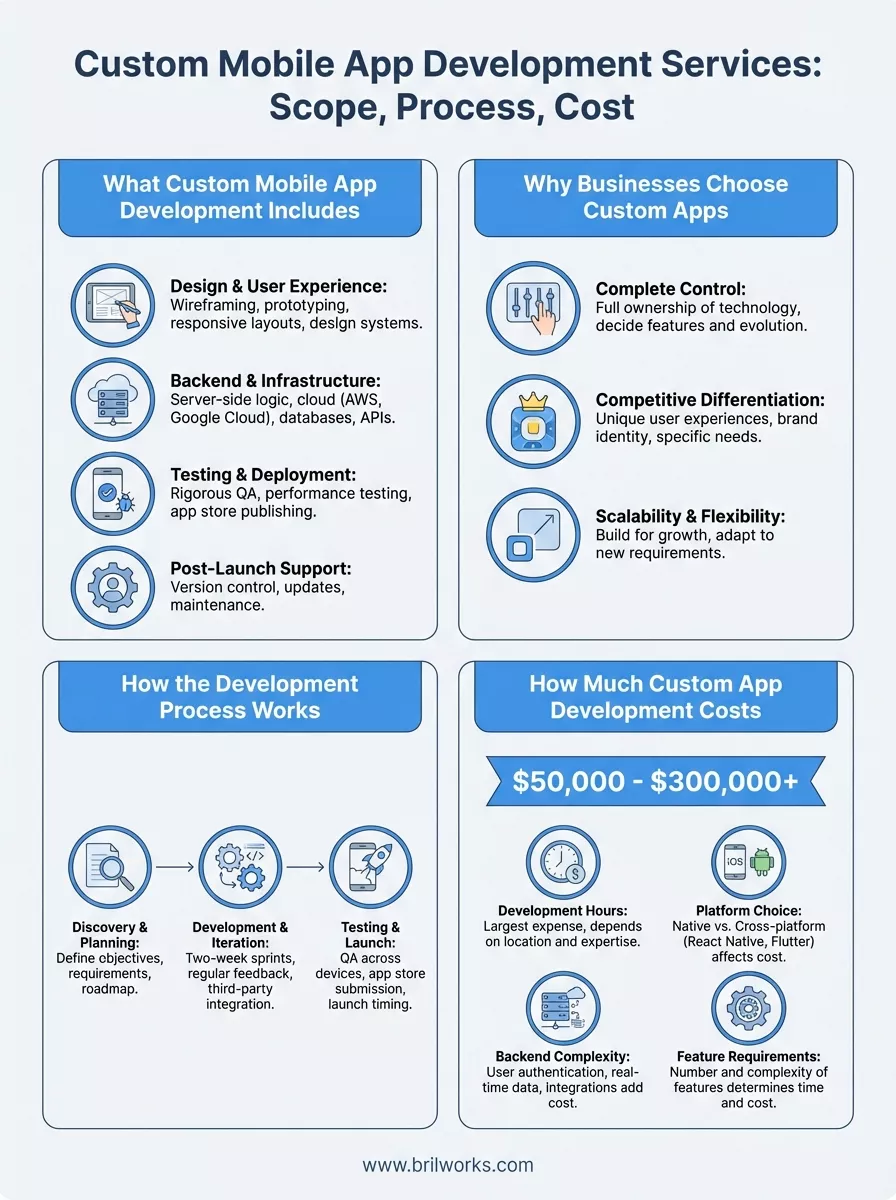
Custom mobile app development services cover significantly more than just writing code. You're investing in a complete product engineering cycle that transforms your business requirements into a functioning application users can download and interact with. The scope typically spans strategic planning, visual design, technical architecture, development, testing, and post-launch support.
Your app's interface determines whether users stay or abandon it within seconds. Development teams start with wireframing and prototyping to map user flows, then create high-fidelity designs that align with your brand identity. This phase includes usability testing to validate that navigation feels intuitive and critical actions are easy to complete.
Professional designers consider accessibility standards, touch targets, and responsive layouts that adapt to different screen sizes. They also establish design systems with reusable components to maintain visual consistency as your app evolves over time.
The visible app is only half the equation. Your development partner builds the server-side logic that powers features like user authentication, data processing, and third-party integrations. This includes setting up cloud infrastructure (typically AWS, Google Cloud, or Azure), databases, and APIs that connect your mobile frontend to backend services securely and efficiently.
A robust backend architecture determines how well your app scales when user demand increases unexpectedly.
Before your app reaches users, it goes through rigorous quality assurance across different devices, screen sizes, and operating system versions. Teams conduct functional testing, performance testing, and security audits to catch issues early.
The final step involves publishing to app stores (Apple App Store and Google Play), which requires following specific guidelines and approval processes. Development teams also handle version control and implement continuous integration pipelines for smoother updates.
Generic solutions force you to compromise. When you work with template-based platforms or white-label products, you inherit someone else's technical decisions, feature limitations, and update schedules. Custom mobile app development services give you ownership of your entire technology stack, letting you build exactly what your business needs without adapting your operations to fit predetermined constraints.
You decide which features launch first and how they evolve based on real user feedback. Template apps lock you into rigid feature sets that might include 80% of what you need and nothing you can do about the missing 20%. Custom development means you prioritize the specific functionality that differentiates your service, whether that's complex data visualization, offline capabilities, or integration with proprietary systems.
When your competitive advantage relies on specific technical capabilities, compromise isn't an option.
Your competitors using the same platform-built app creates a race to the bottom on price rather than value. Custom applications let you design unique user experiences that reflect your brand identity and serve your audience's specific needs. This becomes critical in crowded markets where user experience often determines which product wins long-term customer loyalty.
Custom mobile app development services follow a structured approach that transforms your concept into a production-ready application. Understanding each phase helps you set realistic expectations and prepare the resources your development team needs to succeed. Most projects span three to six months depending on complexity, though timelines vary based on your specific requirements and how quickly you can provide feedback during key milestones.
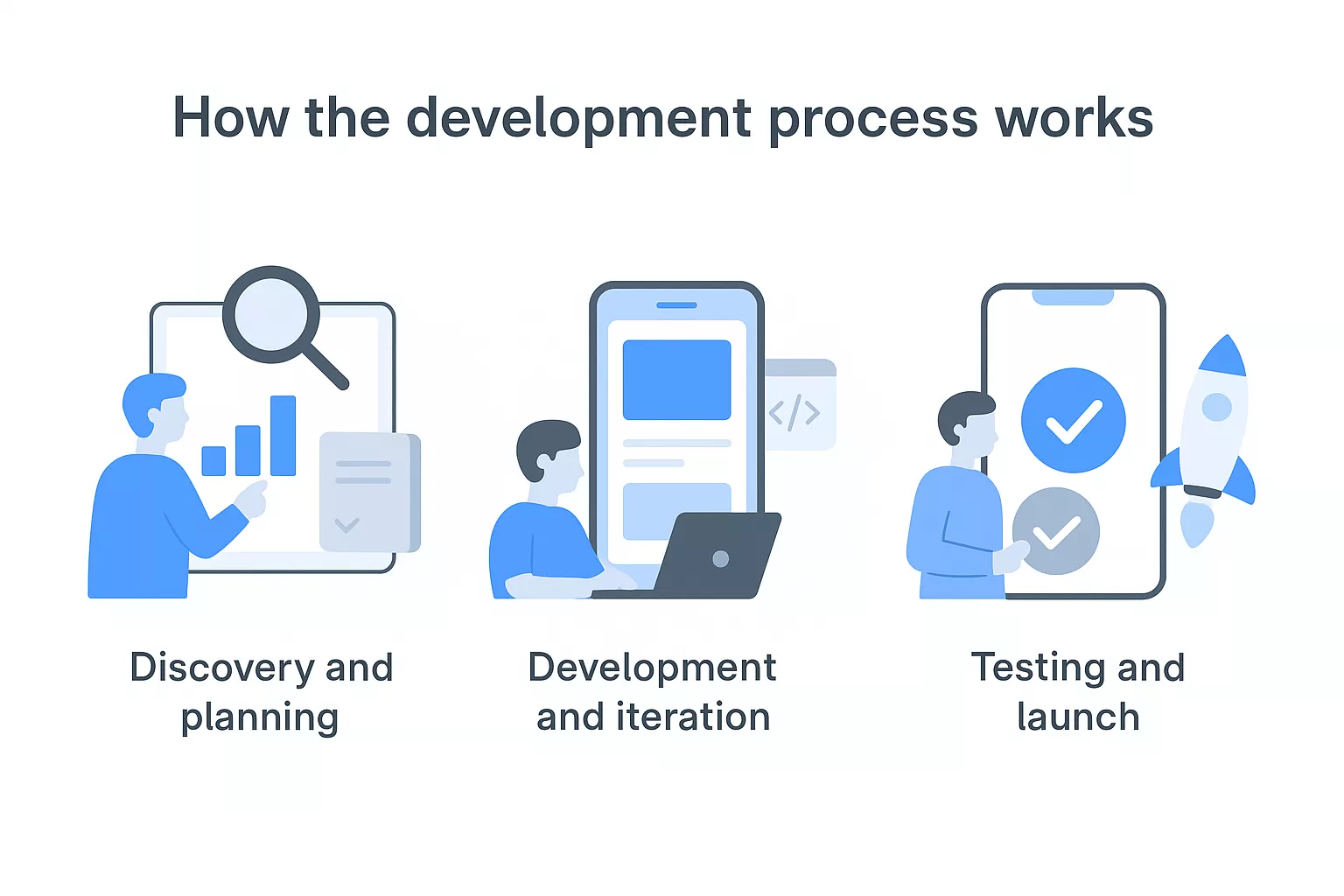
Your development partner starts by documenting your business objectives, target audience, and technical requirements. This phase includes competitive analysis, feature prioritization, and creating a project roadmap with clear deliverables. Teams also establish communication protocols and define success metrics you'll track throughout development.
Skipping thorough discovery leads to expensive course corrections later when fundamental assumptions prove wrong.
Developers build your app in two-week sprints, delivering working features you can test and provide feedback on regularly. This iterative approach lets you adjust priorities based on what you learn rather than waiting months to see the finished product. Your team also integrates third-party services and APIs during this phase, ensuring everything connects properly before launch.
Quality assurance engineers test your app across multiple devices and operating system versions to catch bugs before users encounter them. After fixing issues, your development team submits the app to Apple and Google for review, handles any requested changes, and coordinates your launch timing.
Custom mobile app development services typically range from $50,000 to $300,000 depending on complexity, platform choices, and feature requirements. Your final investment depends on how many user-facing features you need, backend infrastructure complexity, and whether you're building for iOS, Android, or both platforms simultaneously. Simple apps with basic functionality start around $50,000, while enterprise applications with advanced features can exceed $500,000.
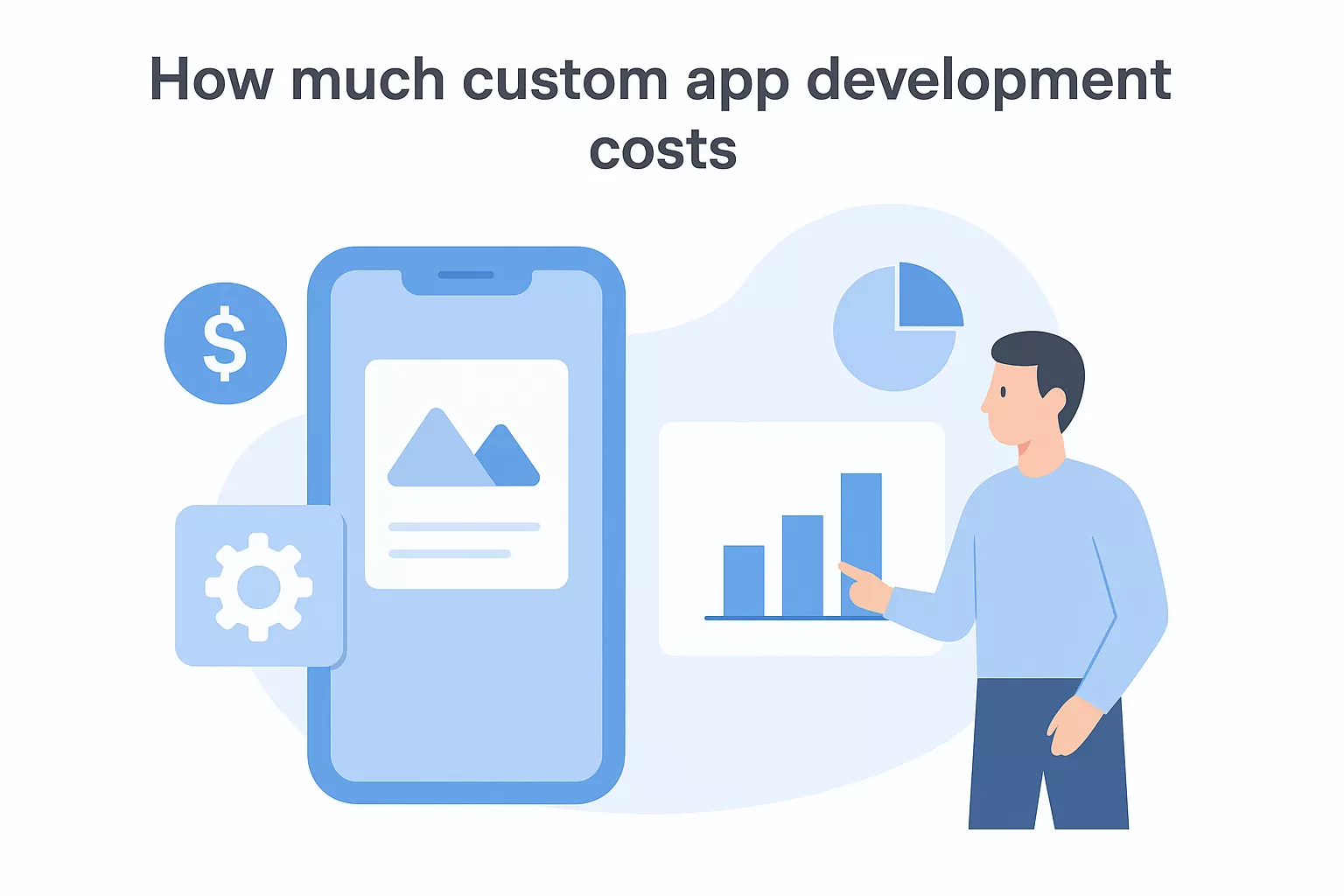
Development hours represent your largest expense. Teams charge between $75 and $200 per hour based on their location and expertise level. A simple app might require 500 development hours, while complex applications can demand 2,000 hours or more across design, development, testing, and deployment phases.
Platform choice significantly impacts your budget. Building native apps for both iOS and Android costs roughly double what you'd spend on a single platform. Cross-platform frameworks like React Native or Flutter reduce this expense by sharing code between platforms, though you still need platform-specific customization.
Your feature list directly determines development time, which means prioritizing ruthlessly saves you money without sacrificing core value.
Backend complexity adds substantial cost when you need user authentication, real-time data processing, or third-party integrations. Cloud infrastructure expenses continue after launch through hosting fees and maintenance.
Finding the right team to build your custom mobile application determines whether you'll launch successfully or waste months recovering from poor technical decisions. You need a partner who understands your business context, not just developers who can write code. Start by evaluating their technical expertise in the platforms you need, whether that's native iOS, Android, or cross-platform frameworks like React Native and Flutter.
Request case studies from projects similar to yours in complexity and industry. Look for teams that have shipped apps to production, not just built prototypes. Ask about their experience with specific features you need like real-time data processing, payment integrations, or offline functionality. Review their GitHub repositories or technical blog posts to assess how they solve complex problems and stay current with platform updates.
Teams that can't demonstrate relevant technical experience will learn on your budget.
Your development partner should provide transparent timelines and regular progress updates without you chasing them down. Ask how they handle scope changes, bug fixes, and post-launch support before signing contracts. Evaluate whether they ask detailed questions about your users and business goals, which indicates they're focused on solving your actual problems rather than just fulfilling a specification document.
You now understand what custom mobile app development services include, how the process works, and what investment you should expect. Your next action depends on where you are in your planning. If you haven't documented your requirements yet, start by writing down your core features, target users, and business goals. This clarity helps development teams provide accurate estimates and identify potential technical challenges early.
Schedule consultations with at least three development partners to compare their approaches and pricing. Ask them to walk through similar projects they've completed and explain how they'd handle your specific requirements. Pay attention to whether they ask detailed questions about your users and business model, which indicates they're focused on building something that actually solves your problems.
If you're ready to discuss your project with a team that specializes in custom mobile applications for startups and enterprises, explore our mobile app development services to see how we've helped businesses launch successful iOS, Android, and cross-platform applications.
Custom Mobile App Development Services are specialized offerings that design, develop, and deploy tailored mobile applications built specifically for your business needs and target audience. Unlike template-based solutions, Custom Mobile App Development Services create unique apps from scratch for iOS, Android, or cross-platform use with features, design, and functionality aligned to your business goals.
Custom Mobile App Development Services typically include business analysis and requirements gathering, UI/UX design, native or cross-platform development, backend infrastructure setup, API integrations, quality assurance testing, App Store/Google Play submission, and post-launch support. Comprehensive Custom Mobile App Development Services also provide maintenance, updates, and feature enhancements.
The cost of Custom Mobile App Development Services varies widely: simple apps range from $25,000-$50,000, medium complexity apps cost $50,000-$150,000, and complex enterprise solutions can exceed $200,000-$500,000+. Custom Mobile App Development Services pricing depends on features, platforms, design complexity, integrations, and development team location.
Custom Mobile App Development Services typically require 3-6 months for simple apps, 6-9 months for medium complexity projects, and 9-18+ months for enterprise-level applications. The timeline for Custom Mobile App Development Services depends on feature scope, design requirements, platform choices, and the complexity of integrations and backend systems.
Custom Mobile App Development Services create unique applications tailored to your specific requirements, branding, and user experience, while template apps use pre-built frameworks with limited customization. Custom Mobile App Development Services offer complete control over features, scalability, integrations, and intellectual property ownership that template solutions cannot provide.
Get In Touch
Contact us for your software development requirements
Get In Touch
Contact us for your software development requirements

Hello, we are BRILLIAN’S. Trying to make an effort to put the right people for you to get the best results. Just insight !

 503, Fortune Business Hub, Science City Road, Sola, Ahmedabad, Gujarat, India Pincode- 380060
 + 91 9313644148
 sales@brilworks.com


