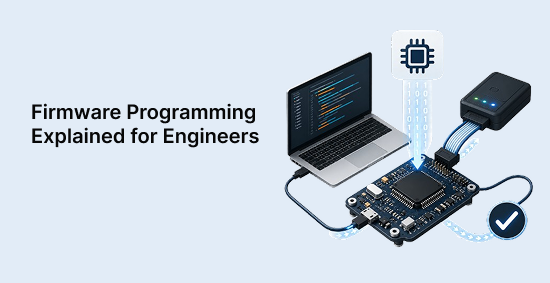
Firmware programming is the practice of writing the low-level code that runs directly on hardware and controls what that hardware physically does. It sits between the silicon and everything else. Often no operating system underneath it, no comfortable abstraction layer, and no second chance to patch it once the device ships.
Think about the last device you used that had no screen and no obvious computer inside it:
A smart thermostat
A car's braking controller
An insulin pump
Every one runs firmware. Whoever wrote it reasoned about interrupts, memory maps, and voltage levels the way a web developer reasons about API routes. The difference is that when firmware fails, you often cannot push a fix over the air. The bug ships in the product and stays there.
What Makes Firmware Programming Different From Regular Software?
The hardware sets the budget, and you write to it. You are coding for a specific chip with a fixed amount of flash and RAM, wired to specific peripherals. A microcontroller with 64KB of flash and 16KB of RAM is common. In that budget you might run the whole application. Sensor reads, control logic, the communication stack, all of it. No garbage collector is coming to save you.
Firmware is not an app that happens to run on a small device. It talks to hardware registers directly, responds to events measured in microseconds, and usually has to run for years without a reboot. That last constraint is the one most people underestimate. It shapes the firmware development lifecycle from the first line of code.
Firmware Programming vs Embedded Software Development
The difference is scope. Firmware programming is the code that drives the hardware at the register level. Embedded software development is the wider job of building everything that runs on the device, which may sit on top of that firmware.
People use the two terms as if they mean the same thing. In small projects they nearly do, because a single engineer writes the register-level code and the application logic in the same file on the same chip. But once a device grows a real operating system, a filesystem, or a network stack, the two split into separate layers, which is where embedded firmware development becomes its own discipline.
Here is how they line up in practice:
Firmware programming
Embedded software development
What it controls
Hardware directly, at the register level
The application running on the device
Runs on
Bare metal or a tiny RTOS
Often on top of an OS like embedded Linux
Typical language
C, sometimes Rust or assembly
C, C++, and higher-level languages
Memory footprint
Kilobytes
Megabytes and up
Updateable after ship
Often not
Usually yes
The table draws a clean line, but real projects blur it. A firmware engineer on a bare-metal sensor node is doing both jobs at once. On a smart camera running embedded Linux, the person writing the video pipeline may never touch a hardware register, because a driver already handles that below them.
What is the difference between firmware and embedded software?
Firmware is a type of embedded software, but not all embedded software is firmware. Firmware is the part written to control hardware directly and is usually stored in non-volatile memory on the device itself. Embedded software is the broader category that includes firmware plus any higher-level embedded firmware development work running on the same product.
A rough rule holds up most of the time. If the code reads and writes hardware registers to make a physical thing happen, it is firmware. If it runs several layers above the metal and never touches a register, it is embedded software sitting on top.
Languages Used In Firmware Programming
Most firmware ships in C, with C++ and Rust taking a growing share and assembly filling the narrow gaps neither can reach. The choice is rarely about taste. It comes down to how much memory you have, how close to the hardware you need to sit, and how many people will maintain the code after you.
C
C is still the default language for firmware programming, and it has been for forty years. It compiles to small, predictable machine code, it maps almost directly onto the hardware, and every microcontroller vendor ships a C toolchain on day one. When you have 32KB of flash and a datasheet full of registers, C gives you exactly the control you need and nothing you have to fight.
The cost is that C trusts you completely. It will let you read past the end of an array, dereference a null pointer, or overflow a buffer without a word of complaint. On a device with no memory protection, that mistake does not throw an exception. It corrupts something three registers over and shows up as a bug you chase for a week.
C++
C++ earns its place when the firmware gets large enough that structure starts to matter more than raw simplicity. On a project with dozens of drivers and a real application layer, C++ gives you classes, namespaces, and compile-time features that keep the codebase from turning into a pile of global functions. Modern embedded C++ can do this without the bloat people used to fear, as long as you stay disciplined about what you pull in.
We would not reach for it on a tiny sensor node. The moment you enable exceptions, RTTI, or the wrong parts of the standard library, your binary balloons and your timing goes fuzzy. On a small chip, that is the wrong trade.
Rust
Rust is gaining ground in firmware programming because it catches an entire class of memory bugs at compile time instead of in the field. Its ownership model makes buffer overruns and use-after-free errors a compiler error rather than a runtime crash, which matters enormously on a device you cannot easily patch after it ships.
The honest catch is maturity. The vendor tooling, drivers, and hardware abstraction layers that C has had for decades are still filling in for Rust. On a mainstream ARM Cortex-M chip the ecosystem is solid now. On an obscure part your vendor only supports in C, you will be writing bindings yourself, and that time has to come from somewhere.
Assembly
Assembly is reserved for the few places where nothing else is precise enough. Boot sequences, interrupt vectors, and cycle-exact timing loops sometimes have to be written instruction by instruction, because the exact ordering and count matter. This is rare. Most engineers touch assembly for a handful of lines in a whole project and let the C compiler handle the rest.
The Modern Toolstack for a Firmware Engineer
A firmware engineer relies on four kinds of tools. A toolchain builds the code, a debugger steps through it on the hardware, a flashing tool loads it onto the chip, and measurement gear shows what the hardware actually does. Most of the day is spent moving between them.
Here is what a typical setup looks like:
Compiler and toolchain: GCC through the ARM GNU toolchain is the common default, with LLVM and Clang gaining users. Vendor toolchains like IAR and Keil MDK are still standard in automotive and industrial work where certification matters.
IDE or editor: Vendor IDEs such as STM32CubeIDE and MPLAB X ship with the chip. Plenty of engineers skip them and run VS Code with the Cortex-Debug extension over a plain Makefile or CMake build.
Debug probe: A hardware probe like a J-Link or ST-Link connects your host machine to the chip over JTAG or SWD. This is how you set breakpoints and read memory on a device that has no screen of its own.
Flashing tool: OpenOCD and vendor flashers write your compiled binary into the chip's flash memory. Often the same probe handles both debugging and flashing.
Measurement gear: A logic analyzer and an oscilloscope tell you what the pins are physically doing, which is the only way to confirm the hardware agrees with your code.
The debug probe is the piece that trips up developers coming from web or app work. There is no console window on a microcontroller, so your host machine becomes the screen instead.
Industry Best Practices for Production-Ready Code
Production firmware fails in the field for boring reasons, not exotic ones. A watchdog that was never enabled. A buffer sized for the happy path. A version no one can trace back to its source. The practices below separate code that survives three years in a device from code that bricks it after a firmware update.
1. Enable the watchdog timer
A watchdog timer resets the chip automatically if the firmware hangs. Skip it and a single stuck loop turns a recoverable glitch into a dead device that needs a physical power cycle, which is not an option when the board is sealed inside a wall.
2. Budget memory up front
Know your worst-case stack depth and heap use before you ship, not after. A stack overflow on a chip with no memory protection does not crash cleanly. It silently overwrites whatever sits next to it and surfaces as a bug you cannot reproduce.
3. Avoid dynamic allocation where you can
Repeated malloc and free on a device that runs for years fragments the heap until an allocation fails at hour 4,000. Static or pool allocation makes the memory picture something you can actually reason about, which is why most long-running firmware avoids the heap almost entirely.
4. Follow a coding standard like MISRA C
A coding standard rules out the language features most likely to cause silent failures. In automotive, medical, and industrial work, standards such as MISRA C are often mandatory, and even outside regulated fields the subset they enforce catches real bugs before they ship.
5. Version every build and tie it to source control
Bake a firmware version and commit hash directly into the binary so any unit in the field traces back to the exact code it runs. Without it, a bug report from a device six months old is a guessing game.
6. Test on real hardware, not just the simulator
A simulator will not show you the timing quirk that only appears when the actual sensor is a millisecond slow. Hardware-in-the-loop testing is where those bugs surface before the customer finds them.
Conclusion
The language matters less than the constraints you pick it for. C when the chip is small and the team knows it, Rust when the safety bar is high and the tooling has caught up, C++ when the codebase is large enough to need structure. Get the constraints right and the language mostly picks itself.
What actually decides whether firmware survives in the field is the discipline around the code, not the syntax. Watchdogs, memory budgets, a traceable version stamp, testing on real hardware. Not glamorous. It's the difference between a product that runs for years and one that comes back as a recall.
If the firmware cannot be easily patched after it ships, let the chip, the safety bar, and who owns the code next drive the decision before anyone opens an editor. That is where custom firmware development holds up or quietly sets up the recall.
FAQ
Firmware is a type of embedded software, but not all embedded software is firmware. Firmware is the code written to control hardware directly and is usually stored in non-volatile memory on the device. Embedded software is the broader category that includes firmware plus any higher-level application code running on the same product.
Rust is gaining ground because it catches an entire class of memory bugs at compile time instead of in the field. Its ownership model turns buffer overruns and use-after-free errors into compiler errors rather than runtime crashes, which matters on a device you cannot easily patch after it ships. The catch is maturity, since the vendor tooling C has had for decades is still filling in for Rust on less common chips.
Yes, C is still the default language for firmware and will be for years. Every microcontroller vendor ships a C toolchain on day one, most existing firmware is written in C, and on a small chip it gives you direct control with almost no overhead. Even teams adopting Rust still read and maintain C daily.
No, most firmware engineers rarely write assembly. The C compiler handles the vast majority of low-level code, and assembly is reserved for the few places where exact timing or instruction ordering matters, such as boot sequences and interrupt vectors. Being able to read it helps when debugging, but writing it is uncommon.
Firmware is updated through a bootloader that can receive a new binary and rewrite the chip's flash memory, often over the air or through a wired connection. Many low-cost or sealed devices ship with no update path at all, which is why getting the code right before production matters so much. The update mechanism has to be designed in from the start, not added later.
Vikas, the visionary CTO at Brilworks, is passionate about sharing tech insights, trends, and innovations. He helps businesses—big and small—improve with smart, data-driven ideas.