COOPERATION MODEL
ARTIFICIAL INTELLIGENCE
PRODUCT ENGINEERING
DevOps & Cloud
LOW-CODE/NO-CODE DEVELOPMENT
INDUSTRY
FRONTEND DEVELOPMENT
CLOUD DEVELOPMENT
MOBILE APP DEVELOPMENT
LOW CODE/ NO CODE DEVELOPMENT
EMERGING TECHNOLOGIES



 6 mins read
 Last updated February 25, 2026
Businesses across industries are racing to integrate generative AI into their products and operations. The technology can automate content creation, accelerate research, personalize customer experiences, and reshape how software gets built. But most organizations lack the in-house expertise to develop these systems from scratch. That's where a generative AI development company becomes essential, a specialized partner that turns ambitious AI concepts into production-ready applications.
Choosing the right partner matters more than you might expect. The wrong fit leads to missed deadlines, blown budgets, and solutions that don't scale. The right partner, one with deep expertise in AI, cloud infrastructure, and product engineering, can mean the difference between a failed experiment and a genuine competitive edge. At Brilworks, we combine AI and AWS expertise with a transparent, partnership-driven approach to help startups and enterprises bring intelligent applications to market quickly.
This guide covers what generative AI development companies actually do, the core services you should expect, and how to evaluate potential partners before making a commitment. Whether you're building a custom LLM-powered tool or integrating generative features into an existing product, you'll walk away knowing exactly what to look for.
A generative AI development company builds custom AI systems that create original content, generate code, analyze data, or automate complex workflows. You come to them with a business problem or product vision, and they translate that into a working AI application using models like GPT, Claude, or custom-trained systems. The work goes far beyond just calling an API. These partners handle everything from model selection and fine-tuning to infrastructure setup, security hardening, and ongoing optimization.
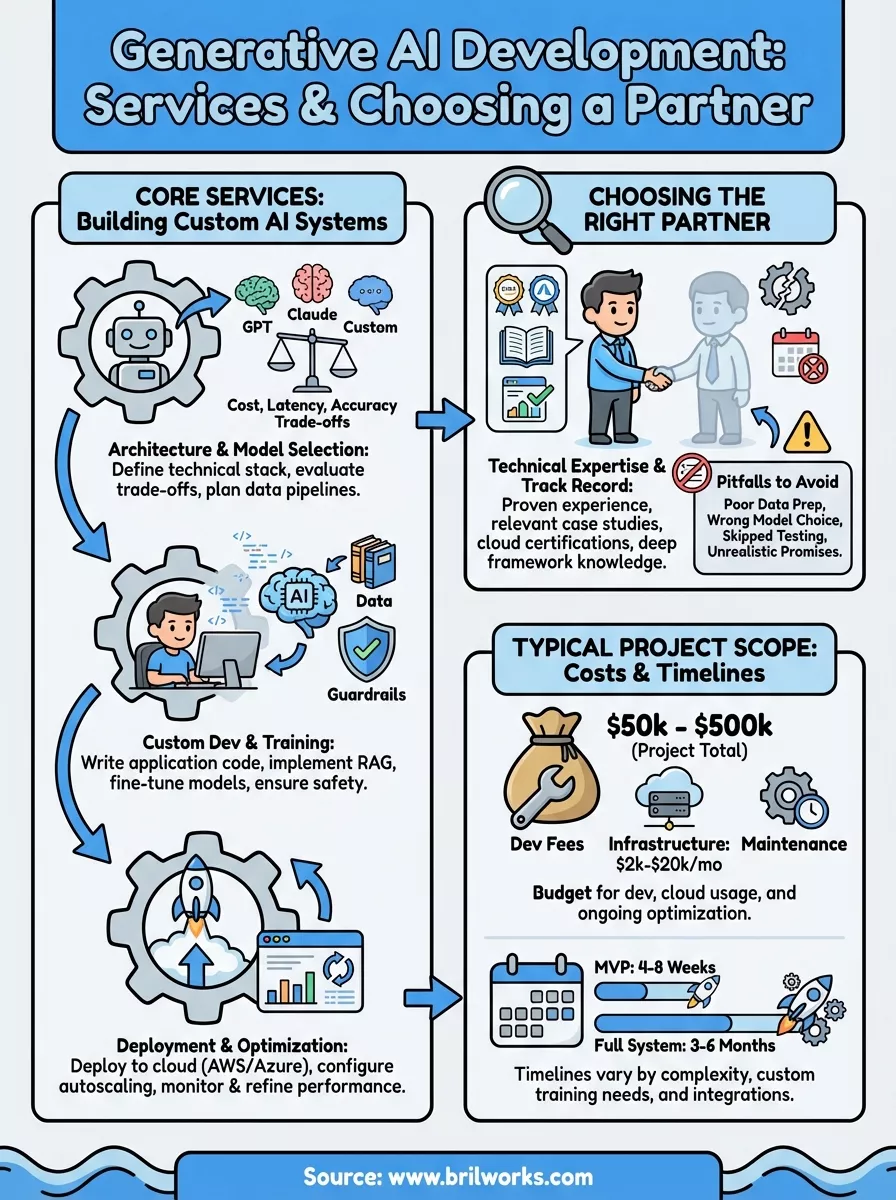
Your partner starts by defining the technical architecture that will support your application. This means deciding whether you need a pre-trained large language model, a fine-tuned version, or a fully custom model built from scratch. They evaluate cost, latency, and accuracy trade-offs across different providers and deployment strategies. For example, a customer service chatbot might use a lightweight model hosted on AWS for speed, while a medical diagnosis tool might require a specialized model with strict data privacy controls.
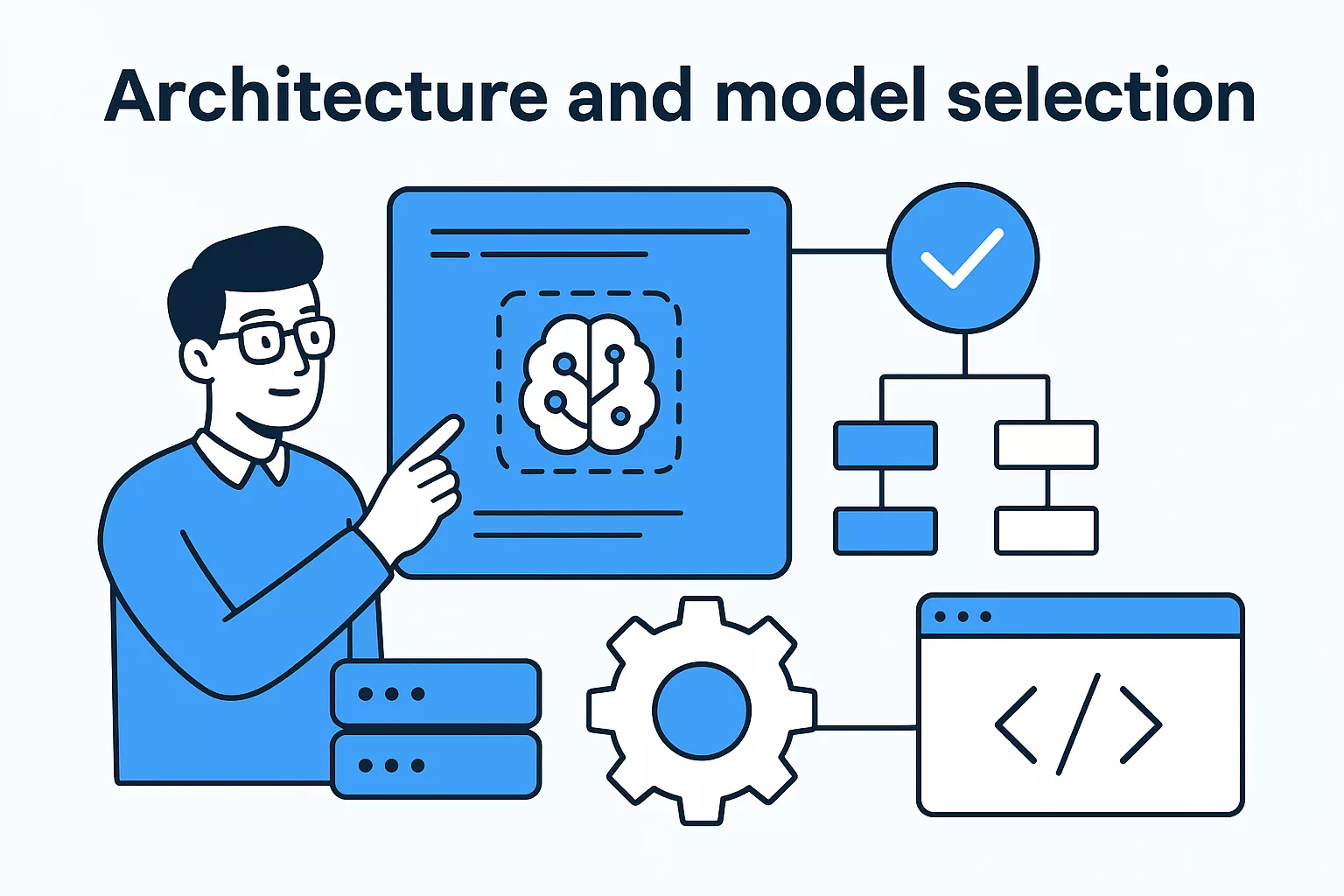
The team also designs how your AI system will connect to existing databases, APIs, and user interfaces. They map out data pipelines that prepare and clean training data, then set up monitoring to track performance after launch. This architectural work prevents expensive mistakes later, like choosing a model that can't scale or building on infrastructure that locks you into a single vendor.
The right architecture balances performance, cost, and flexibility so your AI system can grow with your business.
Development teams write the application code that wraps around the AI model and makes it useful for your specific use case. This includes building prompt engineering systems, integrating retrieval-augmented generation (RAG) for context, and creating guardrails that prevent the model from generating harmful or off-brand responses. If you need a custom model, they handle the training process, which involves selecting datasets, running experiments, and iterating until the model meets your accuracy requirements.
Engineers also build the interfaces your team or customers will use. That might mean a Slack bot, a web dashboard, or an API that feeds AI capabilities into your existing product. Testing happens continuously throughout this phase to catch edge cases and ensure the system behaves reliably under real-world conditions.
Once development wraps, your generative ai development company deploys the system to production infrastructure, typically on cloud platforms like AWS or Azure. They configure autoscaling, set up monitoring dashboards, and implement logging so you can track usage patterns and model performance. The team also establishes feedback loops that let you refine prompts, retrain models, or adjust parameters based on actual user behavior.
Ongoing optimization is critical because generative AI systems often behave unpredictably at first. Your partner analyzes response quality, adjusts prompt strategies, and fine-tunes infrastructure to reduce costs without sacrificing performance. This continuous improvement ensures your AI application stays competitive as both your business needs and the underlying technology evolve.
A professional generative AI development company delivers more than just model integration. You get a complete technology stack that includes infrastructure setup, custom development, security implementation, and ongoing support. The best partners break their offerings into clear service packages, so you can choose what fits your technical maturity and business goals. Some organizations need full product development from concept to launch, while others require targeted help with model fine-tuning or cloud optimization.
Your partner builds AI capabilities tailored to your specific domain and use case. This includes selecting the right foundation model (GPT-4, Claude, Llama, or others), then fine-tuning it with your proprietary data to improve accuracy and relevance. They implement prompt engineering strategies that guide the model to produce outputs matching your brand voice and business requirements. For example, a legal document generator needs different prompt structures than a creative writing assistant, and your development team handles these distinctions.
The service also covers retrieval-augmented generation (RAG) systems that connect models to your knowledge bases, ensuring responses draw from current, verified information rather than outdated training data. Teams test multiple configurations to find the balance between response quality, speed, and cost.
Custom model development ensures your AI system reflects your unique business logic and competitive advantages.
Engineers connect generative AI features to your existing software ecosystem, whether that means embedding capabilities into mobile apps, web platforms, or internal tools. They build secure API layers that let your systems communicate with AI models while protecting sensitive data. This work includes setting up authentication, rate limiting, and error handling to prevent outages or security breaches.
Infrastructure services cover cloud deployment on platforms like AWS or Azure, with autoscaling that adjusts resources based on demand. Your partner configures monitoring dashboards that track performance metrics, costs, and usage patterns in real time.
Post-launch services keep your AI application running efficiently. Teams analyze user interactions to identify improvement opportunities, then refine prompts, retrain models, or adjust infrastructure settings. You receive regular performance reports and recommendations for cost reduction without sacrificing quality or speed.
A generative ai development company follows a structured delivery process that transforms your initial concept into a working AI system. You start with discovery sessions where the team maps your requirements, then move through iterative development cycles where you see progress weekly or biweekly. The process includes clear checkpoints where you review deliverables, provide feedback, and approve the next phase before more resources get committed. This approach reduces risk and ensures the final product matches your actual needs rather than assumptions made during early planning.
Your partner begins with technical discovery sessions where engineers and product managers interview stakeholders, review existing systems, and document specific use cases. They identify what data sources the AI needs to access, what outputs you expect, and what performance benchmarks define success. This phase typically takes one to three weeks and produces a detailed scope document with technical specifications, architecture diagrams, and project timelines.
Teams also conduct feasibility studies during this stage. They test different models with sample data from your domain to validate that generative AI can actually solve your problem before you commit to full development. You receive a risk assessment that outlines technical challenges, compliance requirements, and potential cost drivers so you can make informed decisions about proceeding.
Engineers build your AI system in two-week sprints with demos at the end of each cycle. You see working features early, provide feedback, and watch the system evolve based on real testing rather than theoretical designs. The team implements core functionality first, then adds refinements like prompt optimization, response formatting, and error handling.
Iterative development lets you adjust priorities and requirements as you learn what works best for your users.
Developers share progress through staging environments where you can test new features before they reach production. This hands-on involvement ensures the final system matches your expectations and reduces expensive rework later.
Your partner conducts comprehensive testing that covers accuracy, speed, security, and scalability before launch. They run the system through edge cases, stress tests, and security audits to catch issues that only appear under real-world conditions. You receive a deployment plan that outlines infrastructure setup, monitoring configuration, and rollback procedures if problems emerge after launch.
The team deploys to production using gradual rollout strategies that limit initial exposure. They monitor system performance closely during the first weeks, making quick adjustments to optimize response quality and resource usage.
Selecting a generative ai development company requires evaluating technical capabilities, communication practices, and long-term partnership potential. You need a team that understands your industry, can deliver within your budget and timeline, and will support your system after launch. The wrong choice leads to wasted resources and failed projects, while the right partner accelerates your AI transformation and provides competitive advantages that compound over time.

Look for partners with proven experience building generative AI systems similar to your use case. Review their portfolio of completed projects, focusing on complexity, scale, and outcomes rather than just client names. Ask for case studies that detail technical challenges they overcame, metrics they improved, and how their solutions performed months after deployment. Partners with deep AWS or Azure certifications and expertise in specific frameworks like LangChain or Hugging Face demonstrate commitment to staying current with rapidly evolving AI technology.
Request references from past clients who can speak to the team's ability to solve unexpected problems and adapt when requirements change. You want developers who understand both the AI models and the business context where they'll operate.
Technical expertise matters most when projects encounter the inevitable complications that emerge during real-world implementation.
Evaluate how transparently potential partners discuss timelines, risks, and costs during initial conversations. Teams that provide detailed estimates, outline potential challenges upfront, and explain their development process clearly will maintain that transparency throughout your project. Ask about their collaboration tools, meeting cadence, and how they handle feedback or scope changes.
The best partners operate as extensions of your team rather than distant contractors. They proactively share progress, admit mistakes quickly, and involve you in technical decisions that affect your product's future. Avoid companies that promise unrealistic timelines or guarantee specific AI performance metrics without understanding your data and use case first.
Understanding the financial and time investment required for generative AI development helps you budget accurately and set realistic expectations. Most projects range from $50,000 to $500,000 depending on complexity, customization level, and infrastructure requirements. Simple chatbot integrations might cost less, while enterprise systems with custom models and complex workflows sit at the higher end. Timeline estimates typically span three to six months from kickoff to production deployment, though rapid MVP launches can happen in four to eight weeks with experienced partners.
Your costs break down into development fees, infrastructure expenses, and ongoing maintenance. Development work usually accounts for 60 to 70 percent of initial investment, covering model selection, custom training, integration, and testing. Cloud infrastructure costs vary based on usage but expect $2,000 to $20,000 monthly for production systems handling moderate traffic. Teams that choose custom model training face higher upfront costs but potentially lower long-term API fees compared to proprietary solutions like GPT-4.
Maintenance and optimization require 15 to 25 percent of initial development costs annually. This covers model updates, performance monitoring, security patches, and feature enhancements as your needs evolve.
Budget for ongoing costs from day one, since generative AI systems require continuous optimization to maintain quality and control expenses.
Building a minimum viable product takes four to eight weeks with a capable generative ai development company. Full production systems with multiple features, security hardening, and integration testing require 12 to 24 weeks. Your timeline extends when you need custom model training, complex data pipeline setup, or compliance certifications like HIPAA or SOC 2.
Organizations frequently underestimate data preparation requirements, assuming their existing datasets work immediately with AI models. Poor data quality leads to unreliable outputs and expensive rework. Another mistake involves choosing the wrong model architecture early, then discovering it cannot scale or handle your actual use cases efficiently. You waste months rebuilding systems that should have been designed differently from the start.
Finally, teams often skip proper testing and launch systems that behave unpredictably under production load. This damages user trust and creates emergency situations that cost far more to fix than thorough pre-launch testing would have.
Building generative AI capabilities gives your business a measurable advantage in automation, personalization, and operational efficiency. You now understand what a generative ai development company delivers, how to evaluate potential partners, and what realistic budgets and timelines look like. The technology keeps evolving rapidly, which makes starting sooner rather than later critical for staying competitive.
Your next move depends on where you sit in the planning process. Organizations with clear use cases should request detailed proposals from experienced partners who can demonstrate relevant expertise. Teams still exploring possibilities benefit from discovery workshops that map AI opportunities to business outcomes before committing to full development. Either way, choosing a partner with proven AI and cloud infrastructure experience determines whether your project succeeds or becomes another failed experiment.
If you need a partner who combines technical depth with transparent communication, Brilworks delivers generative AI solutions that scale from rapid MVP launches to enterprise systems. We focus on long-term success rather than quick deployments that create technical debt down the road.
A Generative AI Development Company specializes in building custom AI solutions that create original content, including text, images, code, audio, and video. A Generative AI Development Company provides end-to-end services from strategy and model selection to deployment and maintenance of generative AI applications tailored to business needs.
A Generative AI Development Company typically offers custom model development, LLM integration, RAG implementation, chatbot development, AI consulting, fine-tuning services, prompt engineering, and ongoing support. These services from a Generative AI Development Company help businesses leverage AI for automation, personalization, and innovation.
When selecting a Generative AI Development Company, evaluate their portfolio of AI projects, technical expertise with frameworks like OpenAI, LangChain, and Hugging Face, industry experience, scalability capabilities, security practices, and client testimonials. The right Generative AI Development Company should align with your business objectives and technical requirements.
Costs for hiring a Generative AI Development Company vary based on project complexity, scope, and duration. Simple chatbot implementations may start at $20,000-$50,000, while enterprise-level custom GenAI solutions from a Generative AI Development Company can range from $100,000 to $500,000+ depending on requirements.
A Generative AI Development Company serves diverse industries including healthcare, finance, e-commerce, manufacturing, education, marketing, and legal services. Any industry looking to automate content creation, enhance customer experience, or improve decision-making can benefit from partnering with a Generative AI Development Company.
Get In Touch
Contact us for your software development requirements
Get In Touch
Contact us for your software development requirements

Hello, we are BRILLIAN’S. Trying to make an effort to put the right people for you to get the best results. Just insight !

 503, Fortune Business Hub, Science City Road, Sola, Ahmedabad, Gujarat, India Pincode- 380060
 + 91 9313644148
 sales@brilworks.com


