Last updated April 29, 2026
Generative AI Explained: How It Works, Uses, And Examples

12 mins read
Summarize with AI:


Data
AI
The Stack Underneath
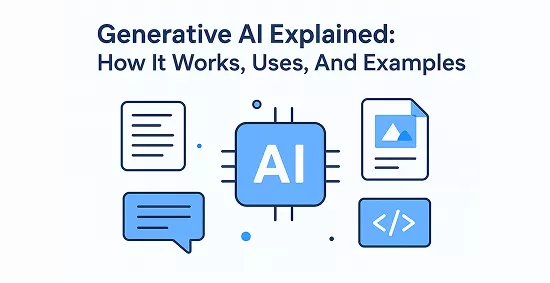
What is generative AI? It's a category of artificial intelligence that creates new content, including text, images, code, audio, and video, by learning patterns from existing data and applying them to produce outputs that never existed before.
That one sentence does a lot of work, but it still leaves the practical questions unanswered. How do these models actually learn? Why do they sometimes get things wrong with total confidence? Which architectures handle which tasks? And where does this fit into a real product roadmap versus a proof-of-concept that never ships?
Those are the questions business leaders and developers are asking right now, and they deserve direct answers.
This post covers how generative AI works at a technical level you can actually use, the major model types driving different content categories, real-world examples across industries, business use cases with measurable impact, the risks you need to plan for, and practical guidance on adoption. No trend-chasing, no vague promises.
Generative AI is a category of machine learning that produces new content rather than analyzing or labeling existing content.
That single sentence does a lot of work. When a model writes a draft email, generates a product image from a text prompt, or autocompletes your function mid-line, the defining action is creation. The model synthesizes output that did not exist before your prompt, drawing on statistical patterns it absorbed during training across text, images, code, audio, video, and structured data. No database lookup. No retrieval of a pre-written answer. Just learned patterns producing something new.
People conflate generative AI with AI in general, and that confusion leads to bad technology decisions. Here is where it actually sits relative to the other categories you will encounter.
| Type | Primary task | Example output |
|---|---|---|
| Generative AI | Creates new content from learned patterns | A product description your team never wrote |
| Predictive AI | Forecasts future values from historical data | Churn probability score for a customer segment |
| Discriminative AI | Classifies or distinguishes between inputs | Spam vs. not-spam label on an incoming email |
| Traditional rule-based AI | Follows explicit programmer-defined logic | Route a refund request to a specific form |
The column that matters most is "primary task." Generative models produce. Predictive and discriminative models judge or forecast. Rule-based systems execute fixed logic. Those are fundamentally different operations, even when they appear inside the same product.
Is ChatGPT generative AI? Yes. ChatGPT runs on a large language model, which is one specific type of generative AI architecture. The model generates each response token by token based on what it learned during training.
Are all generative AI systems large language models? No. LLMs handle text and code. Diffusion models handle images. Audio synthesis models handle voice and music. Video generation models are their own category entirely. LLMs are the most visible type of generative AI right now, but the category is broader.
Can generative AI get things wrong? Absolutely, and this matters for how you build with it. These models produce probability-based outputs, which means confident-sounding responses can be factually incorrect. That phenomenon has a name: hallucination. If you are building anything customer-facing, understanding how hallucinations happen and how techniques like RAG (retrieval-augmented generation) reduce them is worth your time before you write a single line of integration code.
One more thing generative AI is not: a search engine. A search engine retrieves and ranks documents that already exist. A generative model constructs a response. Mixing up those two mechanics leads to misplaced trust in outputs that look authoritative but were never grounded in a verified source.
Understanding how generative AI models actually produce output matters more than most introductions let on. The mechanics determine what you can trust, where outputs break down, and why your prompt wording changes everything. Here's the actual process.
1. Pretraining on massive datasets
Engineers train foundation models on text scraped from books, web pages, code repositories, and other large corpora, often hundreds of billions of tokens. The model processes this data repeatedly, adjusting its internal weights to reduce prediction errors. That process is computationally expensive and happens once at scale before you ever see the model.
2. Learning patterns, not memorizing answers
This distinction gets glossed over constantly. The model learns statistical relationships between tokens, not specific facts stored in retrievable slots. That's what lets it generalize to inputs it never saw during training. But pattern learning isn't perfect. Overfitting can happen when a model is trained too long on too narrow a dataset, causing it to reproduce training data too closely. Data leakage is a related risk, where evaluation examples accidentally appear in training data, making benchmark scores misleadingly high. Neither problem is theoretical in production systems.
3. Fine-tuning or instruction tuning (optional)
Base pretrained models are raw. Most of what you interact with has gone through fine-tuning on curated examples or instruction tuning, where the model learns to follow directions rather than just predict the next token. These steps significantly shape behavior without retraining from scratch.
4. Inference: token-by-token generation
At inference time, the model generates output one token at a time. Each token is roughly a word or word fragment. Here's a concrete example. Say the model receives: "The capital of France is." It calculates a probability distribution over every possible next token. "Paris" gets high probability. "London" gets low probability. It selects a token, appends it, then repeats the process.
That's how "The capital of France is Paris." gets built: one token at a time, each prediction conditioned on everything before it.
5. Prompt-driven generation and output variability
Two parameters control how predictable the output is. Temperature adjusts how aggressively the model samples from lower-probability tokens, so higher temperature produces more creative and less predictable output. Top-p sampling sets a probability threshold, limiting selection to tokens that together account for a cumulative probability mass. A context window defines how many tokens the model can "see" at once, and anything outside that window is invisible to the model, full stop.
Same prompt, different temperature settings. Completely different outputs. That's not a bug.
What most people call "prompt engineering" is really just structured communication
A vague prompt produces vague output because the model has nothing to anchor to beyond statistical likelihood. A well-structured prompt gives it role, context, constraints, and output format. Here's what that difference looks like in practice:
Before:
"Write something about our product."
After:
"You are a senior B2B copywriter. Our product is a workflow automation tool for logistics teams managing over 500 shipments per day. Write a 3-sentence value proposition. Focus on time saved and error reduction. Return plain text only, no headers."
The second prompt activates the right statistical neighborhood in the model's learned space. Role tells it what voice to use. Context gives it specifics to work from. Constraints prevent sprawl. Output format removes ambiguity about structure. Learn more about building prompts that actually work in our prompt engineering guide.
That's the full loop: pretraining builds capability, fine-tuning shapes behavior, your prompt directs inference, and sampling parameters control creativity versus consistency. Every variable in that chain affects what you get back.
One of the biggest misconceptions about generative AI is that it's a single technology. It isn't. Several distinct model families exist, each built for different tasks, trained differently, and suited to different business problems. Picking the wrong architecture for your use case doesn't just produce mediocre results — it can make the entire integration feel broken when the real issue is a mismatch between model type and task.
Here's a clear breakdown of the main types of generative AI models, what each does well, where it falls short, and where it actually belongs in a business context.
| Model Type | Best At | Where It Struggles | Business Fit |
|---|---|---|---|
| Transformers and Large Language Models | Text generation, code completion, summarization, Q&A, translation | Factual accuracy without grounding, long-horizon reasoning, real-time data | Chatbots, copilots, document automation, customer support, code generation tools |
| Diffusion Models | High-fidelity image and video generation from text prompts | Slow inference speed, consistency across frames in video | Marketing creative, product imagery, UI mockups, ad generation |
| GANs (Generative Adversarial Networks) | Fast, high-resolution image synthesis, face generation, style transfer | Training instability, mode collapse, harder to control output | Synthetic data generation, media production, gaming assets |
| VAEs (Variational Autoencoders) | Latent-space manipulation, anomaly detection, smooth interpolation between examples | Output sharpness, less detail than diffusion or GANs | Fraud detection in fintech, drug discovery in healthcare, structured data generation |
| Multimodal Foundation Models | Combining text, image, audio, and video as both input and output | Computational cost, harder to fine-tune on narrow tasks | Complex enterprise workflows, medical imaging plus report generation, multimodal search |
The reason these types of generative AI exist as separate families comes down to what each architecture was designed to optimize. Transformers use a self-attention mechanism that processes entire token sequences in parallel, which is what makes them so effective at understanding context across long passages of text or code. A diffusion model, on the other hand, was purpose-built around a noise-removal process that lets it iteratively refine images with extraordinary detail. You wouldn't ask a diffusion model to write a contract, and you wouldn't ask an LLM to generate a photorealistic product photo.
GANs held the top spot in image generation for years, but diffusion models have largely overtaken them for most creative applications because GANs are notoriously difficult to train without mode collapse, where the generator gets stuck producing a narrow range of outputs. GANs still earn their place in synthetic data pipelines and real-time generation scenarios where speed matters more than perfect detail.
VAEs work differently from all of the above. Rather than generating outputs directly, they compress input data into a structured latent space and then reconstruct from that compressed form. That makes them particularly useful when you care less about visual fidelity and more about understanding the statistical structure of your data, which is exactly what fraud detection and anomaly scoring workflows require.
Multimodal models are the newest and most capable category. GPT-4o and Gemini 1.5 can accept text, images, and audio together and produce outputs across those same modalities. That flexibility comes with real cost in terms of compute and fine-tuning complexity, so they make the most sense when your workflow genuinely crosses content types rather than defaulting to them because they sound impressive.
Knowing which generative AI models exist, and why they differ, is the foundation for making smart build-versus-buy decisions when AI enters your product roadmap.
The output categories matter more than people realize. Generative AI is not one tool doing one thing. The same underlying capability, learning patterns from data and producing new content, branches into wildly different applications depending on what the model was trained on and how it was deployed.
Here is where the technology actually shows up across enterprise workflows today.
Text and code are where most teams start, and for good reason. Chat assistants built on large language models handle customer queries, draft internal documentation, summarize lengthy contracts, and translate content across languages. On the engineering side, coding copilots like GitHub Copilot write function drafts, suggest refactors, and generate unit tests directly inside the developer's IDE. A developer describes what a function should do, and the model produces a working draft in seconds. That is not theoretical. Teams measuring this see real reductions in time spent on repetitive implementation work.
Images, audio, and video cover a broader surface than most people initially budget for. Image generators like Midjourney and DALL-E produce marketing visuals, UI mockups, and product photography variants from plain text prompts. Voice synthesis tools generate realistic speech across multiple languages and voice profiles, which powers everything from accessibility features to localized customer service audio. Video generation is newer but moving fast, with models producing short clips from text descriptions or extending existing footage while maintaining visual consistency.
| Output Type | Representative Tools | Common Enterprise Scenario |
|---|---|---|
| Text and long-form content | ChatGPT, Claude | Customer support drafts, report generation |
| Code generation | GitHub Copilot, GPT-4 | Function writing, unit test creation, code review |
| Image generation | Midjourney, DALL-E | Marketing assets, UI prototypes, product visuals |
| Voice synthesis | ElevenLabs, Azure TTS | Dubbing, accessibility audio, IVR voice profiles |
| Synthetic datasets | Mostly AI, Gretel.ai | Privacy-safe test data, ML training data |
Structured data and synthetic content is where many enterprise teams find the most underrated value. Models can generate formatted JSON, SQL queries, and structured reports when given clear instructions and constraints. More importantly, they can produce synthetic datasets that mirror the statistical properties of real production data without exposing actual customer records. Fintech and healthcare teams use this constantly. You need realistic transaction data to test a fraud detection model, but you cannot feed real customer records into a development environment without triggering compliance requirements. Synthetic data generation solves that cleanly.
The same generative AI capabilities that write a customer email can, with different prompting and architecture, produce a voice response, a test dataset, or a production-ready API integration. One underlying capability, many workflows.
Below are real generative AI use cases and examples across the business functions where deployment is already producing measurable results. Each area has its own workflow patterns, compliance pressures, and review requirements, so treating them as one category does everyone a disservice.
A mid-size SaaS company running 10,000 support tickets monthly can't hire its way out of response-time problems. What works: a retrieval-based assistant pulls relevant articles from the internal knowledge base and drafts a response the agent reviews before sending. Input is the customer message plus conversation history. Output is a structured reply with a suggested resolution path. The agent approves, edits, or overrides.
Zendesk's 2024 CX Trends report found that AI-assisted support reduced average handle time by up to 45% in high-volume deployments. The compliance consideration here is PII. Customer names, account numbers, and payment details must stay within your own infrastructure, not passed raw to a public API endpoint.
Human approval at the send step is non-negotiable for any message that references billing, service agreements, or account status.
This is where the ROI case is easiest to quantify. GitHub's internal data showed Copilot users completing tasks 55% faster than those coding without assistance. The workflow is straightforward: a developer writes a function signature and a plain-language comment, the model returns a working draft, and the developer reviews for correctness and security implications.
Beyond individual productivity, teams use generative AI to write unit tests for existing modules, generate boilerplate for API integrations, and produce plain-language summaries of pull requests for non-technical stakeholders.
Review steps matter. Automated code generation can introduce subtle logic errors or insecure patterns that look syntactically correct. Every generated block needs a human code review pass before it merges.
Clinical documentation is one of the clearest generative AI examples in regulated environments. A physician records a patient consultation. The model transcribes and structures the recording into a draft clinical note formatted to the practice's template. The clinician reviews and signs off.
Input is audio or transcript. Output is a structured SOAP note or discharge summary. The review step is mandatory, both for clinical accuracy and regulatory compliance. PHI handling is the central compliance consideration: the model must run within a HIPAA-compliant environment, and the vendor must sign a Business Associate Agreement. No PHI touches a general-purpose public API.
Nuance's DAX Copilot, used across major health systems, reports that physicians save an average of 3 hours per day on documentation tasks using this exact pattern.
Synthetic data generation is the standout generative AI use case in financial services. Development and compliance teams need realistic transaction datasets to train fraud detection models and run stress tests, but using real customer records for that purpose creates serious regulatory exposure.
A generative model trained on anonymized historical data produces synthetic transaction sets that mirror the statistical distribution of real data without containing any actual customer records. Input is a statistical profile of real transaction patterns. Output is a synthetic dataset. The audit trail requirement here is strict: your team must document what the synthetic data was generated from, what model produced it, and how it was validated before use in a regulated workflow.
Customer-facing applications in fintech also use generative AI for personalized financial summaries and regulatory disclosure drafts, both of which require human review before delivery.
Content teams with large catalog requirements, think e-commerce with 50,000 SKUs or a media operation publishing across 12 regional markets, use generative AI to produce first drafts at scale. Input is a product data sheet, a brand style guide, and a target audience definition. Output is a draft product description or localized article.
The review step is where your editorial standards actually get applied. Generative models reflect whatever patterns appeared in training data, which means brand voice, accuracy, and regulatory claims all need a human pass before publication.
For regulated industries, any content that touches financial advice, health claims, or legal statements requires compliance sign-off as a mandatory gate, not an optional step. Teams that build that gate into the workflow from the start avoid the much more expensive process of reviewing published content after the fact.
Global corporate investment in generative AI hit $25.2 billion in 2023, up from essentially zero as a dedicated category just two years earlier. That is not hype money circling a trend. That is production budget flowing into real engineering teams. And according to McKinsey's 2024 State of AI report, 65% of organizations now use generative AI regularly in at least one business function, nearly double the adoption rate from just twelve months prior.
Something real shifted. The question is what, specifically.
Before 2022, building anything useful with AI meant assembling a machine learning team, curating proprietary training data, and waiting months before seeing results worth showing stakeholders. Model quality was inconsistent. Image generation produced recognizable mush. Text models hallucinated confidently and often. Deployment required serious infrastructure investment.
What changed was the maturation of foundation models at scale. The jump from GPT-3 to GPT-4 wasn't incremental. Output quality crossed a threshold where non-specialists could actually use the results without heavy post-processing. Multimodal capability arrived simultaneously: the same API call that generates a product description can now also interpret an uploaded image or respond to an audio prompt. That convergence of text, vision, and structured reasoning in a single system is genuinely new.
API access changed the deployment equation entirely. In 2020, running a capable language model meant owning the infrastructure. By 2023, any engineering team could call OpenAI, Anthropic, or AWS Bedrock and have a working prototype in an afternoon. Deployment speed dropped from quarters to days.
Where ROI is actually strongest right now: code generation, first-draft content at volume, support ticket deflection, and document processing. These are high-repetition, structured-output tasks where the cost of a wrong answer is recoverable.
Where hype still outruns production readiness: autonomous agents making multi-step decisions without human review, generative AI in high-stakes medical or legal workflows without robust validation layers, and any use case where factual accuracy is non-negotiable and verification is manual. The models are improving fast, but those categories still require architecture discipline that many teams underestimate.
The inflection point was real. The productivity gains in the right use cases are real. The gaps are also real, and knowing the difference is what separates teams building durable AI features from teams cleaning up expensive mistakes six months post-launch.
Knowing what generative AI is gets you only so far. The real work starts when you decide to deploy it. Most teams stumble here, not because they picked the wrong model, but because they skipped the operational scaffolding that makes generative AI applications trustworthy in production.
Here's a phased playbook that actually holds up.
Phase 1: Pick one low-risk use case and define what success looks like
Don't start with customer-facing outputs or anything that touches regulated data. Start with an internal workflow, something like first-draft meeting summaries, internal knowledge base Q&A, or code documentation generation. The lower the blast radius if the model gets it wrong, the better your learning environment.
Before writing a single line of integration code, define your success metrics explicitly:
Without these, you'll have no signal on whether the deployment is working or just generating output.
Phase 2: Choose your model and map your data sensitivity
Match the model to the task. A fine-tuned smaller model often outperforms a large general-purpose one on narrow, well-defined tasks, and it's cheaper to run. For your first deployment, API-based models through AWS Bedrock or Azure OpenAI give you private deployment options and zero-retention configurations, meaning your inputs don't feed back into model retraining.
Before connecting any data source, classify everything the model will touch. Use a simple three-tier approach:
Your data governance policy should define who inside your organization can send what tier of data to which service. Document it before the pilot, not after an incident.
Phase 3: Set prompt controls and output validation
System prompts are your first line of defense. Lock down the model's scope explicitly. Tell it what topics it cannot address, what format outputs must follow, and what to do when it doesn't know the answer. A model that says "I don't have enough information to answer that reliably" is more useful than one that confidently fabricates.
Layer output validation on top of that. For structured outputs, run schema checks to confirm the response matches the expected format. For prose, route outputs through a keyword filter that flags responses containing sensitive terms, competitor names, or phrases your legal team has flagged. These validation layers and evals aren't optional polish, they're the difference between a system you can trust and one that creates liability.
Phase 4: Run evals and red-team tests before you go live
Build a golden dataset of 50 to 100 test cases that cover typical inputs, edge cases, and adversarial prompts. Run the model against this dataset and score outputs before any user touches the system. Red-team testing means deliberately trying to break the model: prompt injection attempts, requests to ignore system instructions, inputs designed to produce harmful or off-policy outputs.
Log everything. Every prompt, every response, every metadata tag including user ID, timestamp, and model version. That logging infrastructure is what lets you debug failures, demonstrate compliance, and retrain or fine-tune when performance drifts.
Phase 5: Build concrete human oversight into the workflow
Human oversight can't be vague. Build it into the architecture with specific mechanisms:
Your first 90 days
That cadence keeps your first deployment contained enough to learn from without the pressure of a full production launch.
If you want engineering support at any stage of that process, Brilworks builds and ships production-grade generative AI applications for startups and enterprises. Talk to our team about where you are in the rollout and what you need to move faster.
Generative AI is, at its simplest, a family of models that produce new content by learning patterns from existing data. Text, images, code, audio — these systems generate outputs that did not exist before the prompt was sent. That definition has held up across everything covered in this post, from transformer mechanics to real deployment examples in healthcare and fintech.
But understanding what generative AI is only gets you halfway. Business value comes from pairing the right use case with the right architecture and building governance in from the start, not bolting it on after launch. The companies pulling ahead right now are not the ones using the flashiest models. They are the ones who picked a focused problem, tested it carefully, and added human oversight where it mattered.
Your practical next step: identify one internal workflow that is repetitive, high-volume, and low-risk, then test a generative AI integration against it with real data before expanding scope. That single experiment will teach you more than any amount of additional research.
If you want to move faster with confidence, Brilworks builds production-ready AI applications on AWS, covering everything from architecture decisions to deployment and product engineering. Talk to our team about what you are building.
Generative AI Explained is understanding AI systems that create new, original content including text, images, audio, video, and code based on patterns learned from vast datasets. When Generative AI Explained simply, it refers to machine learning models that generate human-like outputs rather than just analyzing or classifying existing data, transforming how we create content and solve problems.
Generative AI Explained technically involves neural networks trained on massive datasets to learn patterns, structures, and relationships in data. When Generative AI Explained in depth, models use architectures like transformers, GANs (Generative Adversarial Networks), or diffusion models to generate new content by predicting what should come next based on learned patterns, context, and user prompts.
When different types of Generative AI Explained, the main categories include Large Language Models (LLMs) like GPT and Claude for text, image generators like DALL-E and Midjourney, audio synthesis models for music and voice, video generation AI, and code generation tools. Each type of Generative AI Explained serves different creative and practical applications.
Common applications when Generative AI Explained include content creation (articles, marketing copy), software development (code generation, debugging), design work (images, logos, UI mockups), customer service (chatbots), data analysis and reporting, personalized recommendations, virtual assistants, creative writing, video production, and business process automation.
The difference when Generative AI Explained versus traditional AI is that traditional AI analyzes, classifies, or makes predictions based on existing data, while Generative AI creates entirely new content. When this distinction in Generative AI Explained, traditional AI might identify a cat in a photo, whereas Generative AI can create a completely new, original cat image.
You might also like

Hello, we are BRILLIAN’S. Trying to make an effort to put the right people for you to get the best results. Just insight !