COOPERATION MODEL
ARTIFICIAL INTELLIGENCE
PRODUCT ENGINEERING
DevOps & Cloud
LOW-CODE/NO-CODE DEVELOPMENT
INDUSTRY
FRONTEND DEVELOPMENT
CLOUD DEVELOPMENT
MOBILE APP DEVELOPMENT
LOW CODE/ NO CODE DEVELOPMENT
EMERGING TECHNOLOGIES



 4 mins read
 Last updated March 26, 2026
Technology has moved forward quickly. AI is growing, smartphones drive most customer activity, and modern applications handle tasks that old systems were never designed for. Because of this progress, industries like finance and healthcare now rely on modern digital platforms for critical operations.
Legacy systems struggle in this environment. Today’s users expect fast, smooth, and reliable experiences. Upgrading to modern infrastructure sounds simple, but the work is rarely easy. Migration creates noticeable short-term costs, while delaying modernization creates even bigger long-term problems.
This puts businesses in a difficult position. Development costs keep rising. Teams must decide how much of the system needs rebuilding and where smart engineering can extend the value of existing systems. These decisions depend on internal capability or the guidance of outside experts. Cost remains the main factor that influences the direction.
We have covered modernization strategies before. In this article, the focus is on the financial side and the hidden expenses that often remain unnoticed during planning.
Technical leaders make more than a timing decision. They choose the method of migration, and that choice decides the timeline, complexity, and budget. Before looking at hidden costs, it helps to review the most common starting points.
Rehosting is the simplest starting point. It moves the application to the cloud with minimal changes. Teams choose it because it helps them leave expensive data centers quickly and reduce upfront costs.
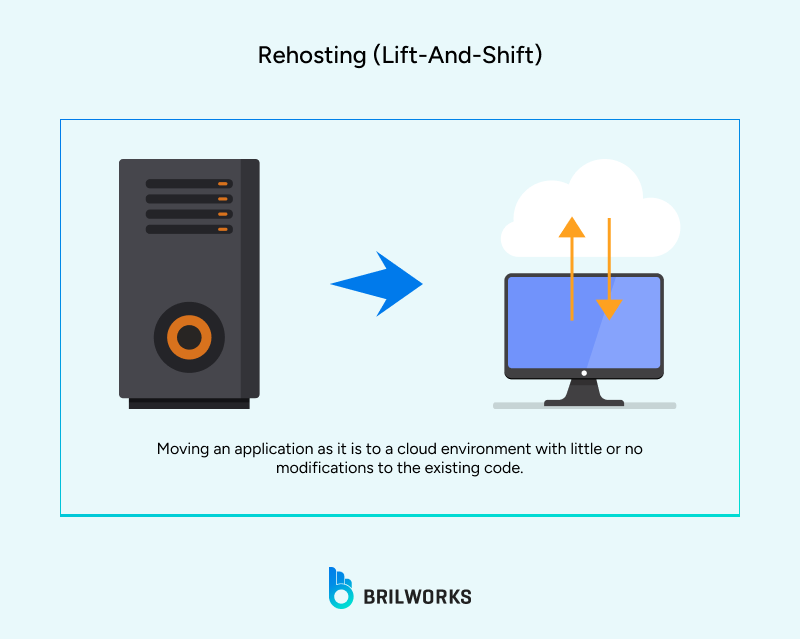
According to the Flexera 2024 State of the Cloud Report, rehosting is still the most common first step due to its speed and low effort.
Refactoring requires more work. Parts of the application are redesigned or rebuilt so they operate smoothly in the cloud. This often includes breaking larger systems into smaller services. The cost is higher at the beginning, but the long-term benefits include better performance, easier scaling, and lower maintenance.
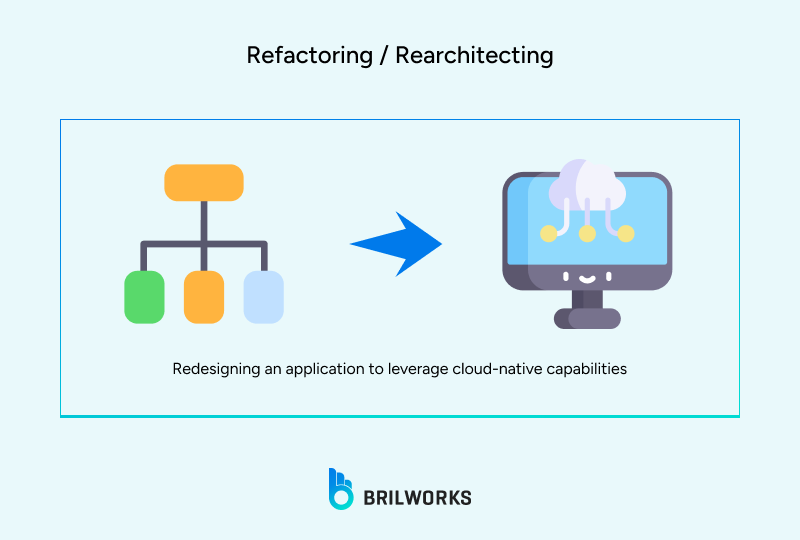
Migration and modernization programs aim to improve legacy systems. Consultants often guide this work by helping organizations remove roadblocks in scaling and innovation.
Security is a major issue because older systems often lack modern protections. Cost optimization is another factor. Modern platforms reduce daily operational expenses and make compliance easier for standards such as GDPR and HIPAA.
Modernization strengthens security, reduces ongoing cost, and positions the business for future growth. Below are the hidden costs that appear during the process.
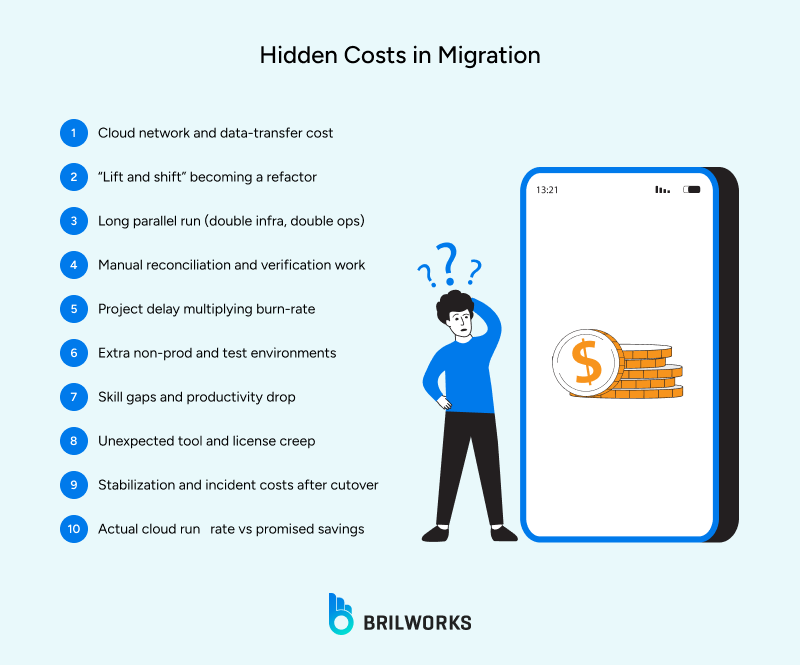
Cloud migrations often overlook the cost of moving data. When applications run in the cloud, different services exchange data constantly. Every request adds to the monthly bill.
During the transition, companies usually run the old system and the new cloud environment at the same time. This doubles the amount of data moving between systems. If not estimated from the start, this becomes a major surprise. Engineers have reported cases where network costs alone would have covered the price of a new mainframe every year.
Teams often begin with a simple lift and shift plan. Once the application runs in the cloud, unexpected issues appear. Response times increase, batch jobs run slower, data formats behave differently, and integration checks fail.
These issues force teams to update code, adjust workflows, or revise parts of the architecture. A simple rehost becomes an unplanned refactor. This adds more work, more testing, and more cost.
Most organizations do not shut down the legacy system immediately. They keep it active while the cloud environment stabilizes. This protects against outages but doubles spending.
The company pays for the old system and the new one. Teams must monitor both, fix issues in both, and run two sets of processes. This period often lasts years and becomes one of the largest hidden expenses.
When both systems run together, data cannot be assumed to match. Teams must verify financial figures, billing details, inventory counts, and customer records.
Most verification work is manual. Engineers and analysts create reports, compare values, and resolve differences. This requires time from skilled team members and often grows into a noticeable cost that never appears in the original budget.
Many modernization projects start with an eighteen-month timeline and then stretch into several years. Longer timelines increase spending because the core team stays on payroll.
External vendors and consultants also continue billing. Test environments remain active longer than planned. By the time the system is stable, the total cost often doubles compared to the original forecast.
To reduce risk during go-live, teams create more environments than expected. These include extra test areas, UAT setups, performance environments, and a pre-production environment that closely mirrors production.
Data migration also requires multiple rehearsals. Each rehearsal creates new copies of data and new resource usage. This consumes compute, storage, licenses, and engineering hours.
A major hidden cost comes from training. Teams familiar with legacy systems must learn cloud services, infrastructure as code, new deployment methods, and updated monitoring tools.
Cloud networking and security also work differently. While the team learns, delivery slows down. Senior engineers spend time on training instead of building. Payroll stays the same, but output temporarily drops. Many companies also bring in external experts at higher rates to help.
Migration usually increases the number of tools used. Legacy tools do not always operate the same way in the cloud. Teams add monitoring tools, logging systems, observability platforms, security scanners, API gateways, and migration utilities.
Each tool has licensing fees, setup time, training needs, and ongoing maintenance. These tools rarely appear in early estimates but become necessary once work begins.
When the system goes live, real traffic exposes issues that testing never revealed. Teams spend weeks or months fixing slow responses, timeouts, and edge-case bugs.
This period includes late-night work, urgent patching, and constant tuning. The effort required for stabilization is significant but often missing from early budgets.
After stabilization, the monthly cloud cost becomes clear. It includes more than compute and storage. It also includes backups, data transfer, security tools, observability platforms, and all managed services.
The operating model also changes. Cloud environments require stronger SRE and DevOps roles. Teams expand or shift responsibilities. Many organizations discover that the real running cost is higher or only slightly lower than their legacy system. As a result, the expected savings do not fully appear.
Every organization wants the benefits of modern infrastructure, yet most underestimate the real effort required to get there. Migration is not just a technical upgrade. It touches budgets, timelines, team skills, and the way daily operations work. The hidden costs listed above show why careful planning matters and why a clear strategy often decides whether the move becomes an enabler or a long-running burden.
Businesses that succeed with modernization usually do one thing well. They treat migration as a long-term investment instead of a quick fix. They build a plan that reduces surprises, strengthens engineering teams, and sets up a cloud environment that can grow with the company.
If your systems are reaching the limits of what they can support, this is the stage where exploring cloud development makes sense. Modern platforms offer better reliability, stronger security, and more flexibility for future products. The right approach helps you avoid unnecessary cost and gives your teams the environment they need to deliver faster.
Modernizing is never simple, but with the right structure, it becomes a practical path forward rather than a risky leap. If you are considering this direction, now is a good time to evaluate what the next phase of your technology should look like and how cloud development can support it.
Get In Touch
Contact us for your software development requirements
Get In Touch
Contact us for your software development requirements

Hello, we are BRILLIAN’S. Trying to make an effort to put the right people for you to get the best results. Just insight !

 503, Fortune Business Hub, Science City Road, Sola, Ahmedabad, Gujarat, India Pincode- 380060

 + 91 9313644148
 sales@brilworks.com


