COOPERATION MODEL
ARTIFICIAL INTELLIGENCE
PRODUCT ENGINEERING
DevOps & Cloud
LOW-CODE/NO-CODE DEVELOPMENT
INDUSTRY
FRONTEND DEVELOPMENT
CLOUD DEVELOPMENT
MOBILE APP DEVELOPMENT
LOW CODE/ NO CODE DEVELOPMENT
EMERGING TECHNOLOGIES



 3 mins read
 Last updated December 26, 2025
From startups to large enterprises, generative AI adoption is surging across industries, but the rate varies. Employees and teams are now using AI for their everyday tasks, but making it work across an entire company is a challenge, even for the tech titans. Stanford’s AI Index shows that use is spreading, and most adoption is happening within teams, not through a company-wide plan.
With AI technology comes a wide range of challenges. There is no such thing as unbiased AI. As LLMs are also trained on public data, they are technically never free from inaccurate results. Every model has these issues. These limitations can be observed when AI is used in real work.
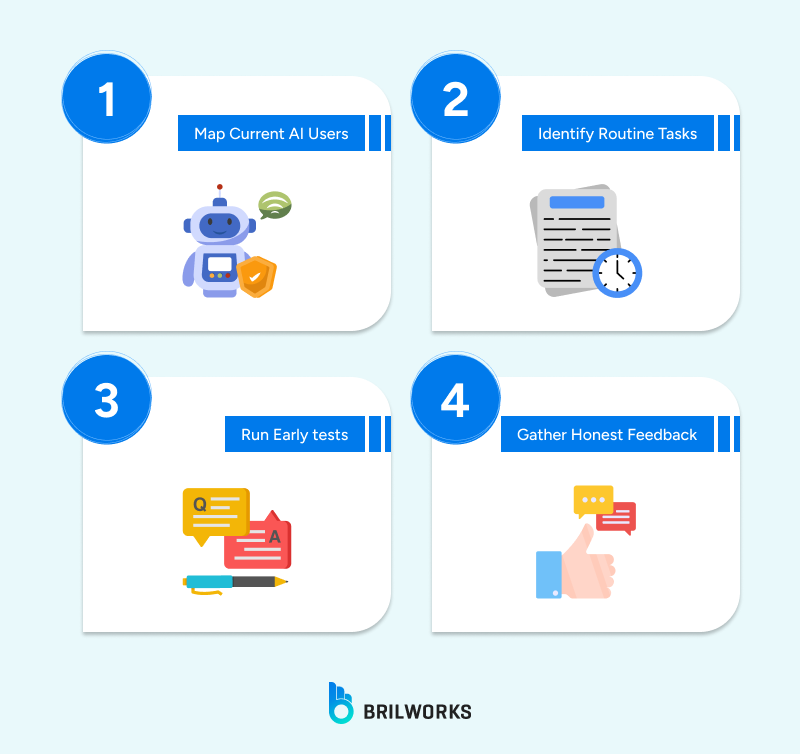
Start by mapping who is already experimenting with AI tools in their day-to-day work. You need the people who have tried these tools extensively. Look for tasks that are repetitive and routine. These are the best places to use AI. At this stage, avoid using AI in complex or connected systems (or at the organizational level).
Trying AI on a small scale at first will show you where it helps and where it fails. It is obvious that some tasks will get faster, while in other areas, it may not work as expected. These results help you learn what works.
Ask employees who are used to AI tools for honest feedback.
Where does the AI hit a wall?
Where does it fail to understand context?
Where do they stop trusting the output?
If several people report the same problem, it is a real issue, not just an individual’s mistake.
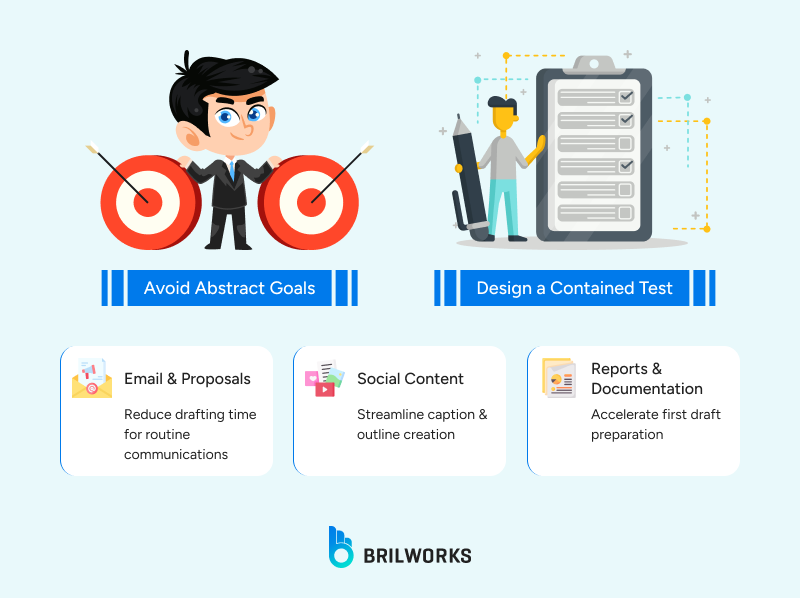
Set goals you can measure, don’t create “abstract goals.” For example, saying “streamline workflows” is not a clear goal. What is measurable then? If software development used to take a month, after using AI, how much time is saved? Compare the difference. Let’s say developers have saved two hours in building an application. This is an example of a measurable goal.
The golden rule is do not try to fix everything at once.
Focus on specific areas.
For developers, that might be writing or refactoring code.
For sales and marketing, drafting emails, proposals, or content.
Test with just three to five people for two or three weeks. Choose one process and set a clear goal, like cutting report prep time by 40 percent. First, focus on learning, not perfection.
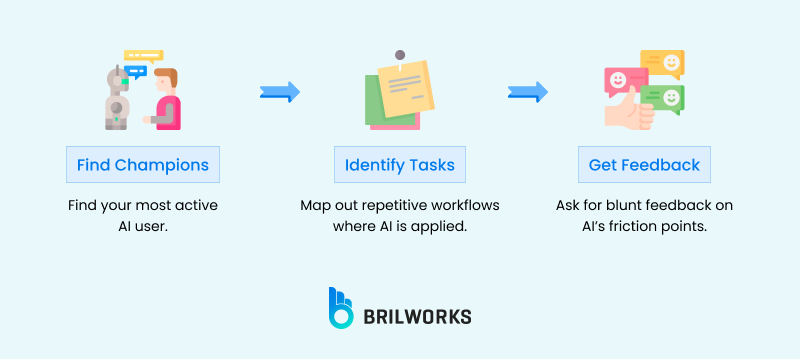
You will always find individuals who like trying new tools. They exist in every company. They test things on their own. These are your AI champions, even if you do not call them that.
You do not need a new job title or extra budget to support them.
Give them clear permission and a little time, even just two hours a week, to test tools on real work. Ask them to share what they tried and what happened in a short team meeting. This keeps learning practical and visible. Do not stop safe, informal experiments just because they are not part of a formal process.
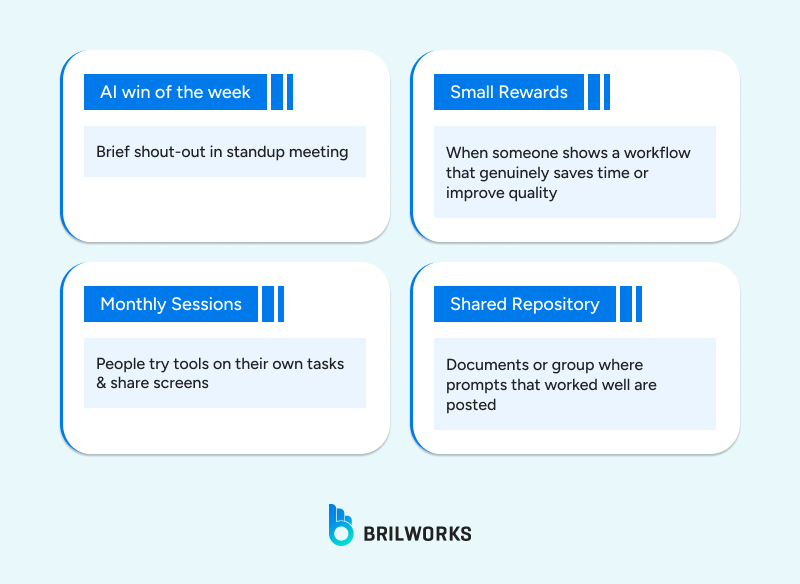
People adopt new tools faster when their learning is recognized. You do not need to offer cash rewards or track performance numbers. Simple, low-cost rewards work well now. Give a quick “AI win of the week” mention in meetings or a small appreciation when someone finds a way to save time or improve quality.
Simple routines help people share what they learn. Hold a monthly session where everyone tries tools on their own work and shares their screens. Create a shared document or group chat to post helpful prompts. Make it clear that learning and sharing are more important than just using AI.
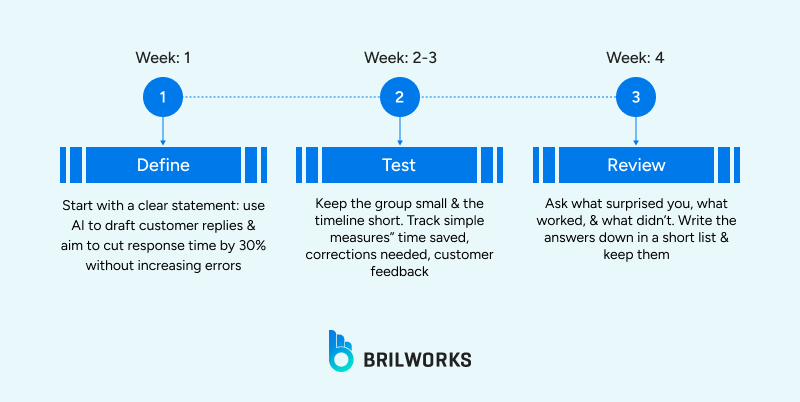
Small businesses get the most from AI by running quick tests and reviews. Start each experiment with a clear goal. For example, use AI to write customer replies and try to cut response time by 30 percent without more mistakes. Keep the group small and the test short, about two to four weeks.
Track simple results that show real impact, like time saved, corrections needed, or customer feedback. You do not need big datasets or fancy dashboards. Small samples are enough to see if something works.
After each test, ask what was surprising, what worked, and what did not. Write these answers in a short list and keep them. This record is often more useful than one big success.
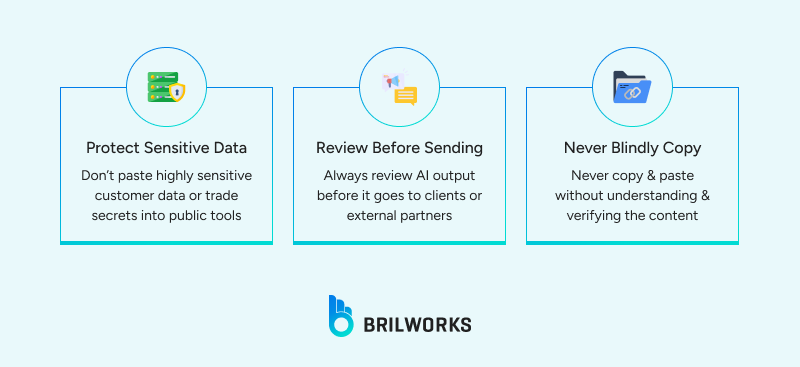
There are a few clear rules. Do not paste highly sensitive customer data or trade secrets into public tools. Always review AI output before it goes to clients or external partners. Big companies have complex rules, but small businesses can start with a simple list of do’s and don’ts on one page, reviewed from time to time. The goal is to build awareness, not create extra paperwork.
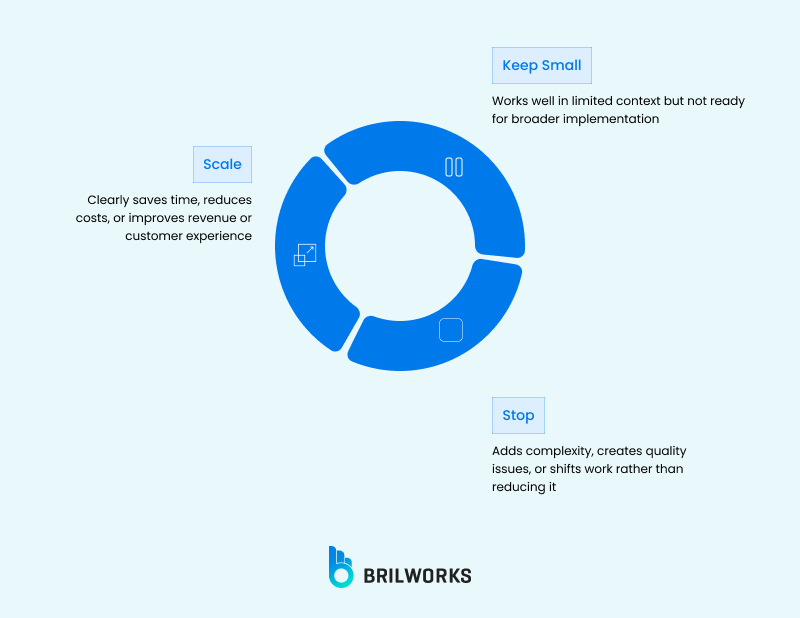
Not every experiment needs to expand. Some should stay small, and others should end.
Use clear, simple rules. Keep a use case if it saves time, cuts costs, or improves revenue or customer experience. Drop it if it makes things more complicated, lowers quality, or just moves work around instead of reducing it.
Encourage teams to report honestly. They should feel safe saying when something did not work and explaining why. These lessons are often more valuable than perfect success stories.
A simple routine every quarter helps. List all AI experiments and mark each as scale, keep small, or stop, with a short reason. This makes decisions clear and prevents unnoticed growth.
The real advantage is not having a certain tool, but how fast your team learns and adapts.
Leaders help by showing they are learning too. Admitting “I am still figuring this out” makes it easier for others to try new things. Asking in meetings where AI is being used and what was learned last month keeps things practical.
Small businesses that learn quickly about AI can compete with much bigger companies, even without large budgets. The key is paying attention, staying disciplined, and being open about learning.

Generative AI will keep evolving, but the fundamentals of good adoption stay the same: start where the value is clear, keep humans in control, and let data, not hype, decide what to scale. Whether you are a startup or an enterprise, the goal is not to “have AI,” but to build a smarter, more adaptive organization that can absorb new tools as they emerge.
The main point is that generative AI is not a tool rollout problem. It is an operating model problem. Without clear workflows, data, roles, and accountability, AI will stall or quietly create more mess.
They stall because organizations are vague. There is no shared meaning of success, AI is used in isolation instead of in workflows, core systems are shielded from change, and junior teams experiment without clear ownership or guardrails.
It should map how work actually happens, choose one concrete workflow to improve, prepare the data that workflow depends on, and define what AI should never see or change.
The guide suggests updating roles so people know what work is AI‑assisted and who is accountable, and training people to use judgment: when AI is useful, when it needs constraints, and when to ignore its output.
Get In Touch
Contact us for your software development requirements
Get In Touch
Contact us for your software development requirements

Hello, we are BRILLIAN’S. Trying to make an effort to put the right people for you to get the best results. Just insight !

 503, Fortune Business Hub, Science City Road, Sola, Ahmedabad, Gujarat, India Pincode- 380060
 + 91 9313644148
 sales@brilworks.com


