
5 mins read
Summarize with AI:


Data
AI
The Stack Underneath
)
Generative AI is a highly sought-after technology today. It can create realistic images and content, help marketers run marketing campaigns effectively, and suggest innovative ideas. With the advancement of technology, the use cases of generative AI are growing beyond content generation.
For businesses, AI technology is a must-have tool that could save both time and money. These AI tools have already found their place in various industries. While its potential seems limitless, it's essential to understand the limitations of artificial intelligence. By knowing how it works and the methods this technology leverages behind the scenes, you can better understand the limitations of generative AI technology.
Generative AI is hailed as the technology of the future, and undoubtedly, it has jaw-dropping capabilities to create diverse forms of content; but it comes with challenges and limitations that one should know before investing in generative AI development.
In this article, we will explore the limitations of generative AI and discuss how the future of generative AI technology has the potential to lower workload and enhance productivity.
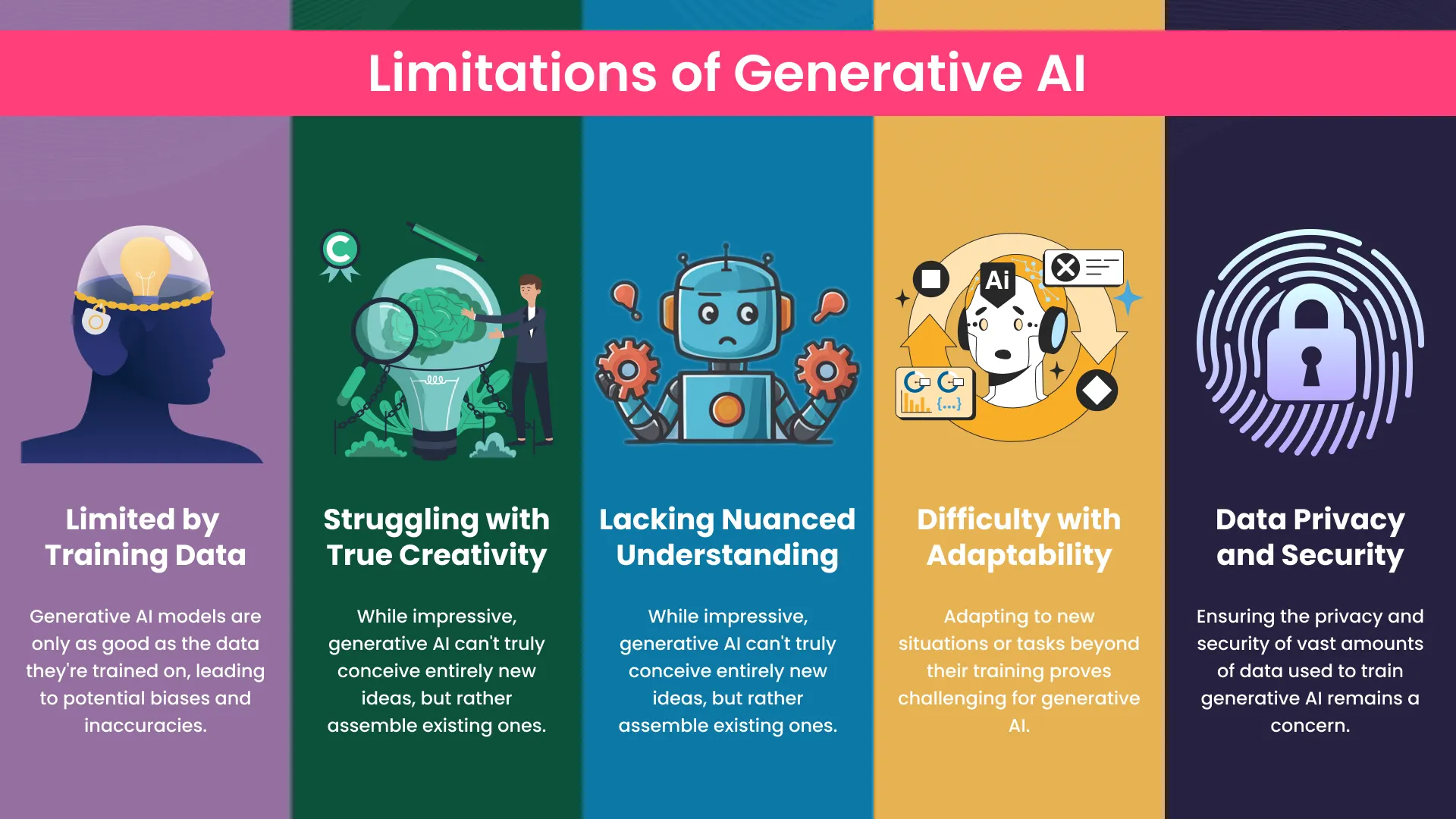
The first limitation is data available for training.
Have you ever wondered how generative AI models can do what they do?
This capability of generating articles and images comes from training.
Take OpenAI's GPT, it was trained on millions-billions of parameters, an unimaginable amount of data available on public and private domain.

And that’s the first limitation of gen AI: it is heavily influenced by the data it was trained on.
If the training data contains inaccuracies, outdated information, or inherent biases, the AI’s generated content can inadvertently mirror those issues.
There are several studies that show that the AI’s generated text directly reflected factual errors and biases within the training data.
For example, a generative AI trained on a data set of news articles with a historical gender bias might generate content that reinforces those biases.
While generative AI can write content such as articles, poems, code, and landing pages in a few seconds, it’s not truly creating from scratch.
Creativity has always been subjective, yet originality is what has defined it throughout the course of history.
Gen AI models will not fall short if you ask them to write like Shakespeare. However, the issue is not about how well it can mimic Shakespeare; rather, it is about how well it can create something original.
A study from the University of California, Berkeley, found that generative AI lacks the ability to make genuine and creative ideas, as it works by remixing the information on which it is trained.
This means that it can create an exact replica of the artwork down to the last stroke of the brush but will struggle to create something new out of a blank canvas.
These AI models identify patterns and connections within their training data, but they can’t actually understand an underlying concept from which the thought emerged.
Generative AI often struggles with the subtleties of human language, particularly when it comes to humor, sarcasm, and irony.
A 2024 evaluation of 11 state‑of‑the‑art LLMs across six sarcasm datasets finds that all current LLMs underperform supervised pre‑trained models, concluding that “significant efforts are still required” for understanding sarcasm.
These elements, so intrinsic to natural communication, rely heavily on context, cultural nuances, and unexpected twists that are challenging for AI models to interpret.
Research has shown that while AI can mimic certain linguistic patterns, it often fails to capture the deeper, more layered meanings behind humorous or sarcastic remarks.
This limitation arises because humor typically depends on a shared cultural understanding and an awareness of societal norms, factors that are difficult to encode into training data.
Consequently, while AI-generated content may superficially resemble witty banter or clever wordplay, it frequently misses the mark in conveying the true spirit and intent of human expression. To overcome this issue, you need to humanize AI text to refine AI-generated content, making it more natural, contextually rich, and emotionally accurate for human readers.

Generative AI models require significant retraining to adapt to new tasks or situations. This rigidity is largely due to the model's deep reliance on patterns learned from its original training data, making it difficult to generalize to contexts or styles that deviate from what it has been exposed to.
Consequently, even minor changes or adaptations in output often demand substantial human intervention and retraining efforts. This lack of adaptability underscores the challenges of deploying these models.
Data privacy is both a practical limitation of how current AI systems are built. Foundation models are trained on , mixed datasets, so it is hard to know exactly what personal or sensitive data they have “seen.”
A study on LLM reveals that models do memorize and can reveal personal information under adversarial querying.
Looking at the state of generative AI, in the future, it will make headlines more than any other technology. When it comes to driving innovation in business, generative AI development is offered as a must-have technology to compete today.
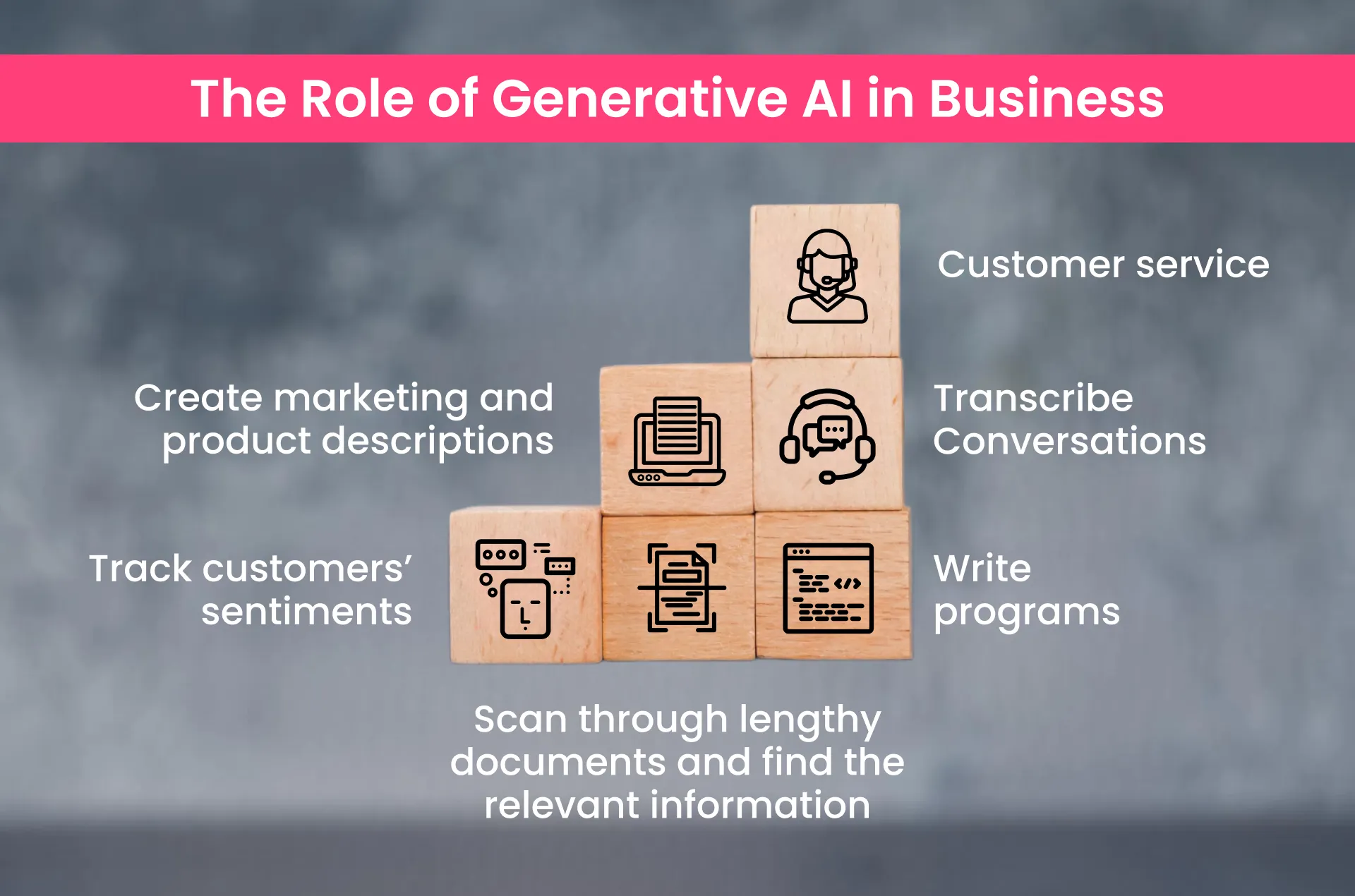
It helps business leaders in many areas, such as content creation, expanding labor productivity, personalizing customer experience, accelerating research and development tasks, and so on.
If we summarise the use case of today’s generative AI models, they can perform the following activities with a little human involvement as following:
As we move forward, we can expect a stronger focus on reducing biases. This can be achieved through diverse datasets or developing bias detection algorithms. There’s also the possibility of AI systems evolving to reason about fairness and ethics on their own.
Right now, AI is fantastic at remixing information, but what if it could go beyond that? The answer is still not known. However, with time, they can get better. We might see AI that doesn’t just replicate patterns but actually invents new forms.
Today, AI often misses the mark when it comes to the subtleties of language like humor or sarcasm. Looking ahead, though, future AI could better grasp these nuances.
One of the current challenges with generative AI is its rigidity. In the future, we might witness breakthroughs.
Future developments are likely to place a higher emphasis security and privacy through stricter regulations, advanced anonymization techniques, or even decentralized AI models that minimize dependency on massive datasets.
Looking ahead, we’re likely to see AI working hand-in-hand with human experts, complementing rather than replacing our skills. Future applications may focus on augmenting human capabilities.
Many of these issues can be managed through practical techniques for working around generative AI challenges that stem from limitations in current AI models.
For many startups, the key challenge with AI is the limits of their infrastructure. Their company infrastructure is not designed to run AI for advanced applications.
What many business owners and IT leaders underestimate is the need for preparation. Generative AI adoption requires a strategic approach for how and where AI will be used inside the business.
To explore this in more detail, see our guide how businesses can prepare for generative AI adoption.

All these limitations and challenges do not mean that geneartive AI will die out soon. It is already making changes and taking leaps. It is how you use it that matters. You can turn these limitations into opportunities if you have proper roadmap for successful generative AI in place. AI integration can be more challenging if not implemented without preparation. Here’s how businesses can get ready:
Before adopting generative AI, companies should identify where it can add real value.
Generative AI relies on datasets. Businesses must ensure compliance with industry regulations and implement strong security measures.
AI tools work best when employees understand how to use them effectively. Companies should invest in training programs to help teams adapt to AI-driven processes.
Since AI models can inherit biases from training data, businesses must regularly audit AI-generated output for fairness, accuracy, and ethical considerations.
Instead of a full-scale AI rollout, businesses should test generative AI on smaller projects first.
By taking a thoughtful approach, businesses can harness generative AI’s potential while mitigating risks. With the right strategy, AI can enhance productivity, drive innovation, and improve customer experiences without compromising security or ethics.

Generative AI has impressed professionals across the globe with its jaw-dropping generation capabilities. It provides a new way to develop and market products. Still, it often misses the subtle aspects of human creativity and communication, such as humor, sarcasm, and context.
These AI models struggle to understand unspoken (deeper) meanings and, therefore, interpret inaccurately. Human judgment remains crucial.
Businesses that want to employ generative AI in their operations should understand where it shines and where it falls short to effectively leverage these awe-inspiring models, improving their marketing, content generation, and customer service. For teams looking to build around these limits in production, see our production AI engagements at Brilworks.
You might also like

Hello, we are BRILLIAN’S. Trying to make an effort to put the right people for you to get the best results. Just insight !

The five limitations that show up most consistently in production work are: (1) bounded knowledge — the model only knows what was in its training data, so it confidently invents facts about anything more recent or more specific; (2) no true reasoning — outputs are statistically plausible continuations of the prompt, not derivations from first principles, so multi-step logic and arithmetic still break; (3) bias inherited from training data — gender, racial, and cultural skews carry through unless actively countered; (4) no grounded creativity — generative AI remixes patterns from its corpus rather than producing genuinely novel ideas; (5) privacy and IP risk — anything you paste into a hosted model can leak into future training runs unless the vendor contractually rules it out. Every one of these is workable around with the right architecture (retrieval-augmented generation for knowledge, tool use for math, human review for bias, on-prem or zero-retention APIs for privacy), but none are solved at the model layer in 2026.
If you have to pick three: (a) it can't reason from first principles, only complete statistically plausible patterns; (b) it inherits and amplifies biases in its training data; (c) it has no built-in mechanism to know what it doesn't know — the same confident tone for facts and hallucinations alike. These are the three that show up in almost every production failure mode we ship around.
Three limitations that make human oversight non-negotiable: (1) hallucination — generative models will produce confidently wrong outputs and cannot reliably self-flag them, so a human must check anything that affects a customer, a contract, or a clinical/legal/financial decision; (2) bias propagation — without review, biased outputs compound at scale and become harder to roll back; (3) lack of accountability — a model has no stake in being right and no audit trail of why it said what it said, so a human must own the final call. These are exactly why most production AI workflows we build for clients route generative outputs through a reviewer or a deterministic verification step before they reach the user.
All four are real limitations. Royalty/IP risk comes from training on copyrighted material that may surface in outputs. Accuracy is limited because models predict plausible text rather than retrieve verified facts. Bias is inherited from training data and rarely corrected at the model layer. Lack of originality follows from the same mechanism — generative AI recombines existing patterns rather than producing genuinely new ideas. The mitigation strategy differs for each: licensing and source-aware RAG for IP, retrieval grounding for accuracy, evaluation suites for bias, human-in-the-loop curation for originality.
Capabilities: drafting structured text, summarising large bodies of content, generating code with awareness of common patterns, generating images and audio from natural-language prompts, and orchestrating multi-step tool use when wired into an agent framework. Limitations (covered in detail above): bounded knowledge, no true reasoning, inherited bias, hallucinated confidence, privacy/IP exposure on hosted models, and brittleness when adapting to genuinely new domains. The honest framing for 2026: generative AI is a force multiplier on tasks where you can verify the output cheaply, and a liability on tasks where you can't.