COOPERATION MODEL
ARTIFICIAL INTELLIGENCE
PRODUCT ENGINEERING
DevOps & Cloud
LOW-CODE/NO-CODE DEVELOPMENT
INDUSTRY
FRONTEND DEVELOPMENT
CLOUD DEVELOPMENT
MOBILE APP DEVELOPMENT
LOW CODE/ NO CODE DEVELOPMENT
EMERGING TECHNOLOGIES



 5 mins read
 Last updated December 17, 2025
In this article, we’re going to break down the four core hiring models for software development projects. Understanding these structures is crucial for aligning your development partnership perfectly with your needs, whether you're a startup on a tight budget or an organization looking for vetted, remote developers.

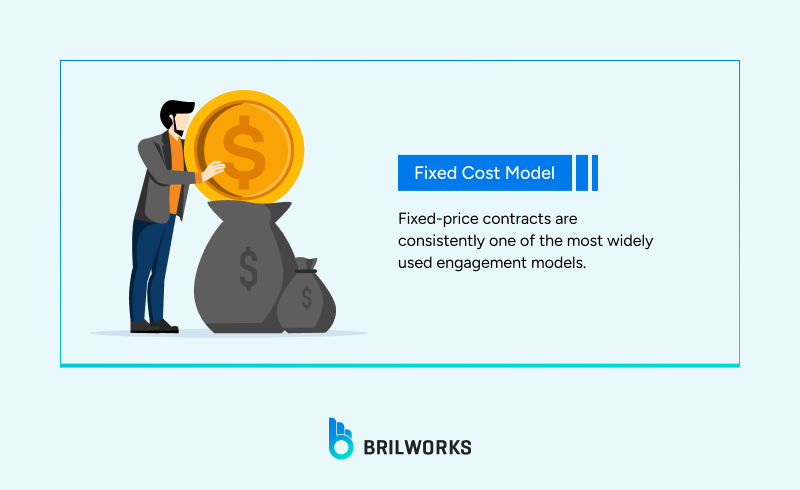
The Fixed Cost model is simple: you define the entire project, reach out to multiple software development agencies, and lock in one fixed price. Then, the agency delivers the projects. It offers total comfort regarding financial predictability.

This model is an excellent choice if you operate with a non-negotiable (fixed) budget and want to know the total development cost upfront. It's perfect for simple projects like a basic app or a website update. This is also popular among non-technical founders.

The appeal is strong: you hand over the specifications and expect a finished product without needing to spend time managing the daily tasks.
The downside of this model is that the fixed cost is high when your plans change. If you try to add an evolving project into this fixed bracket, it is the number one cause of client-vendor tension.
The moment you request a change, the developer has to recalculate the cost and issue a formal amendment.
This model penalizes the very agility that innovative projects need.
If your idea relies on user feedback to evolve, or if your plan is still blurry, Fixed Cost is a trap.
You gain assurance on your initial bill, but you lose the crucial ability to innovate without accruing massive, time-consuming amendment fees. Fixed-price contracts are consistently one of the most widely used engagement models.
The Time and Material (T&M) model (paying Per Hour) is the structural opposite of Fixed Cost. Here, you pay only for the hours worked, which makes it the most flexible framework available.
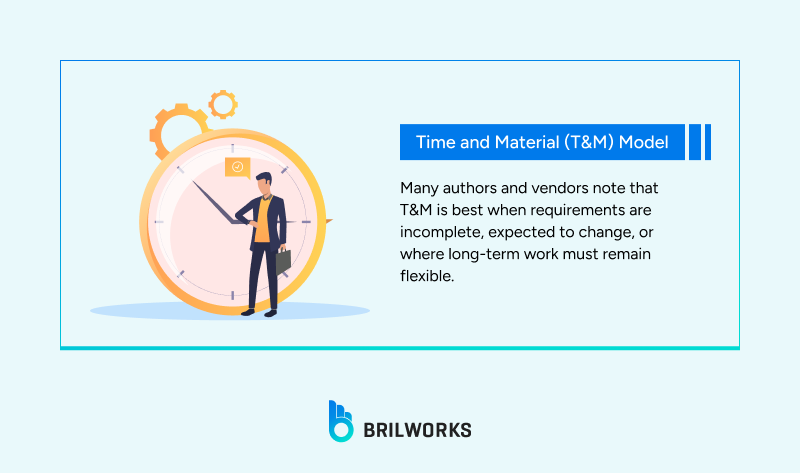
If your project involves R&D, uses new technology, or is focused on finding the right product features, T&M is the correct strategic alignment.
Your plans are likely to change, and T&M allows for instant course correction. Features can be swapped, added, or dropped. This maximum agility is priceless for fast-moving startups and product managers who must react to user data immediately.

Furthermore, for a client who only needs a few hours of specialized work, like a security check or fixing an old system, T&M avoids the need for large contractual commitments.
The big trade-off is you swap a guaranteed price for total flexibility. The final cost is variable. As such, T&M demands active involvement and accountability from the client. You must have a strong Product Owner who consistently manages the priorities.
If you lack the technical expertise or the time for daily oversight, the chance of the costs spinning out of control becomes substantial. T&M requires leadership and focus to succeed.
The Dedicated Development Team (DDT) model is less about a single project and more about building up your long-term team size.
DDT, or Staff Augmentation, is outsourcing your HR work while keeping total control over the technical team. You pay a fixed monthly rate for a dedicated group of specialists who work only for you. The partner company handles recruitment, payroll, benefits, and office space, freeing you from administrative burdens.
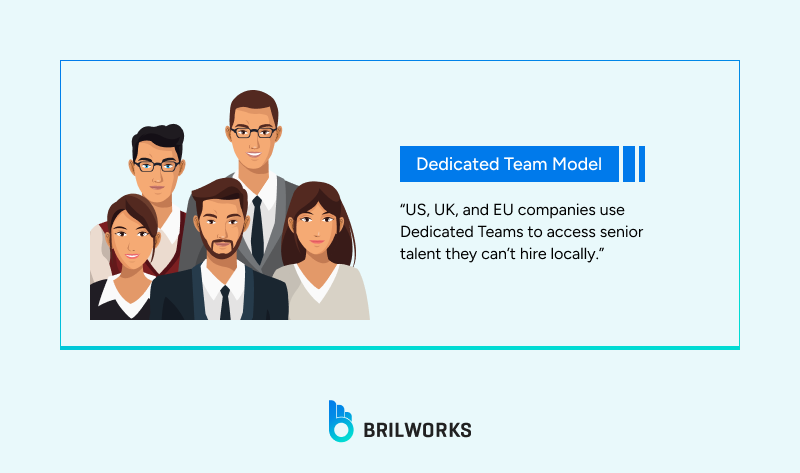
This model is ideal for established organizations and funded startups building long-term products. It is the preferred way to get specialized talent quickly without making permanent, local hires.
Moreover, this is the highest-commitment model. It’s perfect for clients who demand maximum control over the process. You decide the team’s daily tasks and technical direction. If you want to integrate external developers into your internal channels and meetings, this is the way to do it.

The main requirement is that you must have internal technical leadership ready to manage and direct the team. Since you pay for the team's capacity monthly, you need to ensure your product backlog is always full and strategically prioritized.
For a small founder or someone seeking a hands-off approach, this much time spent managing is simply too high.
The Project-Based Model is often misunderstood, but it represents the best choice for full outsourcing and getting a guaranteed final product.
In this model, you are not buying developer hours; you are buying the delivery of a working application. The external partner takes on all the project's day-to-day management and risk. They appoint the Project Manager, design the architecture, and handle quality assurance.
Your communication is channeled through one person, and your focus shifts entirely to business results and strategic feedback.
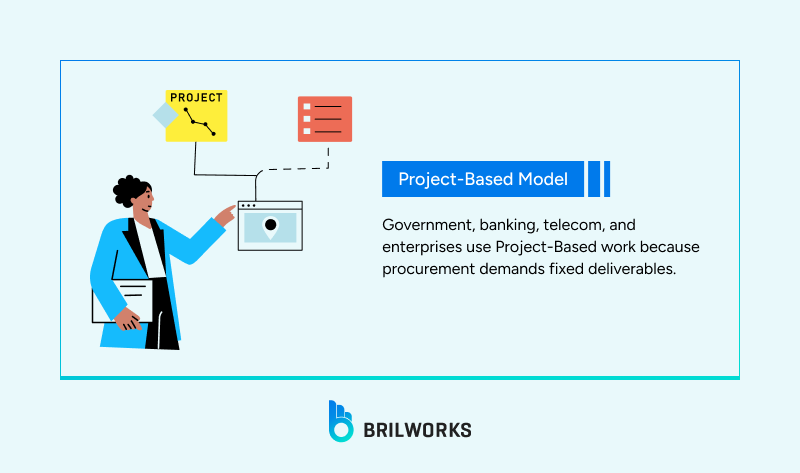
This is a powerful choice for the business owner who is not technical or who simply wants to avoid the distraction of managing developers. You rely entirely on the partner's expertise to follow best practices and deliver the application successfully.
Project-Based models frequently use a hybrid approach. For example, the discovery phase might be Fixed Cost to define the blueprint, while the core development phase uses a milestone-based payment plan.
This ensures your money is tied directly to visible progress, giving you the assurance you need while allowing the partner’s management team to handle complexity efficiently.
For many startups, individuals, and organizations, especially cost is the primary filter. Here is a direct comparison of the four primary models based on cost predictability and cost drivers:

When evaluating cost, look at two factors:
the hourly rate and,
the total risk.

In the Time and Material (T&M) model, you will typically see the lowest hourly rate because the vendor carries the least financial risk. However, this model has the highest risk regarding the total final cost if the scope is not strictly managed by the client.
It’s ideal for high-budget clients who can absorb risk but want the flexibility to spend money exactly where needed, or for very small, defined hourly tasks where a large contract is overkill.
The Fixed Cost model provides the safest picture for a tight budget. However, clients must understand that they are paying a premium—a hidden "buffer"—for that security. This buffer protects the vendor against any time overruns.
If the project finishes early, you still pay the full fixed price. If the client makes frequent changes, the cumulative cost of the Change Requests (CRs) often far exceeds the original budget, making it the most expensive option for an ambiguous project.
The Dedicated Team model represents a high, stable cost—a fixed monthly salary for each team member.1 It is unsuitable for low-budget, short-term projects. It is designed for organizations with sustained funding and an ongoing need for capacity.
You are effectively paying to eliminate the costs and risks associated with hiring, managing HR, and training internal employees. The financial justification is found in the team’s ability to build complex, long-term product features efficiently, not in an initial low price.
The Project-Based Model costs more than T&M because the price includes the vendor’s management team, project managers, and quality assurance processes. For a client who lacks technical knowledge or management time, this expense is justified because they are buying risk reduction.
The cost covers the partner's expertise in delivering the project on time and within the agreed-upon feature set, making it an excellent balanced cost solution for businesses focused on outcomes.
The best partnership model isn't found by comparing price lists; it's found by matching your project’s uncertainty with your own approach to management.

|
If your primary concern is... |
Your strategic model should be... |
Why it works... |
|
Budget |
Fixed Cost |
Locks in the expense, vital for strict budgets. |
|
Project Uncertainty |
Time and Material |
Allows for instant pivots and iteration based on user feedback. |
|
Team Control |
Dedicated Team |
Provides stable, dedicated staff integrated into your company. |
|
Zero Time Spent Managing |
Project-Based |
Transfers all operational risk and daily management to the partner. |
By understanding these four strategic options, you can step into your development partnership with clarity, confidence, and control, ensuring your hiring model is a catalyst for success.

The real signal in all of this is simple: every model forces you to expose how you actually plan to build—not how you say you will. If your idea is still shifting, pretending you can freeze it in a fixed contract only delays the reckoning. If you don’t have someone who can steer developers, a T&M setup will drain you. If you want people who learn your product deeply, a rotating cast of freelancers won’t cut it. And if you want someone else to absorb the operational chaos, you’re going to pay for that structure—one way or another.
Once you strip away the buzzwords, the “best model” is just the one that won’t collapse under your real working style and your real level of clarity. Most teams don’t bother to make that match. They choose based on price tags or convenience, and then spend months undoing the consequences.
If you’re planning a build right now, don’t skim past these models. Put them on the table and force them to compete with the way you operate. The model that survives that scrutiny is the one that won’t sabotage you later. That’s the only filter that matters. The rest is noise.
Get In Touch
Contact us for your software development requirements
Get In Touch
Contact us for your software development requirements

Hello, we are BRILLIAN’S. Trying to make an effort to put the right people for you to get the best results. Just insight !

 503, Fortune Business Hub, Science City Road, Sola, Ahmedabad, Gujarat, India Pincode- 380060
 + 91 9313644148
 sales@brilworks.com


