COOPERATION MODEL
ARTIFICIAL INTELLIGENCE
PRODUCT ENGINEERING
DevOps & Cloud
LOW-CODE/NO-CODE DEVELOPMENT
INDUSTRY
FRONTEND DEVELOPMENT
CLOUD DEVELOPMENT
MOBILE APP DEVELOPMENT
LOW CODE/ NO CODE DEVELOPMENT
EMERGING TECHNOLOGIES



 8 mins read
 Last updated March 20, 2026
You have a product idea. Maybe it's a SaaS platform, a fintech tool, or a healthcare app. The instinct is to build everything, every feature, every edge case, every nice-to-have, before showing it to anyone. That instinct is expensive, slow, and often wrong. So what is MVP development, and why do most successful tech companies start there instead?
MVP development is a strategy for building just enough of a product to test your core assumptions with real users before committing serious resources. It's not about shipping something half-baked. It's about being deliberate with where you invest time and money, learning fast, and making decisions based on actual feedback rather than gut feeling. For founders and technical leaders, it's one of the most effective ways to reduce risk while accelerating time-to-market.
At Brilworks, we've helped startups and enterprises go from idea to functional AI-powered MVPs in weeks, not months. Our product engineering team combines deep expertise in cloud infrastructure, modern frameworks, and AI to build prototypes that aren't just demos, they're launchpads. That hands-on experience shapes everything in this guide.
This article breaks down what an MVP actually is, why it matters, the step-by-step process for building one, and real-world examples that show these concepts in action. Whether you're a first-time founder or a CTO planning your next product line, you'll walk away with a clear, practical framework you can put to work immediately.
MVP stands for Minimum Viable Product. The term comes from Eric Ries, who introduced it as part of the Lean Startup methodology. When people ask what is MVP development, they're really asking how you build something real enough to generate honest feedback without building everything first. An MVP is the simplest version of your product that delivers the core value proposition to your first users, and nothing beyond that.
The goal of an MVP is not to ship a small product. It is to learn as fast as possible with the least amount of wasted effort.
An MVP is a working, deployable product with enough functionality to solve one problem for one target user group. It is not a list of features or a roadmap item. It is a deliberate, functional build that gets into real users' hands so you can observe actual behavior instead of guessing at it. The core question an MVP answers is: does this solve something people actually want?
You build around a single, testable hypothesis. For a fintech app, that might be "users will pay to automate their expense categorization." For a healthcare tool, it might be "clinicians will use a dashboard to track patient medication compliance." Your MVP is the simplest build that validates that specific hypothesis under real conditions. Everything else, the advanced filters, the integrations, the polished onboarding flow, waits until you have clear signal that the core works.
Understanding what an MVP is not saves you from the most common and costly mistakes teams make in early-stage development. An MVP is not a prototype. A prototype is a visual or functional mock-up used to explore design options internally. An MVP is an actual product shipped to actual users, and those two things serve fundamentally different purposes and produce different kinds of signal.
An MVP is also not a low-quality product. "Minimum" refers to scope, not craftsmanship. A buggy, unreliable build will generate the wrong kind of signal. If users drop off, you will not know whether they rejected the idea or just could not tolerate the broken experience. Your MVP needs to work reliably enough that the feedback you collect reflects genuine user interest, not frustration with a broken product.
Here is a quick breakdown of what separates an MVP from concepts teams often confuse it with:
| Concept | Purpose | Shipped to users? | Core output |
|---|---|---|---|
| MVP | Test a core hypothesis | Yes | Validated learning |
| Prototype | Explore design and flow | Usually no | Visual or functional demo |
| PoC | Prove technical feasibility | Rarely | Technical validation |
| Full product | Deliver complete value | Yes | Full feature set |
Finally, an MVP is not a one-time event. Many teams treat launch as the finish line, but it is actually the starting line. The product you ship on day one is the beginning of a feedback loop, not the final answer. Every release cycle builds on what you learned from the version before. Iteration is the mechanism that turns a first release into a product worth scaling, and teams that skip it usually end up rebuilding from scratch after investing far more than they needed to.
When you ask what is MVP development, the business case becomes clear once you examine how most products fail. The culprit is rarely poor engineering. It's teams that build the wrong thing entirely, investing months and budget into features nobody asked for. MVP development forces you to test your assumptions with real users and actual feedback before depleting your runway, which changes your odds of building something that survives contact with the market.
Building the wrong product at full scale is far more expensive than testing your core idea early and adjusting course based on what you learn.
Most new software products fail to reach product-market fit, and a significant share of that failure comes from teams that overbuilt before validating demand. When you scope an MVP correctly, you spend a fraction of your total development budget to generate the signal that tells you whether to continue, pivot, or stop. That kind of early validation protects your runway and gives you the information you need to make confident, data-backed investment decisions rather than expensive guesses. For startups especially, that discipline is often the difference between surviving the early stage and running out of money on the wrong idea.
An MVP also strengthens your position with investors and internal stakeholders. A working product with early user data is far more convincing than a pitch deck, regardless of how polished it looks. Real retention metrics and usage patterns carry weight that projections and forecasts simply do not, and that credibility moves decisions forward in ways that slides and spreadsheets alone rarely can.
Every week you build without user feedback is a week of unchecked assumptions accumulating. An MVP compresses that feedback loop significantly. You get real behavioral data from actual users instead of relying on what people claim they will do in a survey. That distinction matters because stated preference and real behavior rarely align, and acting on the wrong signal early leads to costly rebuilds and wasted sprints.
Faster learning also sharpens team focus and decision-making across the board. When your team has clear feedback from an actual release, prioritization becomes straightforward. You stop debating what users might want and start responding to what they demonstrably do. That clarity reduces friction in sprint planning, cuts stakeholder disagreements, and keeps your development velocity consistent through the early stages of product growth.
Teams frequently confuse these four terms, and that confusion leads to misaligned expectations and wasted sprint cycles on builds that solve the wrong problem at the wrong stage. Understanding what each one does and when to use it helps you make better decisions before you write a single line of code. Knowing what is MVP development also means knowing what it isn't, and the clearest way to do that is to look at what these other concepts actually accomplish.
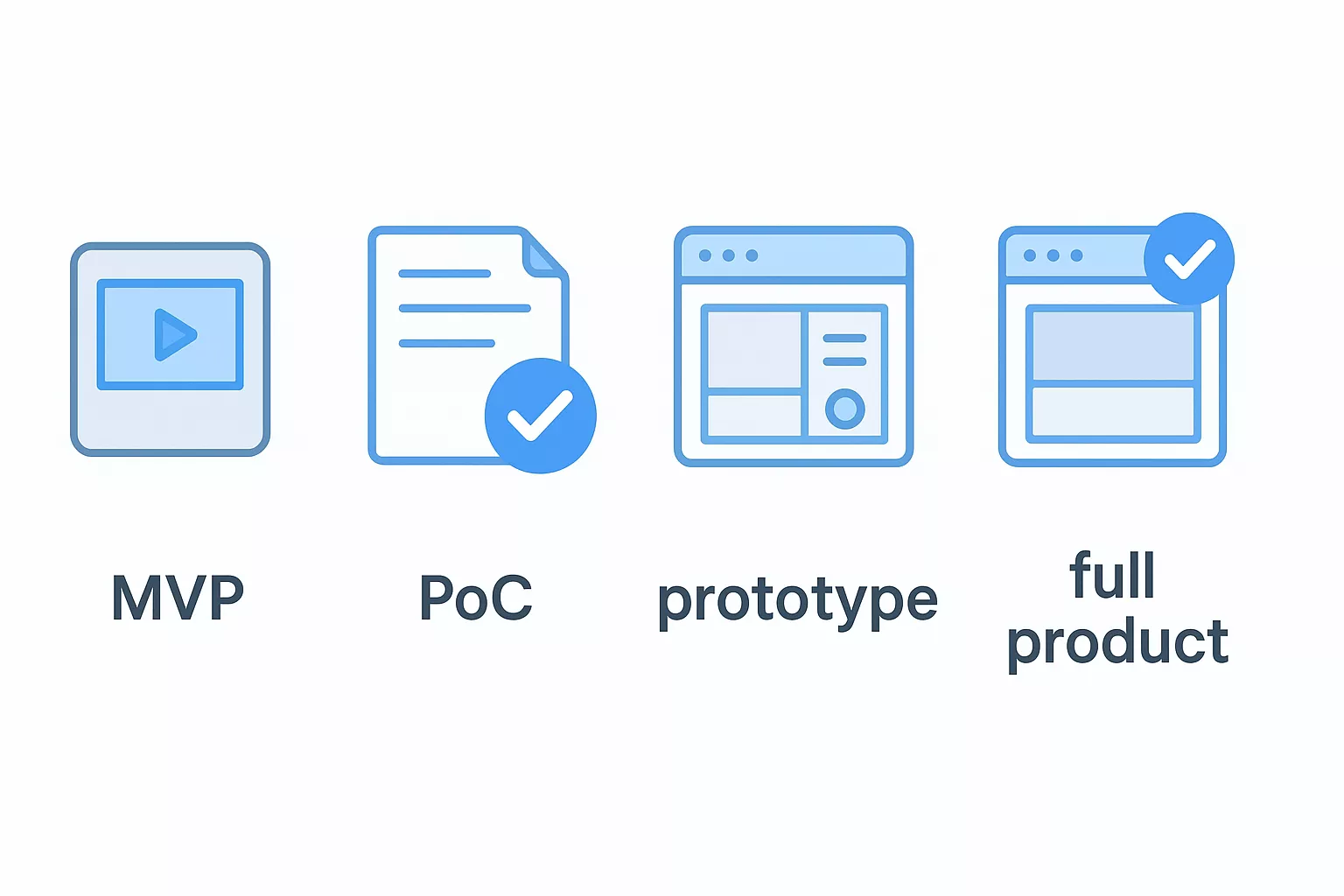
The right tool at the right stage saves you from rebuilding what you already built.
A proof of concept (PoC) answers one question: can this be built? You use a PoC when you face a technical risk that could block your entire product, such as whether a specific AI model can process medical records fast enough, or whether two third-party APIs can communicate reliably. The output is technical evidence, not a user-facing product. You rarely ship a PoC to users because it exists to remove internal uncertainty, not to validate market demand.
Prototypes serve a different purpose than either a PoC or an MVP. A prototype is a visual or interactive model that lets your team explore design decisions before building anything functional. You use it to test flows, gather feedback on navigation, or align stakeholders on what the product will look and feel like. The critical distinction is that a prototype does not need to work under the hood. Designers build prototypes to answer design questions, not to test whether users will pay for a solution or return to use it again.
Prototypes are useful, but they carry a sharp limitation: user behavior in a demo setting rarely matches behavior in a live product. People engage differently when real stakes are involved, which is exactly why you need an actual deployed MVP to collect meaningful signal about retention and demand.
A full product is what you build after an MVP has confirmed your core hypothesis. At that point, you have retention data, user feedback, and clear evidence of demand. Building out your complete feature set on top of a validated foundation is a calculated investment, not a gamble. Skipping the MVP stage and going straight to a full build is where most teams burn through budget on features that real users never asked for.
Understanding what is MVP development in theory is one thing. Putting it into a working, repeatable build process is another. Most teams that struggle with MVPs don't fail because of bad engineering. They fail because they skip the early steps that define scope and lock in the problem they're actually solving before a single sprint begins.
A clear problem statement at the start saves you from expensive scope changes halfway through your build.
Before you write a single line of code, you need to articulate the specific problem your product solves and for whom. This means talking to potential users, identifying their actual pain points, and formulating a testable hypothesis. Your hypothesis should be concrete: something like "small business owners will pay to automate invoice tracking" gives you a specific claim to validate. Vague problem statements produce vague products that fail to generate clear signal after launch.
Once you have a hypothesis, narrow your target user to the smallest viable group. Early adopters are people with the most acute version of the problem you're solving, and they give you faster, more honest feedback than a broad audience. Focus your MVP on that specific group rather than trying to accommodate everyone at once.
With your hypothesis in place, map the complete user journey from the moment someone encounters your product to the moment they receive the core value you're promising. Identify the minimum number of steps required to deliver that value. Everything outside that critical path is out of scope for your first release. This exercise forces necessary trade-offs that keep your build lean and your timeline realistic.
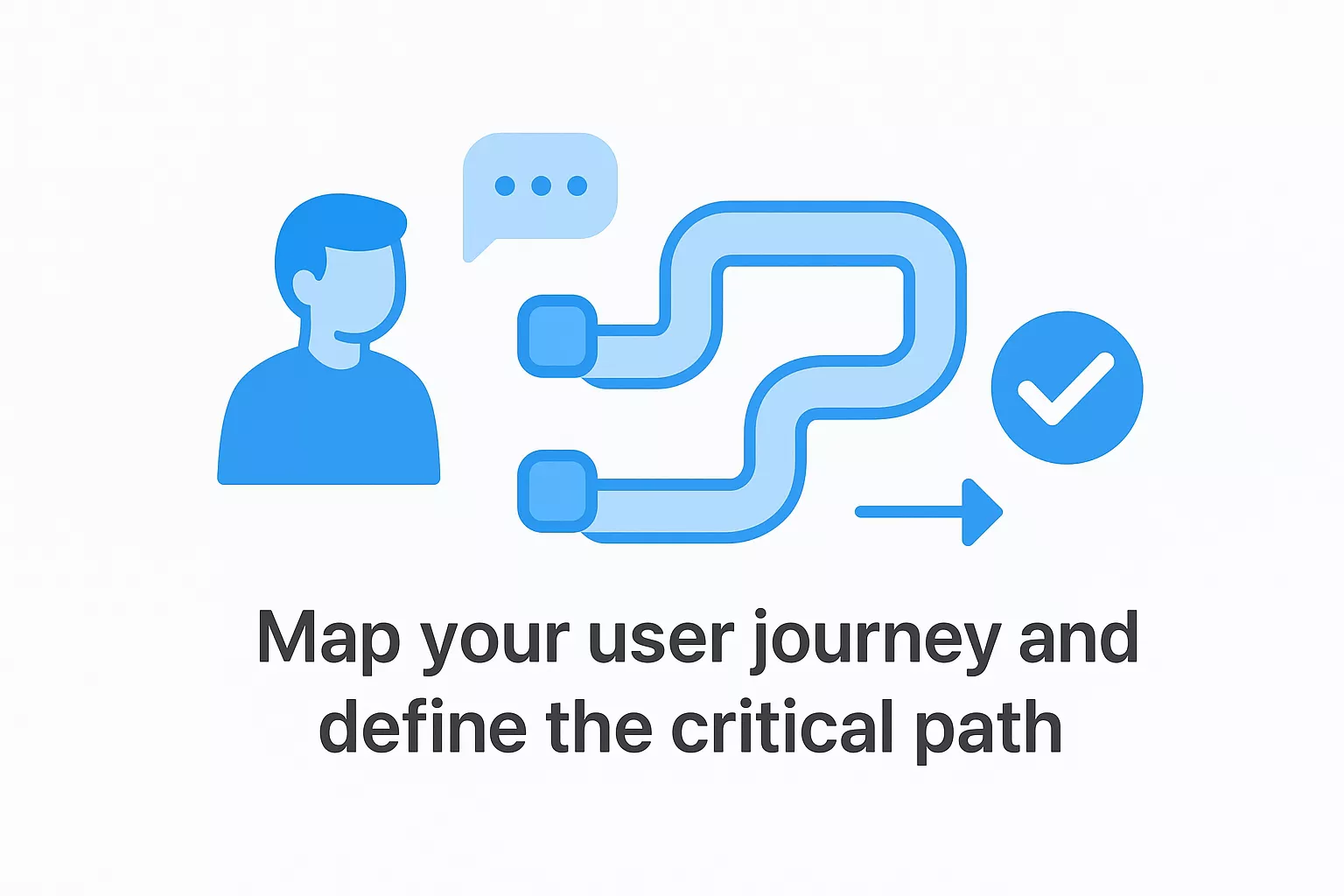
Document each step of the journey as a simple flow. This gives your engineering and design teams a shared reference point that prevents feature creep from entering the build mid-sprint. Decisions move faster when everyone can point to the critical path and ask whether a new request is on it or off it.
Short build cycles, typically one to two weeks per sprint, keep your team accountable and your scope visible. Each cycle should produce a testable increment that moves you toward a shippable release. Assign clear ownership for each component and set a firm cutoff date before you ship.
Before you call an MVP ready to launch, confirm each of these:
One of the most common ways teams sabotage their MVP is by letting scope expand without discipline. When you understand what is MVP development at its core, you realize the value is not just in what you build but in what you deliberately leave out. Every feature you add to your first release costs time, money, and complexity that delays your ability to test your core hypothesis with real users. The teams that ship effective MVPs treat every addition to the feature list as a question, not a given.
Scope decisions made before development begins are far cheaper than scope changes made during it.
The simplest filter for feature decisions is to ask whether a specific feature is required for a user to experience the core value of your product. If a user can reach the moment where your product solves their problem without that feature, it does not belong in your first release. Apply this question to every item on your initial list and you will quickly separate what is essential from what is aspirational.
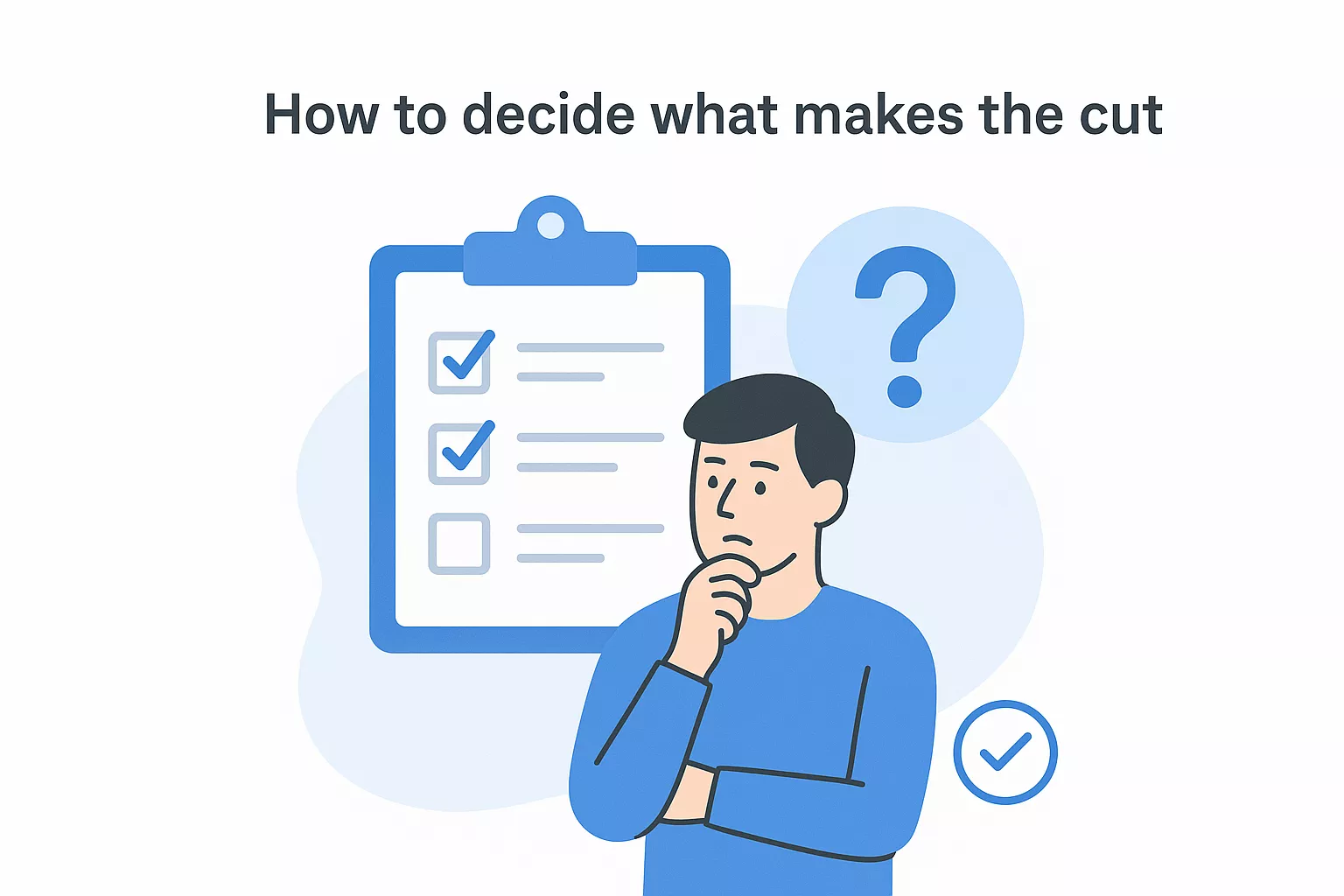
A practical tool for this is a prioritization matrix. Map features across two axes: user impact and build effort. Features with high impact and low effort belong in your MVP. Features with low impact and high effort belong in a later release cycle. Here is a simple version:
| Feature | User Impact | Build Effort | MVP? |
|---|---|---|---|
| Core user journey | High | Low-Medium | Yes |
| Advanced filters | Low | Medium | No |
| Third-party integrations | Medium | High | No |
| Basic notifications | Medium | Low | Yes |
This matrix gives your team a shared decision-making reference that removes opinion from the conversation and replaces it with a repeatable process your whole team can apply consistently.
Your tech stack choice carries long-term consequences that extend well beyond your initial release, so treat it as a deliberate architectural decision rather than a default. For most MVPs, the right choice prioritizes speed of development, developer familiarity, and scalability headroom for when your product grows. Reaching for an experimental framework to solve a problem your MVP does not yet have adds friction without adding value.
Choose tools your team already knows well and that have strong community support. That combination reduces build time, speeds up debugging, and gives you access to a larger talent pool if you need to bring in additional engineers as the product scales past its initial release.
Launching your MVP is not the end of the process. It is the point where real learning begins. Many teams celebrate the release and then wait for growth to happen, but that passive approach wastes the most valuable window you have. The first weeks after launch give you direct, unfiltered signal about whether your core hypothesis holds, and you need a system in place before you ship to capture that signal effectively.
What is MVP development if not a structured method for collecting honest feedback and acting on it faster than your competitors can?
You need to decide on one or two primary metrics before you launch, not after. These should connect directly to the hypothesis you set out to test. If your hypothesis was that users will pay to automate a specific task, your primary metric is paid conversion from first-time users, not general traffic or app installs. Measuring the wrong thing gives you the illusion of data without the insight that actually drives decisions.
Alongside your primary metric, track retention at seven and thirty days. Retention is one of the clearest signals that your product delivers real value rather than just initial curiosity. A product that users come back to without prompting tells you far more than one that generates a spike of interest at launch and then flatlines. Use tools your team already has access to rather than adding complexity with new platforms.
Once you have data, you need a repeatable process for acting on it. Set a fixed review cadence, typically every one to two weeks, where your team looks at your core metrics, reviews user feedback, and identifies the one change most likely to move your primary metric. Keep each iteration cycle focused on a single, testable change so you can isolate what caused any movement you observe.
Avoid the trap of treating every piece of user feedback as a feature request. Filter feedback against your core hypothesis and ask whether each piece of input helps you validate or refine the specific problem you set out to solve. Feedback that falls outside that scope belongs in a backlog for a later stage, not in your next sprint. That discipline keeps your iteration cycles clean and your team focused on what matters most at this stage of the product.
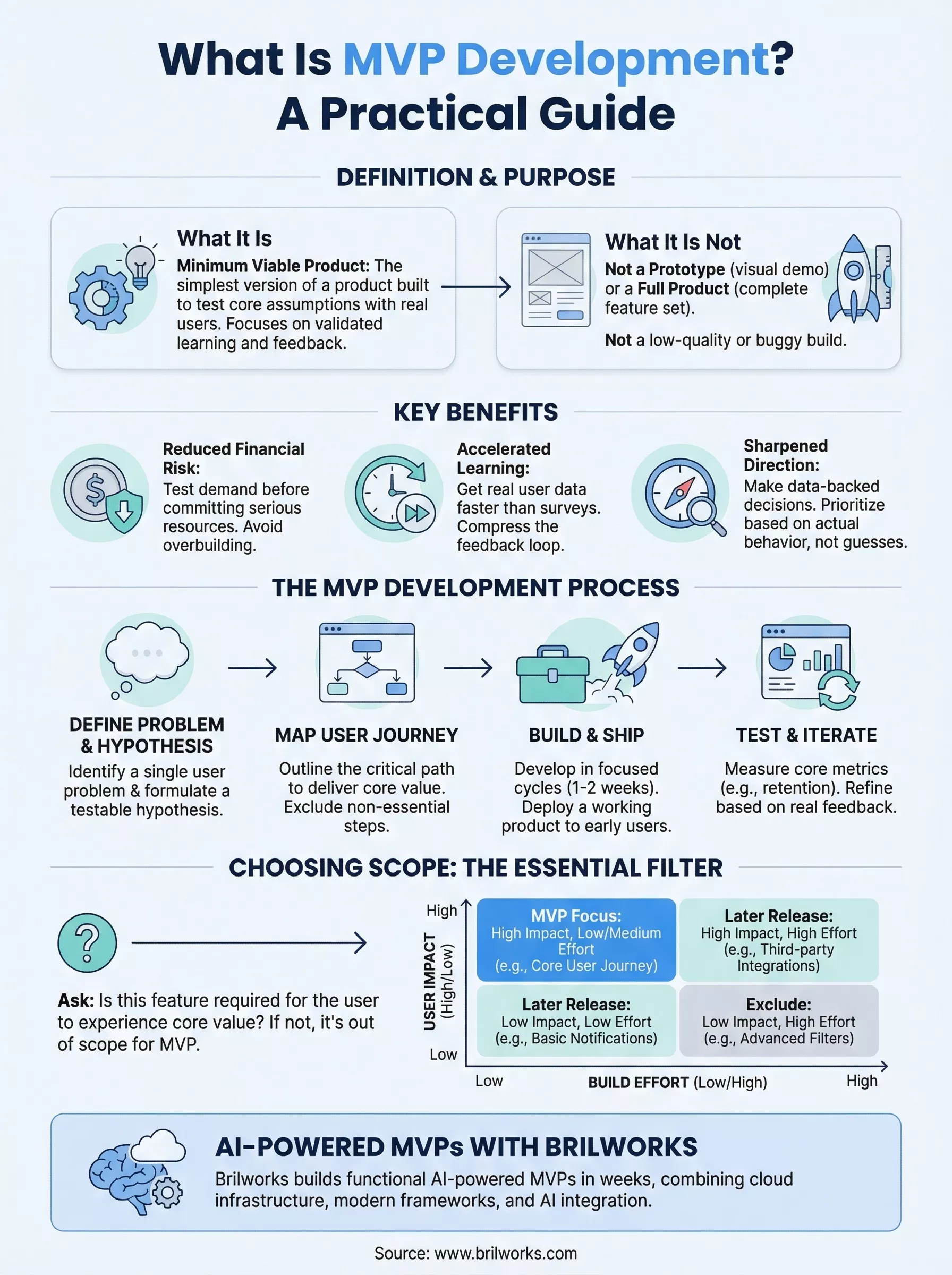
Understanding what is MVP development gives you a practical framework for reducing risk, validating ideas faster, and building products users actually want. The core principle is simple: test your most important assumption with the smallest possible build before committing your full resources to it.
Your MVP succeeds when you define a sharp hypothesis, keep scope ruthlessly narrow, measure the right metrics from day one, and iterate based on real user behavior rather than internal opinion. Each of those steps compounds on the one before it, which is why teams that follow the full process consistently outperform those that skip straight to building and end up rebuilding from scratch after spending far more than they needed to.
Ready to move from idea to a working, launchable product? Brilworks builds AI-powered MVPs in weeks, not months, with a team that covers cloud infrastructure, AI integration, and modern development frameworks from start to finish. Talk to our product engineering team and get a clear plan for your first release.
MVP development is the process of building a basic version of a product with only essential features. It allows businesses to launch quickly, test ideas with real users, and gather feedback before investing in full-scale development.
MVP development helps startups validate their product idea with minimal cost and risk. Instead of spending months building a full product, they can test market demand early and make improvements based on real user feedback.
In MVP development, only core features that solve the main problem should be included. The goal is not to build a perfect product but to deliver enough value for users to engage and provide feedback.
The timeline for MVP development typically ranges from a few weeks to a few months, depending on the complexity of the product. A focused scope and clear priorities help speed up the process.
After MVP development, the product is tested in the real market. Based on user feedback, businesses can improve features, fix issues, and gradually scale the product into a full-fledged solution.
Get In Touch
Contact us for your software development requirements
Get In Touch
Contact us for your software development requirements

Hello, we are BRILLIAN’S. Trying to make an effort to put the right people for you to get the best results. Just insight !

 503, Fortune Business Hub, Science City Road, Sola, Ahmedabad, Gujarat, India Pincode- 380060
 + 91 9313644148
 sales@brilworks.com


