COOPERATION MODEL
ARTIFICIAL INTELLIGENCE
PRODUCT ENGINEERING
DevOps & Cloud
LOW-CODE/NO-CODE DEVELOPMENT
INDUSTRY
FRONTEND DEVELOPMENT
CLOUD DEVELOPMENT
MOBILE APP DEVELOPMENT
LOW CODE/ NO CODE DEVELOPMENT
EMERGING TECHNOLOGIES



 3 mins read
 Last updated December 23, 2025
Low-Code and No-Code (LC/NC) platforms have rightly earned their place as powerful accelerators and democratizing software development. They provide agility for business users. This adoption of LCNC within the development ecosystem is not hype; the low-code/no-code platforms market is projected to reach over $65 billion by 2027, with Gartner predicting that 70% of new applications will use LC/NC technologies by 2025.
Yet, they come with a limitation. You cannot rely on LCNC tools entirely for complex projects. The platforms are fundamentally a set of compromises, trading granular control for speed. When projects cross certain thresholds of complexity, scale, or compliance, the very mechanisms that make LC/NC successful become the cause of its failure.
Understanding these breaking points is not a dismissal of the technology, but a vital exercise in strategic decision-making. Before selecting one of the many best no-code tools or exploring the rise of AI low-code no-code tools, it’s essential to recognize the scenarios where the simplified approach falters.
Here are the critical junctures where the streamlined path of LC/NC veers toward a dead end.

The core appeal of Low-Code lies in its pre-fabricated components, offering speed for common tasks. This advantage vanishes when the application requires anything architecturally unique.
An LC/NC platform operates best within its defined perimeter. When a business demands a highly bespoke user interface or requires implementing an advanced, proprietary algorithm that the drag-and-drop logic cannot natively support, the developer is forced into a confrontation with the platform's limitations. This is the moment the inherent difference between low-code vs traditional development becomes painfully apparent.
The initial promise of rapid assembly dissolves into frustrating hours. While LC/NC is lauded for its flexibility (with 83% of prudent businesses citing this as a major benefit), this flexibility applies primarily to standard use cases, not complex features. The custom development patches the gap. It may cost more time and resources if not planned strategically.

Many LC/NC environments prioritize ease of use over high-performance architecture. They are designed for rapid internal deployment, not for the rigors of peak load. This architectural limitation creates a scalability ceiling.
An application that performs perfectly for a small internal team can choke under the heavy load. In that case, due to the high abstraction, performance tuning can be tedious. Even developers may not be able to optimize the underlying processes hidden behind the platform’s surface.

Scalability is a big concern for many organizations with the LCNC development approach. As companies track software development trends like cloud-native architecture, they must recognize that scaling a Minimum Viable Product (MVP) built on an LC/NC platform often requires almost a complete rebuild.
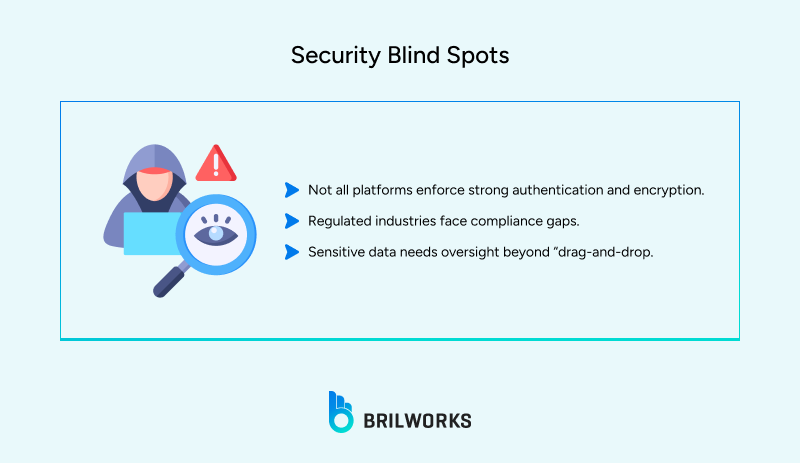
The simplicity of LC/NC can breed a false sense of security. This is a critical issue in cross-platform apps on low-code platforms. In regulated sectors, the platform must meet protocols mandated by HIPAA or GDPR. The visual development environment often obscures many security layers, making it easy for non-technical users to overlook essential controls.
In essence, the ease of building can create a hidden security debt. For bespoke, mission-critical solutions like AI application development, security oversight must be paramount.
By investing in an LC/NC platform, a business trades portability for convenience. This dependency is a risk to long-term digital sovereignty. Should the vendor suddenly raise licensing fees, decommission a crucial service, or pivot their product strategy, the business is left with an application that cannot be easily moved.
Vendor lock-in is a concern for many businesses evaluating these tools, and for good reason. Extracting the application, code, data model, and logic to another platform is rarely straightforward. This creates a vulnerability, turning the application into a long-term hostage of the platform provider, which is a risk even when working with top white-label development companies if the underlying stack is proprietary.

The core genius of Low-Code is the abstraction of complexity. In simple terms, the platform hides the mechanics of the application. When a malfunction occurs, technical teams may feel blocked. The benefit turns into a restriction. And this could be the reason behind, 31% of enterprises using the tools have not used them in their highest-value applications.
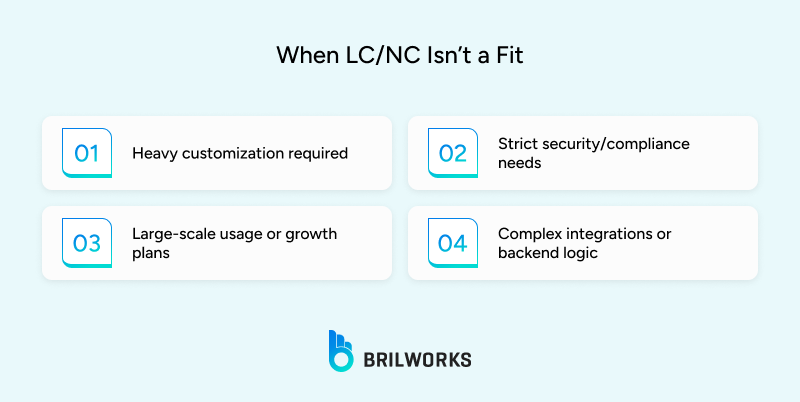
LC/NC platforms are masterful tools for specific, well-defined problems. They are good for rapid prototyping. You can use them to build utility apps and routine business processes. But they are not a universal replacement for custom software engineering.
The clear signal to avoid them is when the project's success hinges on extreme customization. If you are building apps for regulated industries, avoid using them. Or take the hybrid approach combining custom and LCNC development.
Get In Touch
Contact us for your software development requirements
Get In Touch
Contact us for your software development requirements

Hello, we are BRILLIAN’S. Trying to make an effort to put the right people for you to get the best results. Just insight !

 503, Fortune Business Hub, Science City Road, Sola, Ahmedabad, Gujarat, India Pincode- 380060

 + 91 9313644148
 sales@brilworks.com


