Last updated May 19, 2026
Why ReactJS is the Top Choice for Web Development

7 mins read
Summarize with AI:


Data
AI
The Stack Underneath

Enterprise applications aren't developed with end-users in mind. They're usually built to improve business operations, give decision-makers visibility, or bring structure to scattered operations.
Since its release in 2013, React has quietly become the default answer for teams building serious web products. Not because of marketing. Because the component-based model it ships with maps almost perfectly to how B2B software actually needs to be built, layered, role-specific, and fast to update without breaking everything else.
That architecture is why React is a go-to framework for enterprise teams in 2025, not just startups moving fast. What makes it work for enterprise-grade B2B apps specifically is how it handles routing, layered interfaces, and rendering under real load, the three things that quietly break most business-facing UIs at scale.
As you know, business-facing application UI needs to be predictable and render ultra-fast. React ships a multitude of features, saving a lot of time for web engineers.
You don't need to build a form handler or routing logic from scratch; it's already there. You can skip basic feature writing and even build in a few hours by using standard UI templates. What's more, React's modular architecture separates logic and UI, state management, and many other components into reusable pieces.
It means if you have built one feature, you will not need to create it again. From a company owner's perspective, multiple teams can work on a single project to build different layers.
The hiring of web developers also gets easier. It's JavaScript. Millions of developers already know it, and the number of companies with production experience in React continues to grow.
A SaaS product is only as good as the team that builds it. If you're planning a React build or rebuild and want a team that has shipped it before, let's talk.
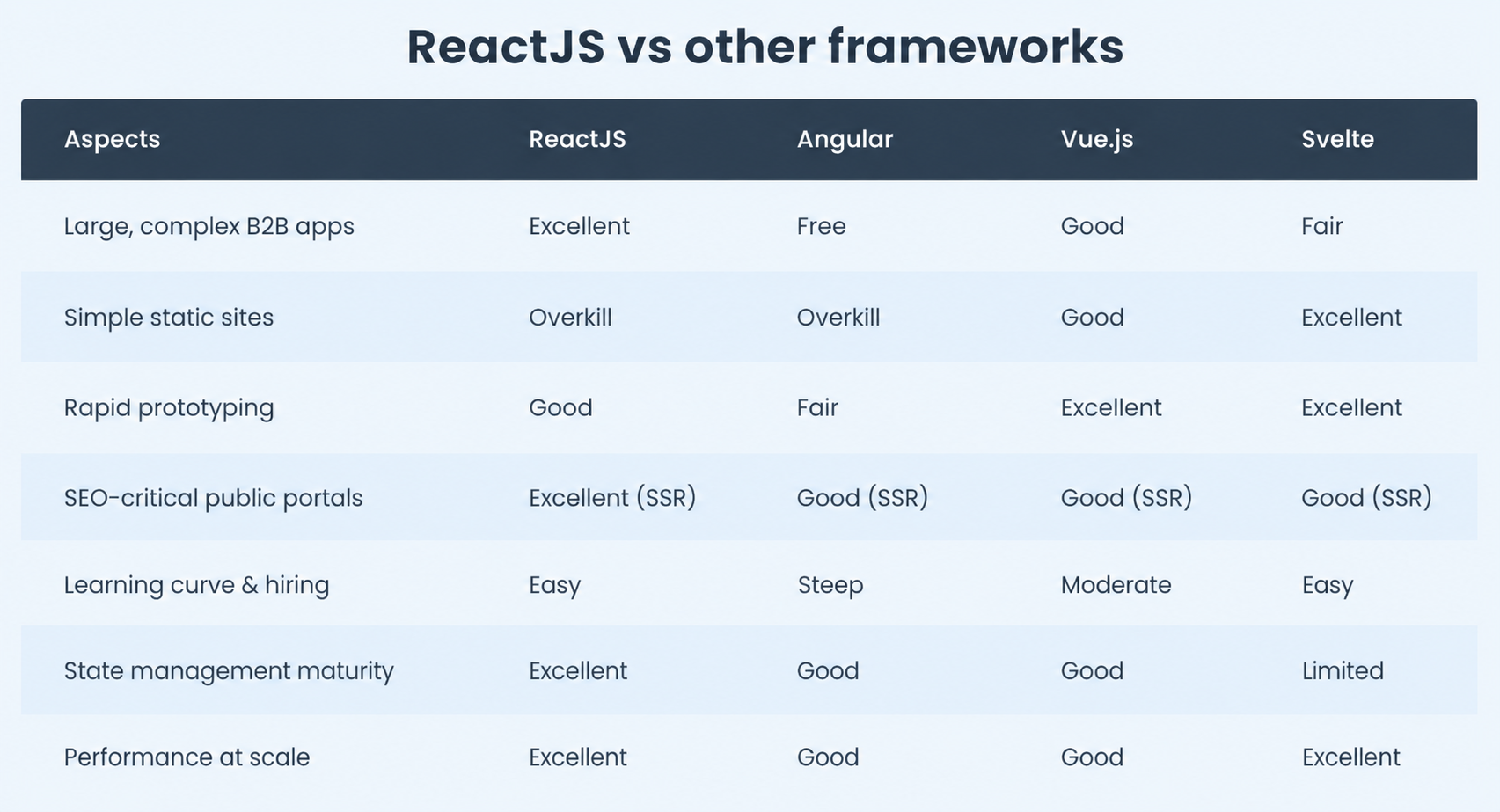
You can pair React js with whatever routing, state management, or build tools. Vue and Solid are similar in terms of flexibility. The difference is that React's ecosystem has matured around this flexibility, with a large number of third-party tools and patterns that support it.
Vue, Svelte, Angular, and even newer entrants like Qwik all use component-based models. React js is popular not only for component-based architecture but also for how early and thoroughly it internalized this model.
React's community is huge, and Meta's continued backing gives it long-term credibility. That said, Angular has Google, and Vue has strong community stewardship. The combination of corporate support and a large, active community gives React both long-term stability and rapid innovation, so you get the best of both worlds: reliable foundations and cutting-edge tooling.
React is JavaScript. Not a proprietary language, not a framework that requires six weeks of onboarding before a new developer touches production code. Most frontend developers already know it or can get productive on it fast. Angular has a steeper curve — decorators, dependency injection, RxJS, which shows up in hiring costs and onboarding time. For B2B teams that need to scale their engineering without rebuilding their hiring process, that gap matters.
State management is where B2B apps get complicated fast. Multi-role dashboards, real-time data, nested permissions, all of it lives in state. React has Redux, Zustand, Jotai, Context API. The ecosystem has been stress-tested on production apps with millions of users. Vue has Pinia, which is solid. Svelte's built-in store works until it doesn't. React is the only one where you can find a proven pattern for almost any state problem you'll run into in a B2B context.
Svelte compiles away the framework at build time, which gives it an edge on raw performance for simpler interfaces. React closes that gap fast once you're dealing with the kind of interfaces B2B products actually ship, thousands of rows, real-time updates, role-based rendering. Virtual DOM diffing, memoization, lazy loading, React has the tooling to handle scale. Svelte, for all its speed, doesn't have the same answers when complexity grows.
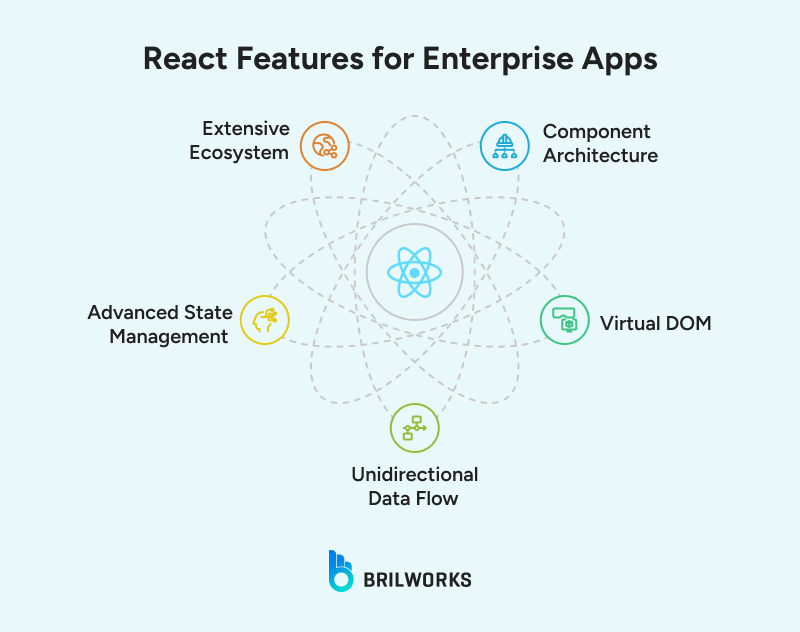
In React, every UI element is a self-contained block. It has its own logic, its own state, its own rendering rules. That isolation is not just a technical nicety, it changes how teams actually work.
In practice, this means:
Vue's single-file component syntax and Angular's all-in-one structure are real alternatives for teams that value convention. But for enterprise products where five teams might be shipping against the same deadline, React's composability wins.
2. Virtual DOM
React keeps a lightweight copy of the UI tree in memory. When something changes, it diffs that copy against the real DOM and updates only what needs updating. Not the whole page. Not the whole component tree. Just the part that changed.
For B2B interfaces this matters more than most people realise. A dashboard with thousands of rows, live data feeds, and nested filters is making hundreds of update decisions per second. Repainting the entire UI for each one is expensive. React skips that cost. The result is an interface that stays fast under the kind of load enterprise products actually face.
3. Unidirectional Data Flow
Data in React moves in one direction. Parent components pass it down via props. Children signal changes back up via callbacks. That's it.
It sounds restrictive. It isn't. When something breaks in a B2B app with fifty components, knowing exactly which direction data travels cuts debugging time significantly. You're not chasing state across a two-way binding system. You follow the props down and the callbacks up. The bug is usually obvious once you know where to look.
4. State Management
Complex B2B products live and die by how well they handle state. Multi-role permissions, real-time data, nested UI conditions — all of it needs to be managed somewhere. React gives you options at every scale:
The honest answer is that no other framework has this many battle-tested state management options with this much production evidence behind them. That breadth matters when your requirements change six months after launch. They always do.
5. Extensive Ecosystem
The 2024 State of JavaScript survey found React still at the top alongside Vue and Angular, each over a decade old. Longevity in frontend frameworks is rare. It usually means the ecosystem around the framework has compounded into something genuinely hard to replace.
For B2B products specifically, that ecosystem does real work:
None of these are React-exclusive. Some have Vue or Angular equivalents. But the depth of documentation, community answers, and production usage behind the React versions of these tools is not matched elsewhere. When your team hits a wall at 11pm before a release, that depth is what saves you.
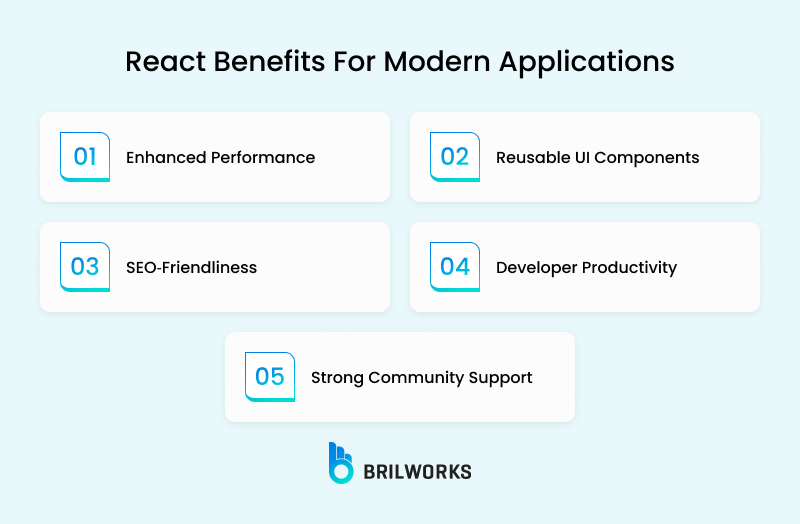
React delivers a smooth experience even when users sift through thousands of records. Its virtual DOM ensures only the parts of a page that change are re‑rendered, so actions like sorting or filtering large data sets feel instantaneous.
That speed translates directly into fewer delays for sales reps or account teams, boosting their output and cutting down on frustration. In one B2B CRM, switching to React cut the average page load by nearly half, helping reps handle more calls and close deals faster.
Building once and using it everywhere drives both consistency and cost savings. When your team develops a data table or a user‑management panel as a standalone component, it slots into every module without extra work.
That reuse means fewer hours spent on repetitive coding and fewer visual hiccups for end users. Over time, a curated library of components becomes your brand's single source of truth, so every portal, report, or dashboard feels familiar from day one.
Modern React frameworks solve the old problem of search engines missing content hidden behind client‑side code. Server‑side rendering serves up complete page markup so crawlers index all your partner portal or documentation pages right away.
Tools like Next.js offer this out of the box, letting your marketing or partner‑success teams publish updates that show up in search without extra configuration. The result: better visibility for public B2B resources and more inbound interest from potential collaborators.
Finding a React developer is not a sourcing problem. It's a filtering problem. The pool is that large. Most frontend developers have shipped something in React before they walk into an interview, which means onboarding is weeks, not months. Hot reloading cuts the feedback loop on UI changes to seconds. Testing utilities are built in.
The practical result: fewer delays between sprints, fewer defects slipping into production, and a team that doesn't grind to a halt when someone quits. Hire React developers and you're not training people from scratch. You're directing people who already know the tool.
Meta funds React's core team. But that's not why the framework stays healthy. It stays healthy because hundreds of thousands of developers are running it in production and have every incentive to catch what breaks before you do.
Security patches don't wait for a quarterly release cycle. Performance improvements show up because someone at a company with millions of users filed an issue and fixed it. When your team hits a wall, the answer is usually already out there, a GitHub thread, a library, a documented workaround from someone who hit the same wall two years ago. That's not a marketing claim. That's just what a decade of widespread adoption looks like.
React is not the answer to every brief. We'd rather say that plainly than let you find out six months into a build.
If the site is five pages, a contact form, and a blog, React is the wrong tool. The bundle size alone is overkill for a brochure site. Svelte or plain HTML ships faster, loads faster, and costs less to maintain. Reaching for React here is not a technical decision. It's a habit. A bad one.
Low-powered IoT devices, ultra-fast microsites, anything where every kilobyte is a real cost, React's runtime becomes a liability. Svelte compiles away the framework entirely at build time. Plain HTML/CSS has no runtime at all. If first-byte and first-paint times are the primary constraint, React will not win that race.
A team that has shipped five Angular apps in the last two years will outperform a React team with half the experience. Every time. The framework matters less than the depth of knowledge behind it. Retraining takes time you probably don't have, and hiring specifically for React when your team already knows Angular rarely pays back in the first year.
Bridging React with older server-side platforms or proprietary UI toolkits is possible. It's also expensive and slow. The integration overhead often cancels out whatever React brings to the table. If the system you're connecting to has its own UI conventions baked in, those conventions usually win — and fighting them with React adds complexity without adding value.

React looks good in benchmarks. It looks better when you're staring at a production system that hasn't gone down in six months.
One project that shows this clearly is a CRM we built for Green Home Consulting, an energy auditing firm juggling administrators, managers, field auditors, contractors, and service organizers across a single workflow. Before we got involved, their scheduling was manual, documentation was error-prone, and invoices ran late consistently. The kind of operational drag that compounds quietly until it becomes a real problem.
We chose React.js for the frontend because the interface had to serve five different user types without becoming a navigation mess. React's component model let us build role-specific views from shared logic. One codebase, no duplication, every stakeholder sees exactly what they need.
Here's what we shipped and what came out of it:
That uptime number matters more in B2B than most people acknowledge. A missed audit or a delayed invoice in field operations is not a UX complaint. It costs money and erodes trust with the end client. React's component isolation is what made reliable updates possible.
Read the full case study here.
When you choose a ReactJS partner, you're not just outsourcing code; you're investing in years of hard‑won expertise. At Brilworks, we've guided dozens of B2B teams past the usual pitfalls of component design, performance tuning, and long‑term maintainability.
We know that the best collaboration feels less like vendor management and more like an extension of your own team.
That's why we take the time to understand your unique challenges, whether it's integrating with legacy systems, optimizing server‑side rendering for SEO, or building out a custom design system that reflects your brand. By partnering early and often, we ensure each sprint delivers value and keeps your roadmap on track.
Ready to turn ReactJS into a true competitive advantage? Hire dedicated React experts or a team to build your next application.
ReactJS is a popular framework for modern web development because it offers a component-based architecture, fast rendering via the Virtual DOM, and a rich ecosystem of tools and libraries. Its flexibility and strong community support make it ideal for building scalable enterprise and B2B applications.
ReactJS helps enterprise applications by enabling reusable UI components, improving performance with virtual DOM, supporting unidirectional data flow, and simplifying state management. Teams can collaborate more efficiently, build faster, and maintain consistency across complex applications, making React a top choice for large-scale web projects.
ReactJS, Angular, and Vue each have strengths. React excels in flexibility, reusable components, and a large developer community. Angular provides an all-in-one solution with strong structure, while Vue offers simplicity and ease of integration. For enterprise-grade modern web apps, React’s ecosystem and scalability often make it the preferred option.
For most SaaS products, yes. No framework has closed the gap on React's ecosystem maturity, hiring pool, or production track record at scale. The one exception worth noting: if your SaaS is heavily content-driven and SEO is the primary growth channel, the Next.js conversation becomes more important than the React one.
A focused rebuild typically runs with four people: a frontend engineer, a backend engineer, a tech lead, and a QA engineer. Multiple user roles, a custom design system, or complex integrations push that to six. Starting lean and scaling the team mid-build costs more in the long run than getting the team size right from day one.
You might also like

Hello, we are BRILLIAN’S. Trying to make an effort to put the right people for you to get the best results. Just insight !