Most B2B SaaS founders come in with a number in their head, and it's almost always wrong. Either undershooting because they're benchmarking against a weekend prototype, or overshooting because they Googled enterprise AI pricing. This piece is for the founder in the middle: running a real B2B SaaS product, ready to add a customer-facing AI agent inside it. Here's what that costs.
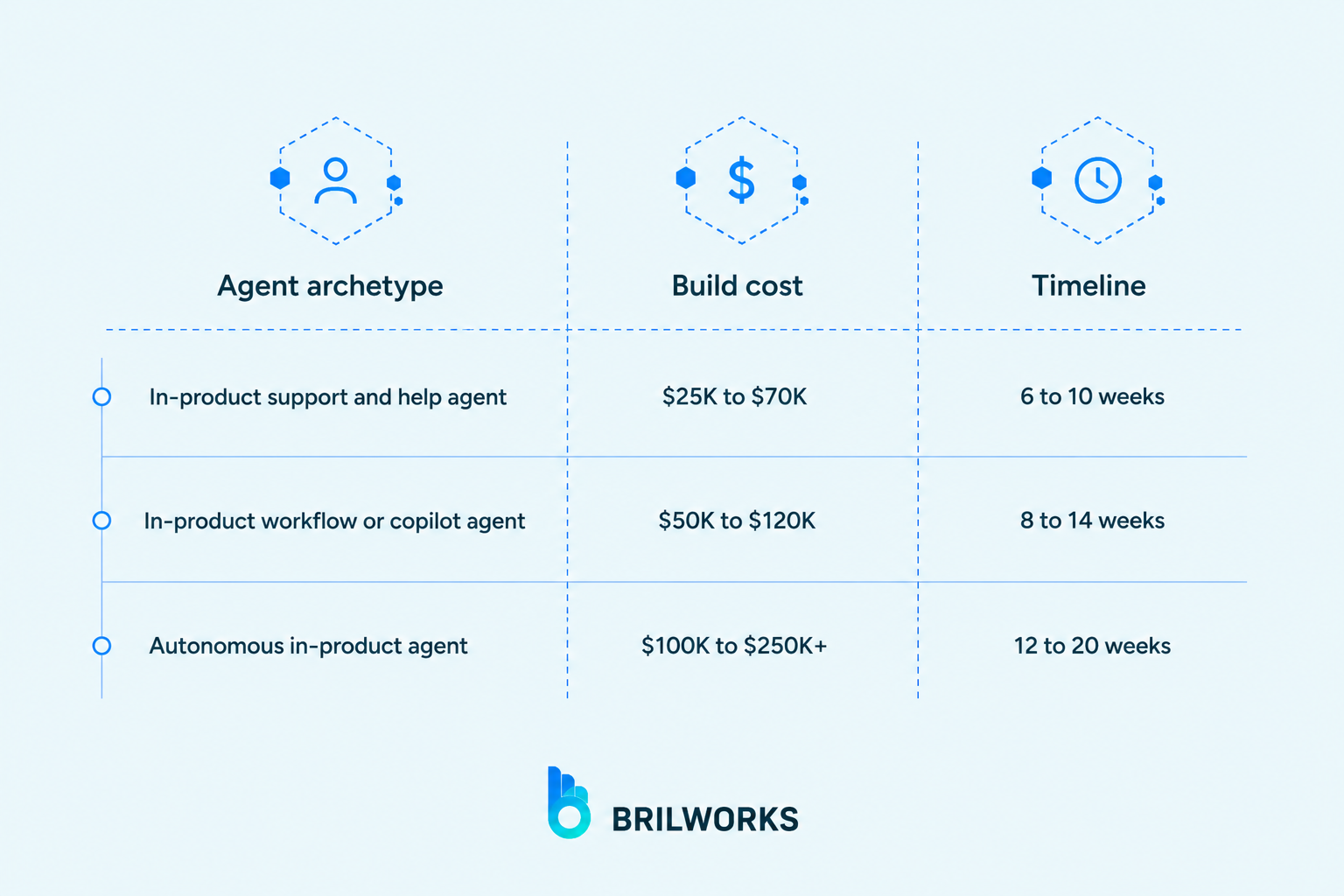
Build cost ranges for B2B SaaS AI agents
These are production-grade build costs. Single agent, customer-facing, reliable enough to ship to paying users.
What "AI agent development cost" actually includes
The numbers above cover seven components: discovery, architecture, core development, integrations, eval and testing, observability, and project management. Agencies that quote a flat number without breaking these down are usually skipping work that matters or moving it into a follow-on contract.
What's not included in the build cost
Three line items, all important. Token costs to the model provider, which scale with usage. Infrastructure costs for vector database, observability tooling, and eval platform. Maintenance, which runs 15 to 25% of build cost per year. Budget for the build alone and you've planned for roughly 60 to 70% of what you'll actually spend in year one.
Most cost articles on the SERP are written for "any business considering AI" — enterprise back-office tools, internal HR bots, healthcare agents, consumer chatbots, all in one piece. The ranges have to be wide enough to cover everything, so they end up at $10K to $500K and tell you nothing. The three archetypes below narrow the question to what B2B SaaS teams actually build. If you're scoping a broader AI feature set rather than a single agent, AI app development cost covers the wider context.
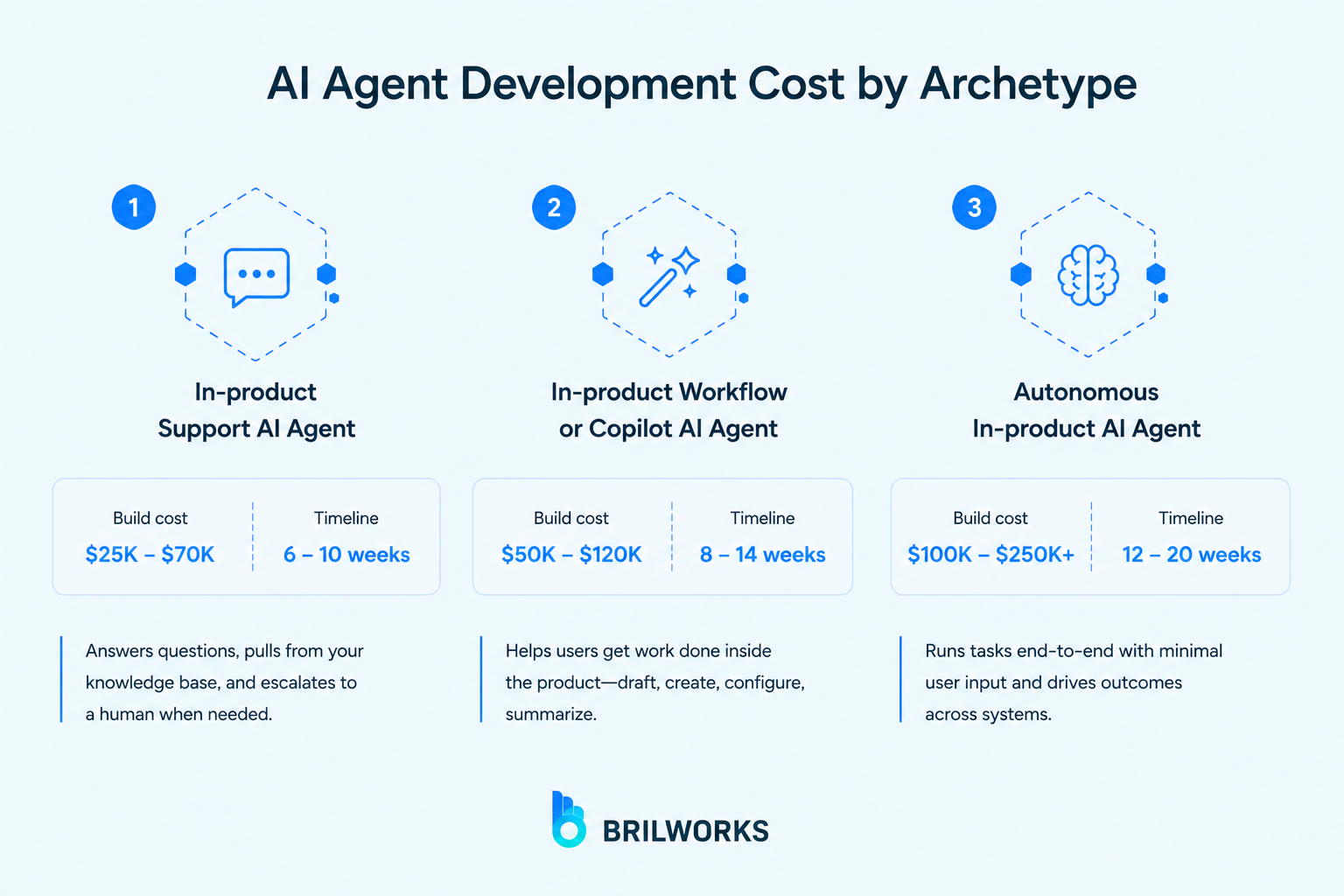
AI Agent Development Cost by Archetype
Cost to build an in-product support AI agent
Build cost: $25K to $70K. Timeline: 6 to 10 weeks.
The first AI feature most B2B SaaS teams ship. The agent sits inside the app, answers product questions, pulls from help docs and knowledge base, and escalates to a human when stuck. Think Intercom's Fin or Drift's AI assistant.
Cost moves toward the low end when the knowledge base is one clean source, integration is light, and escalation to humans is acceptable. Cost moves toward the high end with multiple knowledge sources, the agent needing to take actions inside the product, deep integration with user state, multi-language support, or tight latency requirements.
Cost to build an in-product workflow or copilot AI agent
Build cost: $50K to $120K. Timeline: 8 to 14 weeks.
The second AI feature, usually 6 to 12 months after the support agent. The copilot doesn't answer questions. It helps users do something inside the product: draft emails, write reports, configure workflows, summarize data.
Cost moves toward the low end when the copilot helps with one well-scoped task, works with a defined data shape, and users approve outputs before they ship. Cost moves toward the high end when the copilot spans multiple product surfaces, integrates with three or more data sources, or needs to maintain state across a session. The thing founders don't budget for is eval: a copilot doesn't have a clear definition of "right answer," and answering that question reliably can cost 20 to 30% of build on top.
Cost to build an autonomous in-product AI agent
Build cost: $100K to $250K+. Timeline: 12 to 20 weeks.
The archetype most teams are scoping rather than shipping. Runs tasks end-to-end with minimal user input. A customer onboarding agent that completes setup. A research agent that pulls data from five tools and writes a report.
Cost moves toward the low end with a narrow workflow, low downside from failure, and human review before anything ships externally. Cost moves toward the high end when the workflow spans systems you don't control, the agent makes consequential decisions, or reliability targets exceed 95% successful completion. Most B2B SaaS teams are better served shipping the support agent first and the copilot second before attempting this.
AI Agent Development Cost Breakdown by Component
The archetype ranges are the sum of seven components. Each has its own range and its own variance driver. If you're comparing proposals, this is the breakdown to ask for.
Component
Range
Main variance driver
Discovery and scoping
$3K to $10K
Stakeholder count, workflow documentation quality
Architecture and design
$4K to $15K
Stack complexity, compliance requirements
Core agent development
$10K to $80K+
Archetype, reasoning complexity
Tool and integration development
$5K to $30K+
Number of integrations, legacy API quirks
Eval and testing infrastructure
$5K to $30K+
Reliability target, output ambiguity
Observability and monitoring
$3K to $15K
Custom dashboards, audit requirements
Project management and QA
$5K to $20K
Engagement length, team size
A few notes on the components founders typically underbudget.
Eval infrastructure is the line item most agencies don't quote. For a support agent, basic eval works: a test suite of common questions with expected answer shapes. For a copilot or autonomous agent, eval becomes its own engineering project. Skipping it is how founders end up with an agent that quietly hallucinates for three months.
Observability is one of the cheapest things to do well and one of the most expensive to skip. An agent without observability isn't a product, it's a black box you can't debug.
The low ends sum to roughly $35K. The high ends sum to roughly $200K+. Those should look familiar from the archetype ranges. They're the same numbers sliced differently.
How Much Do AI Agents Cost to Run Per Month?
The build cost is the line item founders focus on. The run cost is the line item that surprises them in month three.
AI agent token costs with a worked example
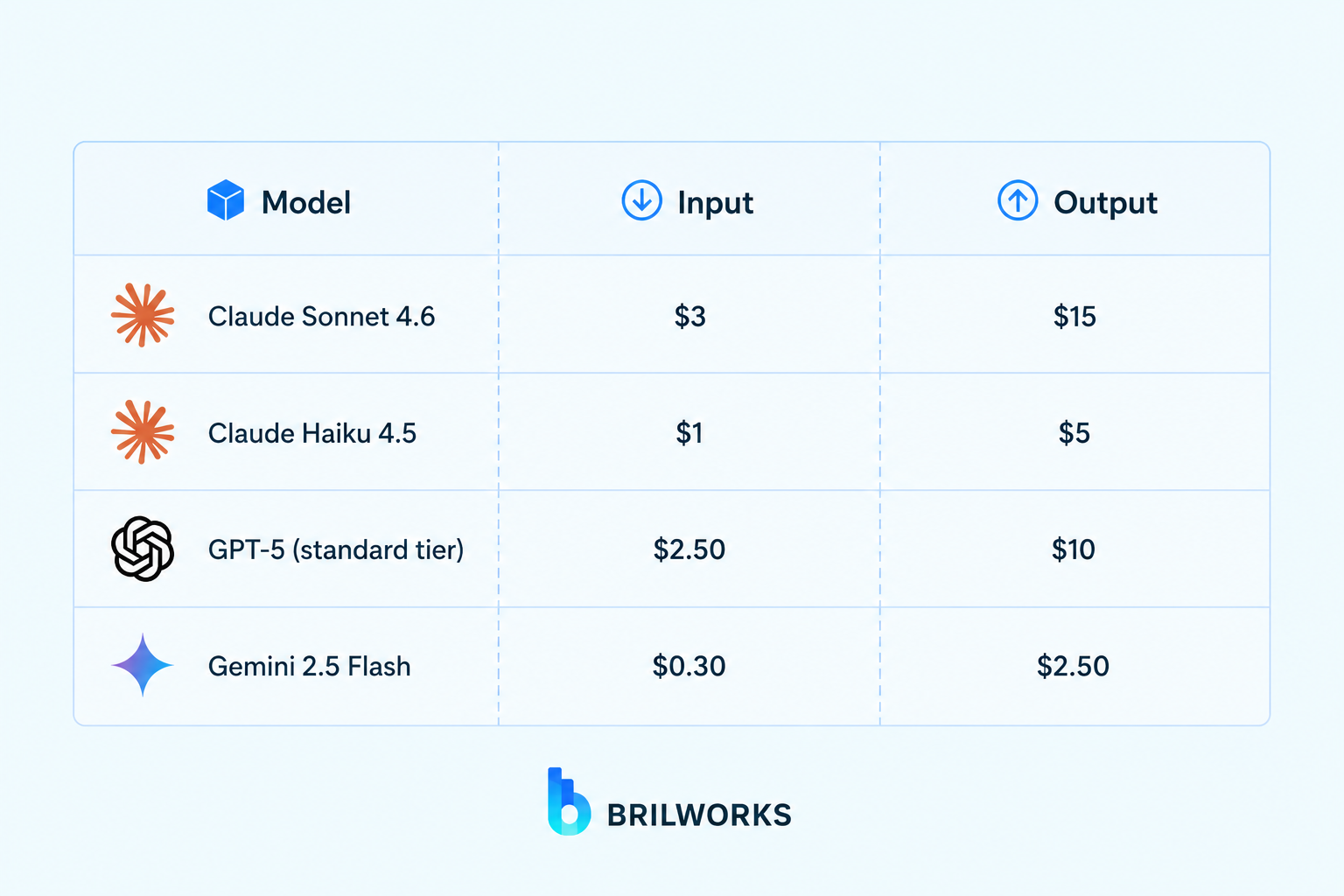
Token costs are what you pay model providers for every conversation. Output tokens cost 3 to 5 times more than input. Current per-million-token pricing for models most B2B SaaS teams use (verify on date of build, prices shift quarterly):
Worked example: A support agent, 10K monthly active users, 3 conversations per user, 8 turns each. With RAG retrieving help docs, that's roughly 15,000 input tokens and 2,000 output tokens per conversation. Monthly volume: 450M input tokens, 60M output tokens.
On Claude Sonnet 4.6: $2,250 per month
On Claude Haiku 4.5: $750 per month
On Gemini 2.5 Flash: $285 per month
Same agent, same traffic. Model choice swings monthly cost by almost 8x. Prompt caching, model routing, and tight context discipline can cut costs another 30 to 50%. A badly-tuned agent runs 2 to 3x more expensive than these numbers.
Infrastructure and maintenance costs
Three infrastructure line items matter. Vector database (Pinecone, Weaviate, or pgvector): $0 to $500+ per month. Observability tooling (LangSmith, Helicone, Langfuse): $0 to $300 per month. Eval and dataset tooling: $0 to $200 per month. Total infrastructure for a typical production AI agent runs $100 to $1,000 per month.
Maintenance covers model migrations (every 6 to 12 months when providers deprecate versions), prompt and RAG refinement, eval expansion, and standard dependency updates. Budget 15 to 25% of build cost per year. For a $50K support agent build, that's $7,500 to $12,500 annually. Founders who skip this end up with an agent that quietly degrades until users notice.
All-in monthly run rate for a typical B2B SaaS support agent on Claude Haiku 4.5 serving 10K MAU: $1,200 to $2,500.
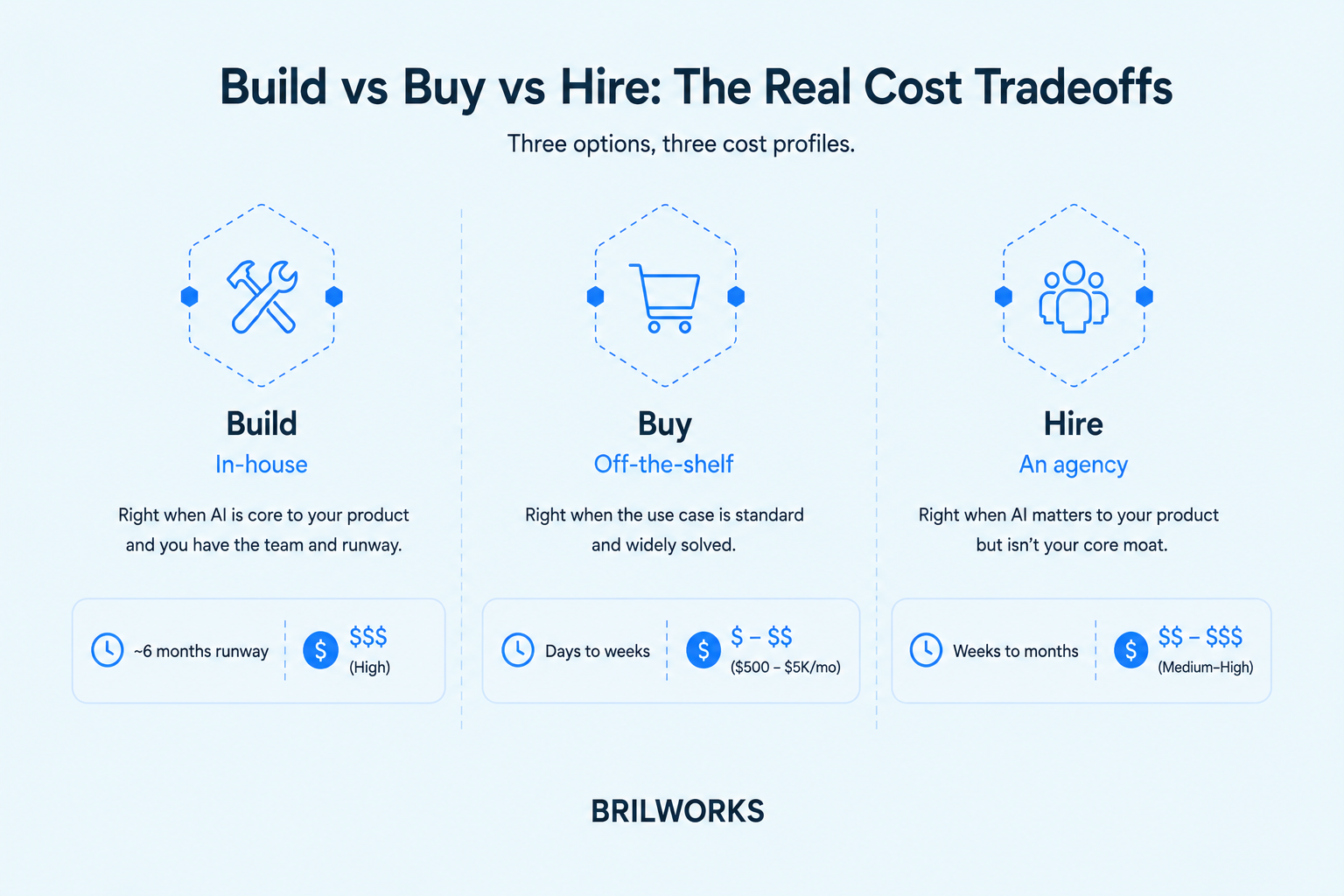
Build vs Buy vs Hire: The Real Cost Tradeoffs
Three options, three cost profiles.
Build in-house if AI is core to your product's differentiation, you already have engineers who've shipped production AI, and you can afford a six-month runway. Most B2B SaaS companies fail at least one of those three. The first one is the one founders lie to themselves about. Fully loaded in-house cost for a 6-month build lands in the same range as agency cost, but with hiring time, opportunity cost, and ongoing overhead added.
Buy off-the-shelf if the use case is standard. A generic support chatbot, an FAQ deflection layer. Intercom Fin, Drift AI, and similar tools give you a working agent for $500 to $5K per month with no engineering required. If buy is the path, choosing the right AI platform is the next decision. The buy option is underrated and most agencies won't tell you that. The signal it's not working: you're paying for the tool and also paying engineers to work around it.
Hire an agency if AI is important to your product but not your core moat, you don't have AI engineering in-house, and you need it shipped in months not quarters. This is the most common shape, which is why this market exists.
A Realistic Framework for Budgeting Your AI Agent Build
Pick the archetype that matches what you're building. Take the midpoint of the range as your starting build number. Add first-year ongoing costs ($15K to $50K for support or copilot agents). Add a 20 to 30% scope buffer on top.
For a typical B2B SaaS first AI feature, year-one all-in lands at $60K to $90K. For a second feature, $105K to $135K. Higher than that and you're scoping something bigger than a feature, which is a different conversation entirely.
The scope buffer is not optional. Every project we've shipped discovered scope it wasn't quoted for. Not because the original scope was wrong, but because production reality surfaces things discovery couldn't catch. Skip the buffer and you'll either pause the project mid-build to renegotiate, or ship a thinner agent than you wanted.
Final Thoughts on AI Agent Development Cost
AI agent development cost is a sum of components, not a single number. The seven components above are the bare minimum to ask about in any proposal. Ongoing costs are the part you'll forget until month three. The scope buffer is what separates projects that ship on schedule from projects that ship compromised.
The pattern we've seen: builds that worked had clear scope, real maintenance budgets, and founders who treated AI as ongoing operations rather than as a one-off project. The ones that struggled missed at least one of those three.
If you're scoping a build and want a structured second opinion before committing, Brilworks runs a 60-minute AI agent architecture review for B2B SaaS teams. Scope, archetype, integration surface, realistic budget. No contract pressure. Just a real conversation before money gets spent.
FAQ
For a B2B SaaS team adding a customer-facing AI agent, build cost lands between $25K and $250K depending on archetype. Support agents run $25K to $70K. Workflow copilots run $50K to $120K. Autonomous agents start at $100K. Monthly run costs add another $300 to $3,000 depending on traffic and model choice.
Building an AI agent from scratch includes seven cost components: discovery, architecture, core development, integrations, eval and testing, observability, and project management. For a production-grade B2B SaaS support agent, those add up to $25K to $70K. For a copilot, $50K to $120K. The biggest line item is usually core development. The most underbudgeted is eval infrastructure.
Monthly run cost has three parts: token costs (scaling with conversation volume and model), infrastructure ($100 to $1,000 per month at SMB scale), and maintenance (15 to 25% of build cost annually). A support agent serving 10K MAU on a lightweight model runs $1,200 to $2,500 per month all-in.
The cheapest working AI agent is an off-the-shelf tool like Intercom Fin or Drift AI, $500 to $5K per month, no engineering required. The cheapest custom build is a bounded support agent on a lightweight model, single knowledge source, no complex integrations, around $25K. Anything cheaper is either a prototype or a wrapper that won't survive contact with real users.
Vikas, the visionary CTO at Brilworks, is passionate about sharing tech insights, trends, and innovations. He helps businesses—big and small—improve with smart, data-driven ideas.