COOPERATION MODEL
ARTIFICIAL INTELLIGENCE
PRODUCT ENGINEERING
DevOps & Cloud
LOW-CODE/NO-CODE DEVELOPMENT
INDUSTRY
FRONTEND DEVELOPMENT
CLOUD DEVELOPMENT
MOBILE APP DEVELOPMENT
LOW CODE/ NO CODE DEVELOPMENT
EMERGING TECHNOLOGIES



 6 mins read
 Last updated February 25, 2026
Moving to the cloud involves more than lifting servers and dropping them into AWS. It requires alignment across technology, people, and business goals, which is exactly what the AWS Cloud Adoption Framework provides. AWS designed this framework to give organizations a structured approach to planning, executing, and optimizing their cloud journey, whether they're migrating legacy systems or building cloud-native applications from scratch.
At Brilworks, we've guided dozens of companies through cloud transformations using AWS infrastructure, and the CAF consistently serves as the foundation for successful migrations. It breaks down the complexity of adoption into manageable perspectives and actionable guidance.
This article walks you through the six CAF perspectives, the four transformation phases, and practical ways to apply the framework within your organization. By the end, you'll have a clear roadmap for structuring your cloud adoption strategy and avoiding common pitfalls that derail migrations.
You can't execute a successful cloud migration by throwing engineers at AWS services and hoping things work out. Without a structured framework, cloud initiatives fragment across departments, create security gaps, and burn budgets on redundant efforts. The AWS Cloud Adoption Framework solves this by providing a common language and organizational structure that aligns your technical teams, business leaders, and security stakeholders around shared goals.
Most organizations approach cloud adoption with technical tunnel vision. They focus exclusively on which EC2 instances to spin up or how to configure S3 buckets, completely ignoring the people, process, and governance changes required to support those technical decisions. This creates situations where your infrastructure team deploys cloud resources faster than your security team can audit them, or where business units purchase SaaS solutions that duplicate functionality already available in your AWS environment.
The framework addresses this problem by forcing you to think across six distinct perspectives simultaneously. You can't simply migrate a database without considering who will manage it long-term, how you'll govern access to it, what compliance requirements it must meet, and how it supports specific business outcomes. This holistic approach prevents the siloed thinking that typically derails cloud projects.
AWS CAF ensures that technical migration activities stay synchronized with organizational readiness and business transformation goals.
Your cloud migration will fail if your operations team doesn't understand the new deployment model while your developers push code to production. The aws cloud adoption framework creates clear ownership assignments across every capability your organization needs, from platform engineering to cloud financial management. Instead of everyone pointing fingers when something breaks, you know exactly which team owns each piece of the puzzle.
Organizations using the framework report 30 to 50 percent faster migration timelines because they identify capability gaps early, before those gaps cause project delays. If your security team lacks cloud expertise, you discover that during the planning phase when you can hire specialists or contract partners, not three months into a migration when you're already behind schedule.
Cloud migrations without frameworks typically suffer from scope creep, cost overruns, and security incidents. You start by migrating one application and suddenly discover you need to rebuild your entire identity management system, retrain your operations team, and renegotiate vendor contracts. The CAF helps you surface these dependencies upfront through its structured assessment process.
Beyond risk reduction, the framework accelerates your ability to extract business value from cloud investments. You don't waste six months building a perfect landing zone only to realize your developers need different access patterns. The phased transformation approach built into CAF ensures you're delivering measurable business outcomes throughout your journey, not just at the end. This maintains executive support and justifies continued investment in cloud initiatives when stakeholders see concrete results quarter over quarter.
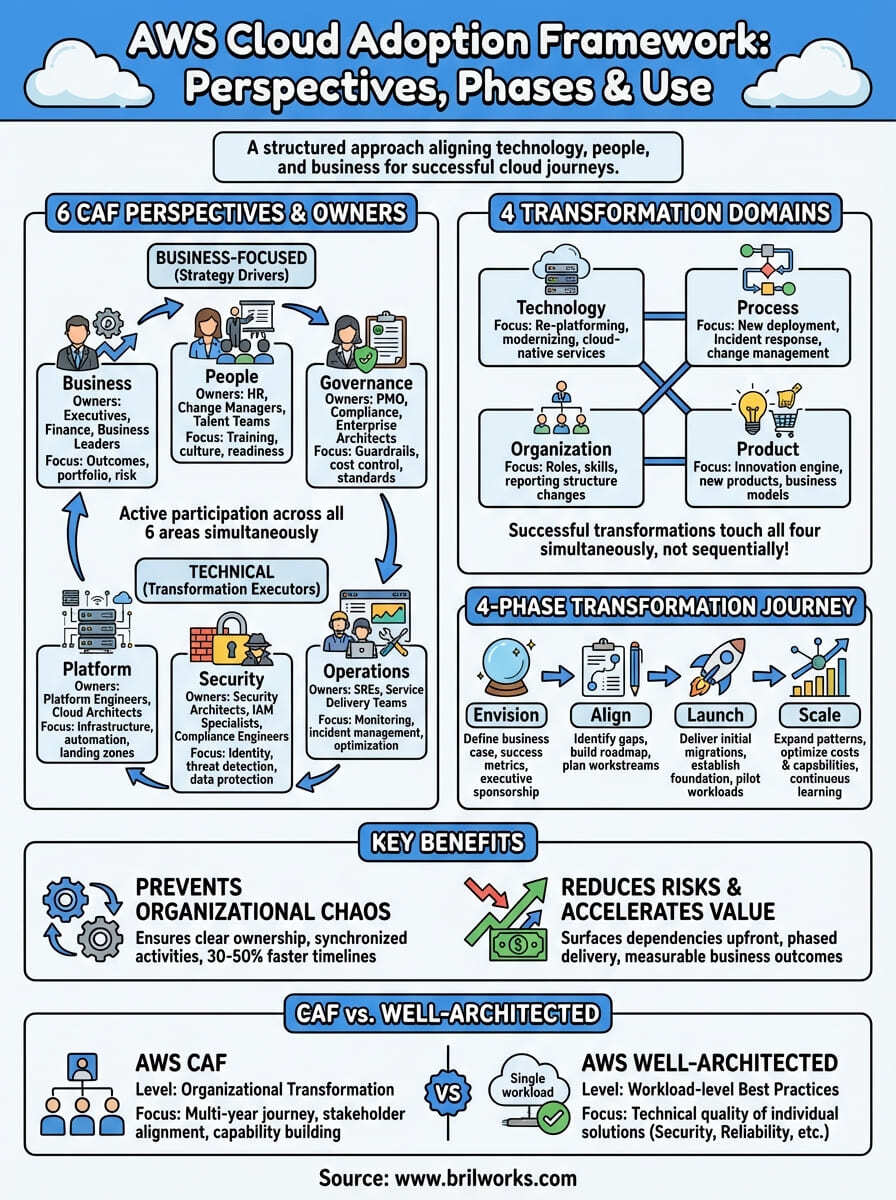
The aws cloud adoption framework divides organizational capabilities into six distinct perspectives, each representing a specific stakeholder group with unique responsibilities during cloud transformation. These perspectives ensure every critical function gets represented in your migration planning, from executive strategy to daily operations. You don't pick and choose which perspectives to address; successful cloud adoption requires active participation across all six areas simultaneously.
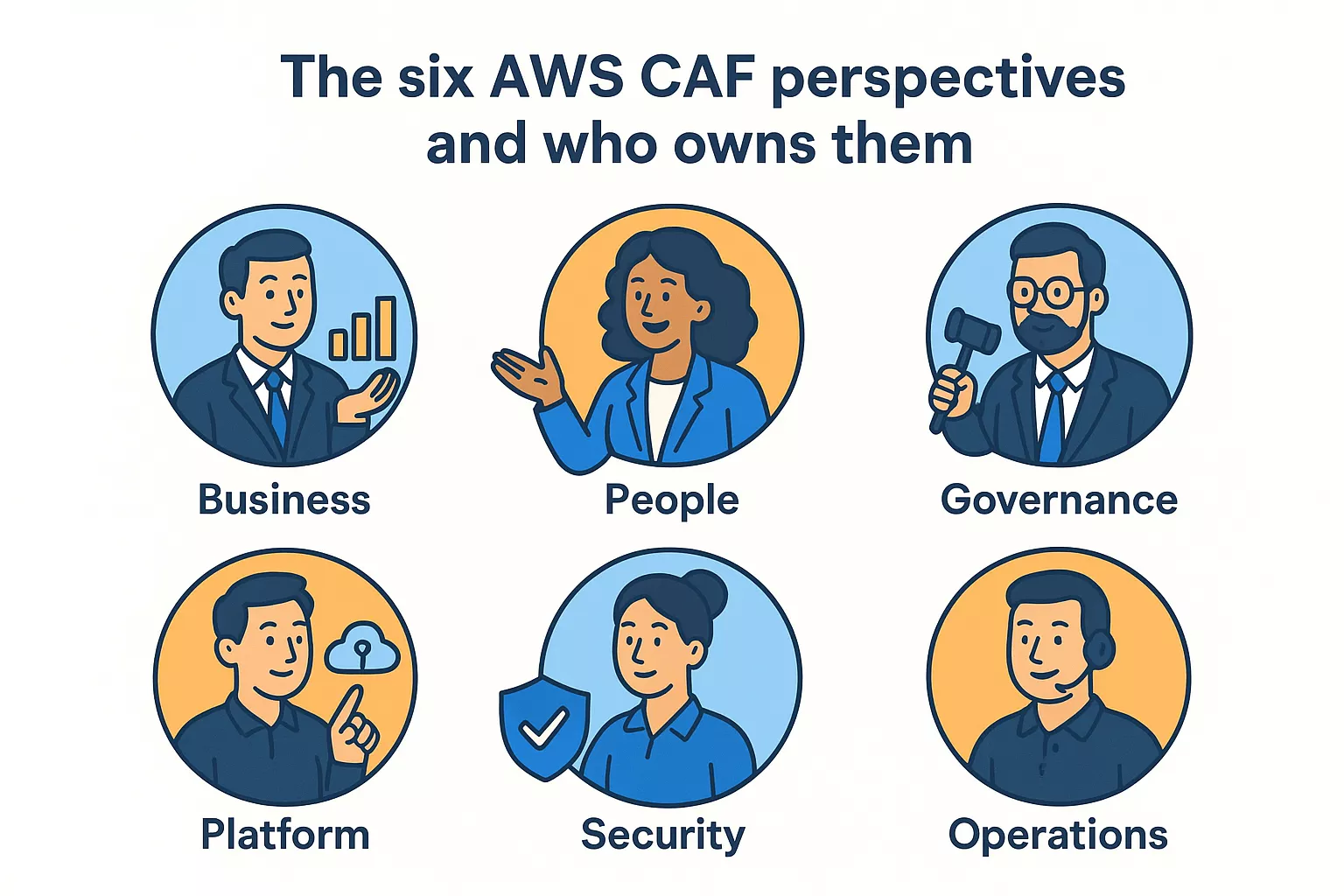
The Business Perspective belongs to your executives, finance teams, and business unit leaders who define how cloud investments deliver measurable outcomes. They own capabilities like business case development, portfolio management, and strategic risk assessment. These stakeholders ensure your cloud spending aligns with revenue goals and competitive positioning, not just IT modernization for its own sake.
Your People Perspective sits with HR leaders, organizational change managers, and talent development teams who prepare your workforce for cloud operations. They manage training programs, career development paths, and the cultural shifts required when moving from traditional IT to cloud-native ways of working. Without this perspective actively engaged, you'll migrate infrastructure while your teams still operate like they're managing on-premises data centers.
The Governance Perspective falls to your PMO, compliance officers, and enterprise architects who establish guardrails for cloud usage. They build frameworks for cost control, ensure regulatory compliance, and create standards that prevent every team from building their own version of the same service.
Strong governance prevents cloud sprawl while maintaining the agility that makes cloud valuable in the first place.
Platform engineers and cloud architects own the Platform Perspective, which covers your core infrastructure capabilities like compute, storage, networking, and deployment automation. They design landing zones, establish connectivity patterns, and build the foundational services other teams consume.
Your Security Perspective belongs to security architects, IAM specialists, and compliance engineers who protect cloud workloads and data. They implement identity management, threat detection, and incident response capabilities specific to cloud environments.
Finally, the Operations Perspective sits with site reliability engineers and service delivery teams who run production workloads day to day. They handle monitoring, incident management, and the continuous optimization required to maintain performance and cost efficiency post-migration.
The aws cloud adoption framework organizes your migration work into four transformation domains that represent the fundamental areas where change must occur. These domains ensure you're transforming your organization holistically rather than treating cloud as purely an infrastructure project. Each domain requires specific capabilities from multiple perspectives working together, and neglecting any single domain creates bottlenecks that slow your entire transformation.
Your Technology domain covers the technical migration of applications, data, and infrastructure to cloud platforms. This includes re-platforming legacy systems, modernizing application architectures, and implementing cloud-native services. Most organizations naturally focus here first because technology changes feel tangible and measurable.
The Process domain addresses how you operate and deliver value after migration. You need new deployment processes for continuous integration, different incident response procedures for distributed systems, and updated change management workflows that match cloud velocity. Your existing ITIL processes won't translate directly to cloud operations without significant modification.
Your Organization domain handles structural changes in roles, responsibilities, and team composition. Cloud expertise requires different skill sets than traditional IT, which means rethinking job descriptions, hiring priorities, and reporting structures to support cloud-native operations effectively.
Finally, the Product domain focuses on how you create and deliver customer value using cloud capabilities. This transforms your relationship with technology from viewing it as a cost center to treating it as an innovation engine that enables new products and business models.
Successful cloud transformations touch all four domains simultaneously rather than treating them as sequential phases.
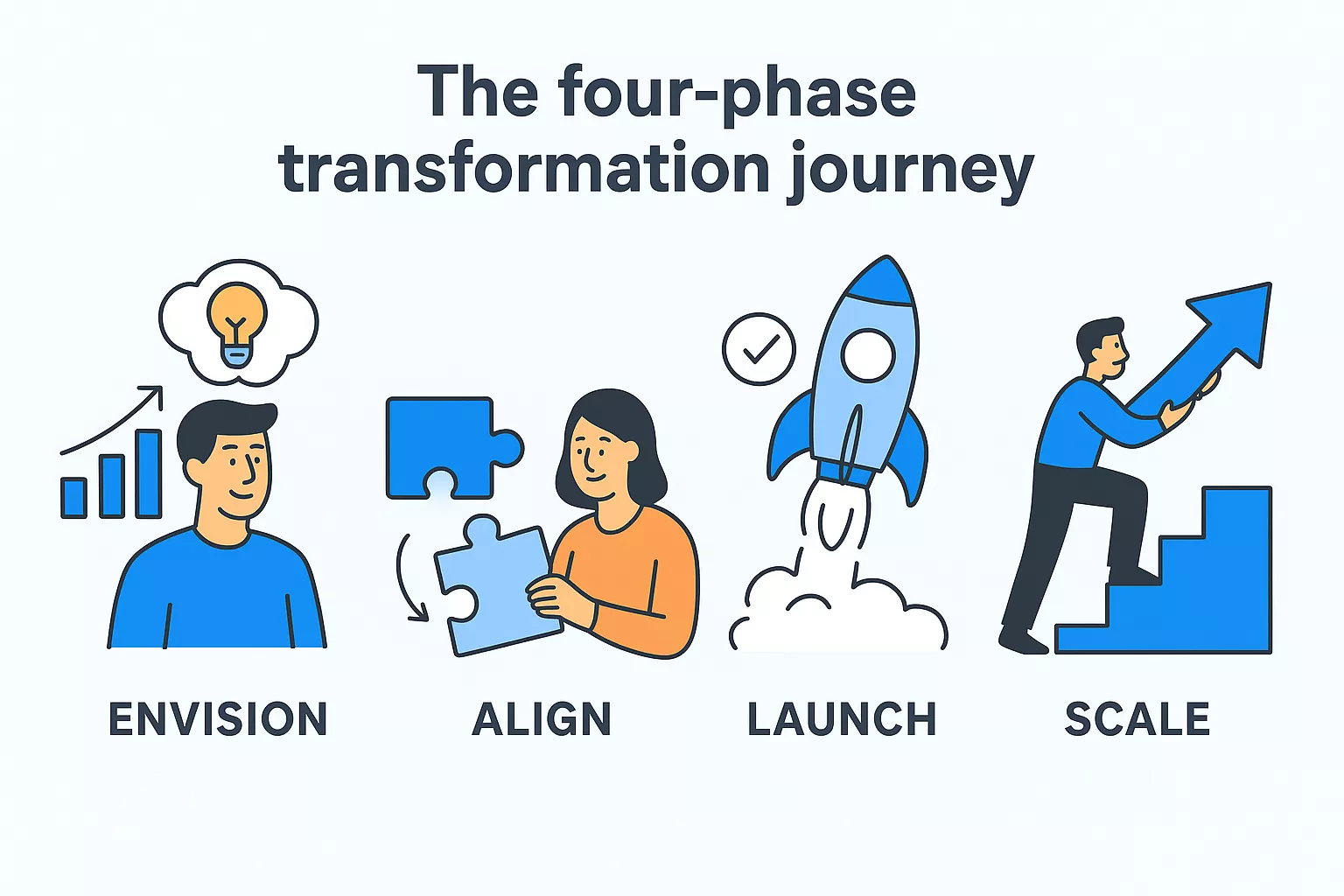
AWS structures cloud adoption into four distinct phases that build on each other progressively. The Envision phase creates your initial business case and identifies specific outcomes you'll achieve through cloud adoption. You define success metrics and secure executive sponsorship during this phase.
During the Align phase, you identify capability gaps across all six perspectives and build plans to close them. This phase creates your transformation roadmap with specific workstreams, timelines, and resource requirements.
The Launch phase delivers your initial migrations and proves your operating model works at production scale. You implement governance controls and establish the foundation for ongoing operations through pilot workloads.
Finally, the Scale phase expands successful patterns across your entire portfolio while continuously optimizing costs and capabilities based on operational learnings.
Applying the aws cloud adoption framework starts with honest assessment rather than jumping directly into migration planning. You need to understand where your organization stands today across all six perspectives before building roadmaps or setting timelines. Most companies skip this assessment phase and discover critical gaps only after expensive migration failures, which forces them to backtrack and rebuild foundational capabilities they should have addressed upfront.
Your first action involves evaluating your current state across every CAF capability using AWS's assessment tools or working with experienced partners. You score each capability on a maturity scale from absent to optimized, which reveals specific gaps blocking your transformation goals. This assessment shows you exactly where investment is needed, whether that's security automation, cloud financial management training, or governance frameworks.
Assessment results guide your prioritization decisions by highlighting high-impact capability gaps that would otherwise derail migrations. If your operations team lacks monitoring expertise for distributed systems, you address that before moving production workloads to the cloud.
Based on assessment findings, you construct a phased roadmap that sequences capability building alongside technical migration activities. Your roadmap identifies quick wins that demonstrate value early while establishing long-term programs for cultural transformation and skill development. This prevents the common mistake of creating purely technical migration plans that ignore organizational readiness.
Effective roadmaps assign clear ownership for each workstream across the six perspectives and define measurable milestones tied to business outcomes rather than infrastructure metrics alone. You track progress against capability maturity improvements and business value delivery simultaneously.
Your roadmap must balance technical migration velocity with organizational capacity to absorb change and operate new cloud environments effectively.
You implement your roadmap through short iteration cycles that deliver working capabilities every few weeks rather than waiting months for complete transformations. Each iteration includes pilot migrations, capability deployments, and feedback loops that validate your approach works before scaling it broadly. This iterative method allows you to adjust based on real operational experience instead of theoretical plans.
Continuous measurement against your original success criteria keeps transformations focused on business outcomes rather than technology deployment for its own sake. You refine processes, upskill teams, and optimize costs based on production learnings from each iteration.
Organizations frequently confuse the aws cloud adoption framework with migration tools or technical blueprints when it actually functions as an organizational transformation methodology. This confusion leads teams to download CAF documents, skim through capabilities, and then continue their migrations using the same broken processes that caused problems in their on-premises environments. You need to treat CAF as a strategic framework that changes how your entire organization operates, not as a checklist you complete once and forget.
The most common failure happens when organizations assign CAF implementation to a single team or individual instead of engaging stakeholders across all six perspectives. Your cloud architect cannot successfully drive business, people, and governance transformations alone, regardless of their technical expertise. Each perspective requires active ownership from appropriate leaders who have authority to make decisions and allocate resources within their domains.
Another critical mistake involves treating capability assessments as paperwork exercises rather than honest evaluations of organizational readiness. Teams inflate their maturity scores to look better on reports, which creates false confidence and hides gaps that later cause migration failures. Assessment results should drive investment decisions and training programs, not performance reviews.
Accurate capability assessments reveal uncomfortable truths about readiness gaps, but those insights prevent expensive failures during actual migrations.
Many organizations struggle to understand how CAF relates to the AWS Well-Architected Framework, which covers operational excellence, security, reliability, performance efficiency, cost optimization, and sustainability pillars. CAF operates at the organizational transformation level and helps you build capabilities needed for successful cloud adoption across your entire enterprise. Well-Architected functions at the workload level, providing technical best practices for designing individual applications and systems.
You use CAF to structure your multi-year cloud adoption journey and align stakeholders around shared transformation goals. Well-Architected reviews help you validate that specific workloads follow AWS best practices before and after migration. Think of CAF as your strategic roadmap for organizational change and Well-Architected as your technical quality framework for individual solutions.
The aws cloud adoption framework transforms chaotic cloud migrations into structured organizational changes that deliver measurable business value. You've learned how the six perspectives ensure every stakeholder group participates in your transformation, from executives defining business outcomes to engineers building secure infrastructure. The four-phase approach gives you a clear progression path from initial planning through scaled operations, while the transformation domains prevent you from treating cloud as a purely technical project.
Success requires honest capability assessments that reveal readiness gaps before they derail production migrations. You can't skip perspectives or rush through phases without creating technical debt and operational risks that compound over time. Organizations that follow the framework systematically build cloud competencies faster and extract value earlier than teams attempting migrations without structured guidance.
If you need help structuring your cloud transformation or implementing AWS infrastructure that supports your business goals, Brilworks provides expert AWS development and migration services that align technical execution with organizational readiness.
The AWS Cloud Adoption Framework (AWS CAF) is a comprehensive guide developed by Amazon Web Services to help organizations plan and execute their cloud transformation journey. The AWS Cloud Adoption Framework provides structured best practices across six core perspectives and four transformation phases to ensure successful cloud adoption.
The AWS Cloud Adoption Framework organizes guidance into six perspectives: Business, People, Governance, Platform, Security, and Operations. These perspectives within the AWS Cloud Adoption Framework address both business and technical capabilities needed for successful cloud transformation.
The AWS Cloud Adoption Framework defines four key phases: Envision, Align, Launch, and Scale. Each phase in the AWS Cloud Adoption Framework has specific objectives and deliverables that guide organizations from initial cloud strategy through full-scale implementation.
The AWS Cloud Adoption Framework is designed for organizations of all sizes planning cloud migration or optimization. The AWS Cloud Adoption Framework benefits CIOs, cloud architects, IT managers, security teams, and business leaders involved in digital transformation initiatives.
The AWS Cloud Adoption Framework reduces risks and accelerates cloud adoption by providing proven methodologies, identifying capability gaps, and aligning technical implementation with business outcomes. Organizations using the AWS Cloud Adoption Framework typically experience smoother transitions and faster time-to-value.
Get In Touch
Contact us for your software development requirements
Get In Touch
Contact us for your software development requirements

Hello, we are BRILLIAN’S. Trying to make an effort to put the right people for you to get the best results. Just insight !

 503, Fortune Business Hub, Science City Road, Sola, Ahmedabad, Gujarat, India Pincode- 380060
 + 91 9313644148
 sales@brilworks.com


