COOPERATION MODEL
ARTIFICIAL INTELLIGENCE
PRODUCT ENGINEERING
DevOps & Cloud
LOW-CODE/NO-CODE DEVELOPMENT
INDUSTRY
FRONTEND DEVELOPMENT
CLOUD DEVELOPMENT
MOBILE APP DEVELOPMENT
LOW CODE/ NO CODE DEVELOPMENT
EMERGING TECHNOLOGIES



 8 mins read
 Last updated March 26, 2026
Moving your infrastructure to the cloud sounds straightforward until you're knee-deep in dependency maps, compliance requirements, and decisions about which workloads go where. That's exactly where cloud migration consulting services come in. These engagements pair you with specialists who assess your current environment, build a migration strategy, and execute the transition without torching your uptime or budget.
But here's the thing, the term gets thrown around loosely. Some providers offer little more than a lift-and-shift script, while others bring deep architectural thinking and post-migration optimization to the table. If you're a CTO or founder evaluating partners, knowing what these services actually include (and what they realistically cost) matters more than any sales deck. At Brilworks, we've helped businesses migrate and modernize on AWS, so we've seen firsthand what separates a smooth cloud transition from a painful one.
This article breaks down what cloud migration consulting services cover, the typical engagement models, cost ranges you should expect, and how to evaluate whether a consulting partner is worth the investment. Consider it a buyer's guide before you sign anything.
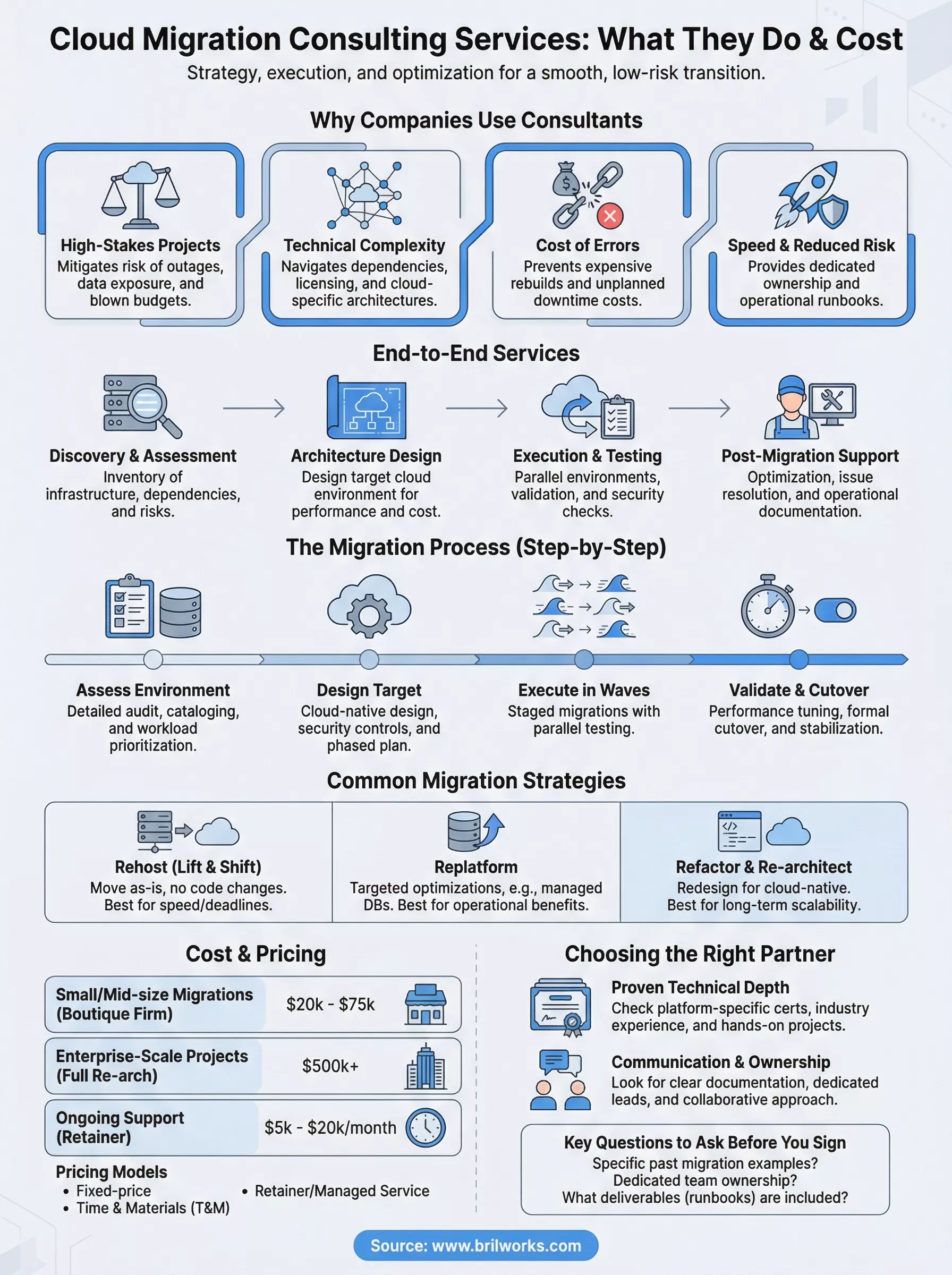
Most companies don't hire a cloud migration consultant because they lack smart engineers. They hire one because cloud migrations are high-stakes projects where a single misconfigured network rule or overlooked dependency can take down production systems, expose data, or blow a budget that wasn't built for surprises. Your internal team knows your business deeply, but consultants bring pattern recognition from running dozens of migrations across different industries, platforms, and compliance environments.
Cloud migrations are rarely just "moving files to a server somewhere else." You're dealing with inter-service dependencies, licensing constraints, data residency rules, and the need to sequence workloads so nothing breaks mid-move. On top of that, each major cloud provider, whether AWS, Azure, or Google Cloud, has its own tooling, pricing models, and architectural best practices that take time to learn properly.
A consultant who has done this work before knows where the landmines tend to sit. They can map your application portfolio, flag which workloads need refactoring before they move, and design a target architecture that actually fits your traffic patterns and compliance requirements, not just a generic template pulled from a documentation page.
The biggest technical risk in any migration isn't the move itself. It's the assumptions your team makes about what's compatible before the move starts.
Underestimating migration complexity is expensive. Teams that attempt a migration without experienced guidance often find themselves rebuilding architecture mid-project or managing unplanned downtime that ends up costing far more than the consulting engagement would have. One poorly scoped lift-and-shift can leave you with cloud infrastructure that runs slower and costs more per month than the on-premises setup you left behind.
Cloud migration consulting services exist partly to protect that investment. A good consultant runs a financial analysis alongside the technical one, modeling your projected cloud spend against your current costs and identifying optimization opportunities before you commit. That kind of upfront work prevents the "why is our AWS bill higher than expected?" conversation six months after go-live.
When your engineering team is already stretched across product development and maintenance, asking them to lead a complex migration in parallel is a fast path to burnout and errors. Bringing in a consultant means the migration work has dedicated ownership, and your team doesn't have to split focus between keeping the lights on and designing a new cloud architecture at the same time.
There's also an operational risk angle that often gets overlooked. Consultants build runbooks, rollback plans, and testing frameworks as part of the engagement, not as an afterthought. That documentation has long-term value because it gives your team a clear picture of how the new environment is structured once the consultants are gone. You're not left with a system only one person understands.
For companies in regulated industries like healthcare or fintech, this matters even more. Consultants with relevant compliance experience know how to structure migrations so you stay aligned with requirements like HIPAA or SOC 2 throughout the process, not just at the end when an auditor asks for evidence.
Cloud migration consulting services vary by provider, but most full-service engagements cover the same core phases: discovery, architecture design, hands-on migration, and post-launch optimization. Understanding what falls in scope before you sign is the difference between a predictable project and one that generates surprise invoices halfway through. Knowing what to expect from each phase also helps you hold your consultant accountable to clear deliverables rather than vague promises.
Every solid migration starts with a thorough inventory of what you currently have. Consultants map your existing infrastructure, application dependencies, data flows, and licensing agreements. This phase surfaces risks before they become problems. A workload that looks simple on the surface might carry undocumented dependencies on a legacy database that needs refactoring before it can move. Discovery is where those issues get found and documented rather than stumbled into mid-migration, when fixing them is far more disruptive and expensive.
Once consultants understand your environment, they design a target cloud architecture that fits your performance, security, and cost requirements. This is not a copy of your existing setup pushed into the cloud. It is a deliberate design that accounts for scaling, redundancy, and cloud-native capabilities your current infrastructure likely does not use. Alongside the architecture, consultants build a detailed migration plan with sequenced workloads, rollback procedures, and clear ownership for each phase so nothing moves without a documented plan behind it.
A migration plan that includes explicit rollback procedures protects you from a single bad deployment window turning into an extended outage.
The execution phase is where workload moves actually happen, but strong consultants do not just flip a switch and walk away. They run parallel environments during the transition, validate functionality in the new environment before cutting over, and monitor performance closely in the days after go-live. Testing covers functional checks alongside load and security validation to confirm the new environment holds under real traffic. Post-migration support typically includes tuning your cloud spend, resolving issues that surface after cutover, and delivering the documentation your team needs to operate the new environment with confidence once the engagement closes.
Most cloud migration consulting services follow a structured, phased process that keeps risk controlled and your team informed at every step. The exact sequence varies by provider and project scope, but the core phases remain consistent whether you're moving a single application or an entire data center.
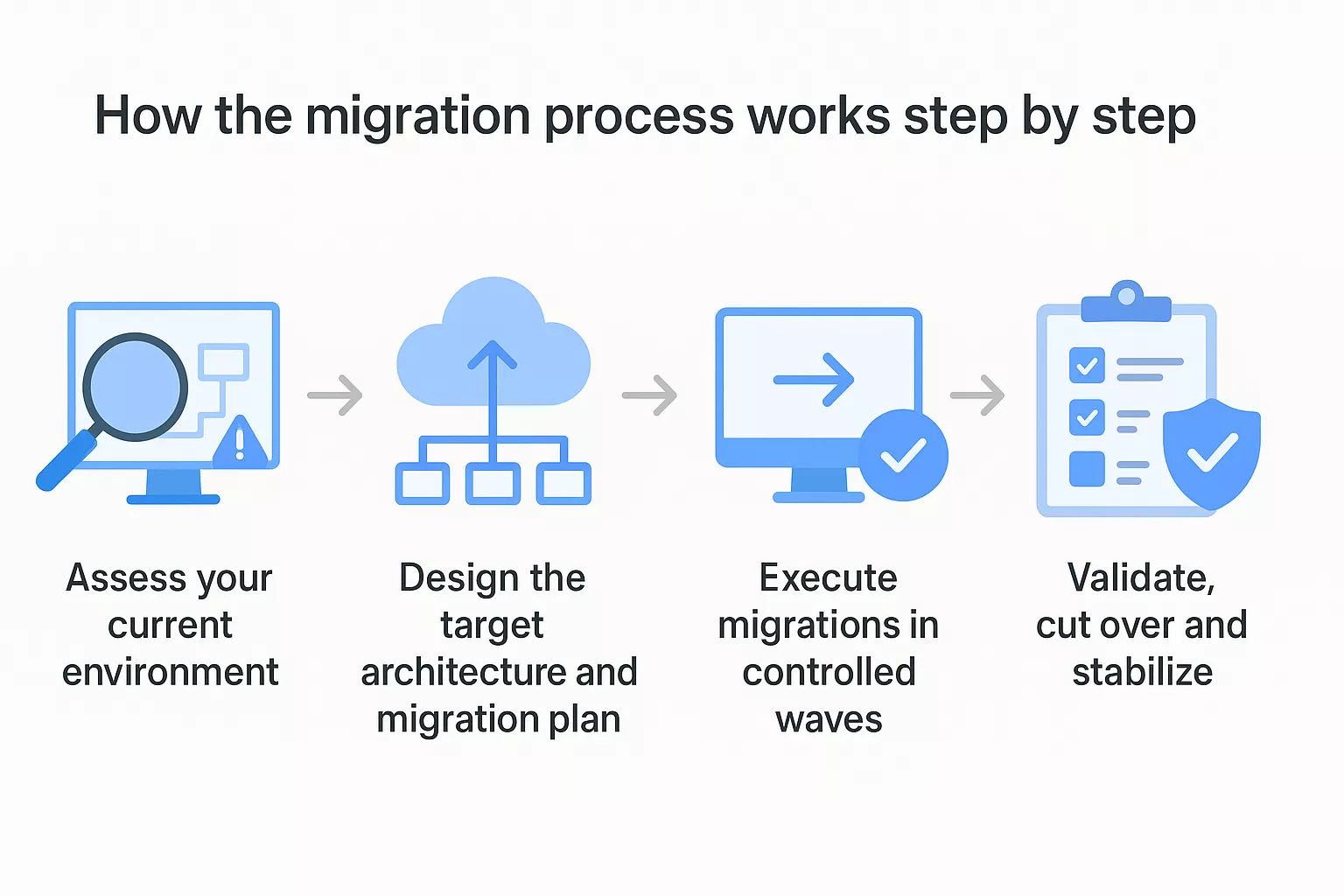
Before anything moves, your consultant runs a detailed audit of your existing infrastructure. They catalog servers, applications, databases, data flows, and network dependencies. This step exists to eliminate assumptions, because what looks like a simple workload on a diagram often carries hidden dependencies that would break things if moved without preparation. The output is a clear inventory and risk register that drives every decision that follows.
Your consultant also scores each workload during this phase, flagging which applications can move as-is, which need refactoring first, and which are candidates for replacement. That prioritization directly shapes the migration sequence and prevents you from moving a high-risk workload before the environment is ready to handle it.
With your current state documented, your consultant designs the cloud environment you are moving into. This is not a direct copy of your on-premises setup. They account for cloud-native scaling, redundancy patterns, and security controls that fit your compliance requirements. You also get a sequenced migration plan here, with each workload prioritized based on complexity, business criticality, and dependencies, so nothing moves in the wrong order.
The architecture design phase is where most of the real thinking happens. A rushed design produces a cloud environment that costs more and performs worse than what you started with.
Rather than moving everything at once, strong consultants migrate workloads in staged waves. Low-risk, less critical systems go first, which lets your team validate the process before higher-stakes workloads follow. Each wave includes parallel testing in the new environment before cutover, so you always have a fallback if something surfaces unexpectedly.
Once each workload passes functional and performance testing, your consultant manages the formal cutover from the old environment to the new one. After go-live, they monitor closely for several days, tuning performance and resolving any issues that surface under real traffic. This stabilization window confirms that cost projections and performance benchmarks match reality before your team takes full ownership of the new environment.
Not every workload moves the same way, and one of the most valuable things a consultant brings to an engagement is helping you pick the right approach for each application. The framework most consultants use is often called the "6 Rs," though in practice most projects focus on three or four of them. Your choice of strategy directly affects timeline, cost, and how much long-term value you extract from the cloud after the move.
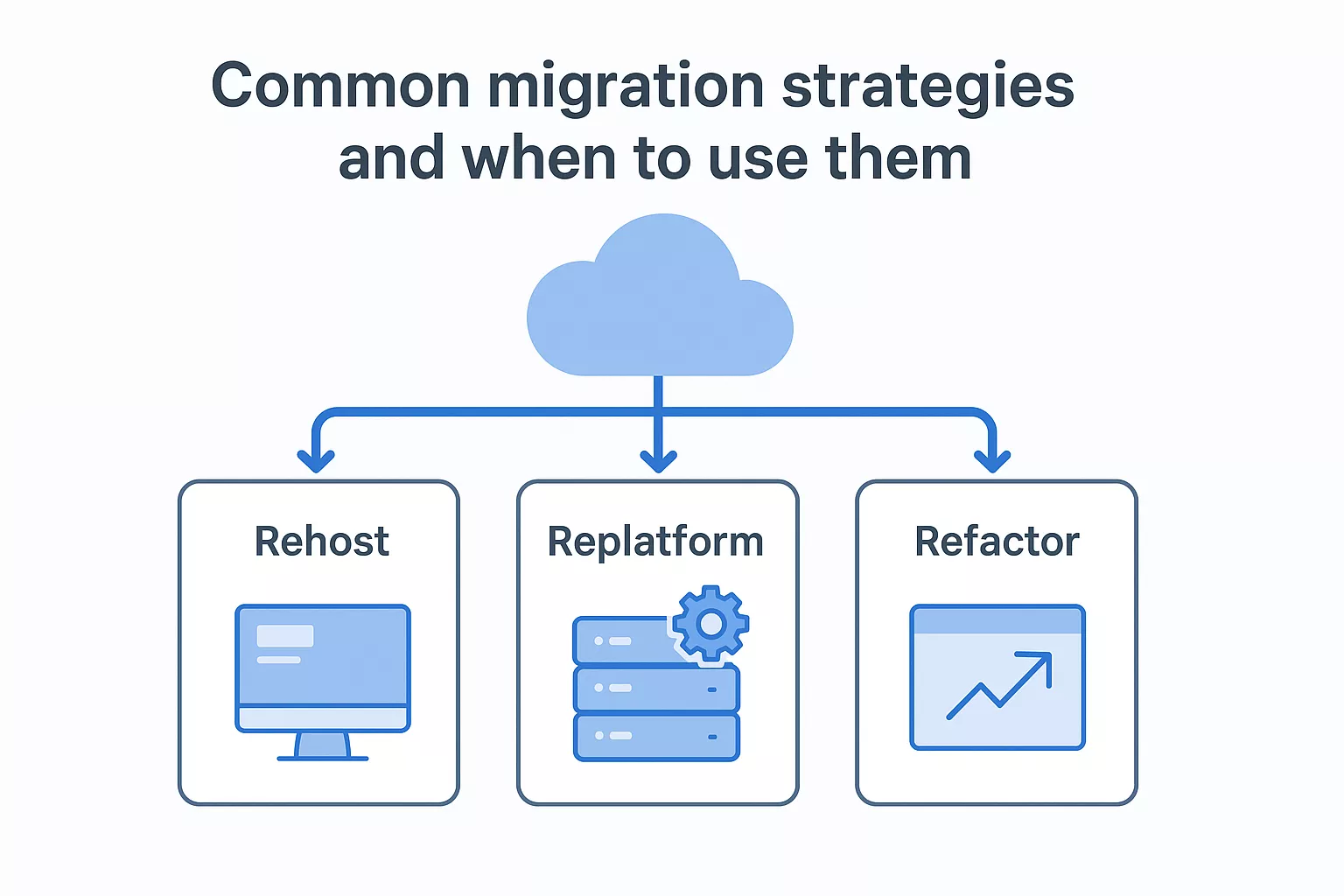
Rehosting moves your application to the cloud with no changes to the underlying code or architecture. You take what you have, migrate it to a virtual machine in the cloud, and run it there. This approach is fast and low-risk, which makes it the right call for workloads that need to move quickly to meet a data center exit deadline. The trade-off is that you do not gain much from cloud-native capabilities since you are essentially running the same workload in a different location.
Works best when:
Replatforming makes targeted, low-effort optimizations during the migration without changing the core application architecture. A common example is moving from a self-managed database to a managed cloud database service like Amazon RDS, which reduces your operational overhead without requiring a full code rewrite. This strategy works well for applications where you want some cloud benefit without the cost and time of a full refactor, and it often delivers the best short-term return on investment.
Replatforming is frequently the most practical middle ground for mid-size applications that need modernization but cannot justify a lengthy rebuild right now.
Works best when:
Refactoring means redesigning your application to take full advantage of cloud-native services such as containers, serverless functions, or managed APIs. This strategy takes the longest and costs the most, but it delivers the strongest long-term scalability and performance gains. Cloud migration consulting services are most valuable here because the architectural decisions made during a refactor have lasting consequences. Consultants help you avoid over-engineering and make sure the new architecture matches your actual traffic patterns, not a hypothetical future state that never arrives.
Works best when:
Pricing for cloud migration consulting services varies widely based on scope, provider size, and how much ongoing support you need. Small to mid-size migrations handled by a boutique firm might run between $20,000 and $75,000 total, while enterprise-scale projects that include full re-architecture, compliance work, and extended post-migration support can exceed $500,000. Most engagements land somewhere in between, and the number shifts significantly based on how complex your current environment is and which migration strategies your workloads require.
Getting a realistic cost estimate requires a discovery phase first. Any consultant who quotes a firm number before assessing your environment is guessing.
Consultants structure their fees in a few different ways, and knowing the model upfront helps you budget accurately and avoid unexpected charges partway through the project.
Several factors push migration costs higher, and knowing them helps you scope conversations with potential partners more honestly. Application complexity is the biggest driver. A portfolio of tightly coupled, legacy monoliths costs far more to migrate than a set of loosely coupled services that are already containerized. Compliance requirements add significant cost too, particularly in industries like healthcare and finance where your consultant needs to document controls and run validation testing that a standard migration would skip.
Timeline pressure also affects your total spend. Compressed timelines require more consultant hours in a shorter window, which raises the total engagement fee. If you can afford a phased approach spread over several months, you generally extract more value for the same spend than you would rushing the same scope into six weeks.
Picking the wrong consulting partner is not just an inconvenience. It can set your project back months and leave you with an architecture you need to fix immediately after launch. When you evaluate cloud migration consulting services, focus on concrete evidence of past work rather than polished sales materials. The firms worth hiring can show you real examples of migrations they have run, including the complexity they handled, the timelines they hit, and the problems they solved along the way.
Your consultant's technical credentials should align with the specific platforms and workloads in your environment. A firm with deep AWS expertise may not be the right fit if your target architecture involves Azure-native services, and vice versa. Ask whether their architects hold current certifications from your target cloud provider, such as AWS Certified Solutions Architect or comparable credentials, and confirm those certifications reflect hands-on project experience rather than just exam preparation.
The most telling proof of technical depth is a consultant who asks harder questions about your environment than you expected, not one who has a ready answer for everything before hearing your situation.
Beyond certifications, look for industry-specific experience that matches your compliance environment. A consultant who has run migrations in healthcare understands data residency and audit requirements your team faces. One without that background may build a technically sound architecture that still fails a compliance review.
Technical skill matters, but a consulting engagement that runs poorly from a communication standpoint produces friction at every milestone. Look for a partner who documents decisions clearly, communicates blockers early, and treats your internal team as a collaborator rather than a passive observer. How a consultant handles your discovery call tells you a lot about how they will handle a problem during a cutover window.
Pay close attention to how they structure staffing on each engagement and whether they assign dedicated architects or rotate generalist staff through your project. Firms that keep dedicated leads on each account tend to produce better outcomes because the people who designed your architecture are the same ones executing it, which means fewer handoff errors and faster decision-making when issues surface.
Before you commit to any cloud migration consulting services engagement, you need to pressure-test the relationship with direct questions. Good consultants expect this and answer clearly. Ones who dodge or generalize are telling you something important about how they will handle harder conversations once the project is underway.
Your first set of questions should focus on what the consultant has actually done, not what they are capable of doing in theory. Ask for specific examples of migrations that match your stack, your industry, or your compliance requirements. A reference call with a past client who ran a similar project is worth more than any case study on their website.
If a consultant cannot point to a concrete example that resembles your situation, they are treating your project as a learning opportunity at your expense.
The second set of questions protects you after the engagement closes. Many companies sign a contract focused on the migration itself, then discover that post-migration support, documentation, and knowledge transfer were out of scope or priced separately. Get explicit answers before you sign.
Ask who owns the engagement day to day. Confirm whether the same architect who designs your environment is the one executing it, or whether that person hands off to a junior team once the planning phase ends. Staff continuity directly affects how quickly issues get resolved when something breaks during a cutover window.
Also ask what you receive at the end of the engagement. You should walk away with runbooks, architecture diagrams, and operational documentation that your team can actually use, not a high-level summary that becomes useless the moment a new engineer needs to troubleshoot something six months later. Knowing exactly what deliverables are in scope before you sign prevents the handoff from becoming a frustrating guessing game.
Cloud migrations reward preparation. The companies that get the most value from moving to the cloud invest time upfront in honest assessment, clear scoping, and choosing a partner who understands both the technical and business sides of the project. Cloud migration consulting services exist to make that process faster, safer, and more predictable than attempting it without experienced guidance. Getting this right from the start protects your budget and your team's time.
You now have a clear picture of what these engagements cover, how they are structured and priced, and what separates a consulting partner worth hiring from one that costs you more in rework than the original contract. The right partner builds your team's confidence in the new environment rather than leaving you dependent on outside help every time something breaks. If you are ready to work with a team that brings hands-on AWS and cloud architecture experience to every project, reach out to Brilworks to start the conversation.
Cloud migration consulting services help businesses move their applications, data, and infrastructure from on-premise systems to the cloud. These services include planning, strategy, execution, and optimization to ensure a smooth and secure transition.
Businesses use cloud migration consulting services to reduce risks, avoid downtime, and ensure data security during migration. Experts help identify the right approach, tools, and cloud platforms based on business goals.
The cost of cloud migration consulting services depends on factors like infrastructure size, complexity, and migration strategy. Small projects may cost less, while enterprise-level migrations require a larger investment due to planning and execution efforts.
Cloud migration consulting services typically include assessment of current systems, migration strategy development, data transfer, application modernization, testing, and post-migration support to ensure optimal performance.
The timeline for cloud migration consulting services varies based on the scope of the project. It can take a few weeks for simple migrations and several months for complex enterprise systems involving multiple applications and dependencies.
Get In Touch
Contact us for your software development requirements
Get In Touch
Contact us for your software development requirements

Hello, we are BRILLIAN’S. Trying to make an effort to put the right people for you to get the best results. Just insight !

 503, Fortune Business Hub, Science City Road, Sola, Ahmedabad, Gujarat, India Pincode- 380060
 + 91 9313644148
 sales@brilworks.com


