COOPERATION MODEL
ARTIFICIAL INTELLIGENCE
PRODUCT ENGINEERING
DevOps & Cloud
LOW-CODE/NO-CODE DEVELOPMENT
INDUSTRY
FRONTEND DEVELOPMENT
CLOUD DEVELOPMENT
MOBILE APP DEVELOPMENT
LOW CODE/ NO CODE DEVELOPMENT
EMERGING TECHNOLOGIES



 4 mins read
 Last updated March 24, 2026
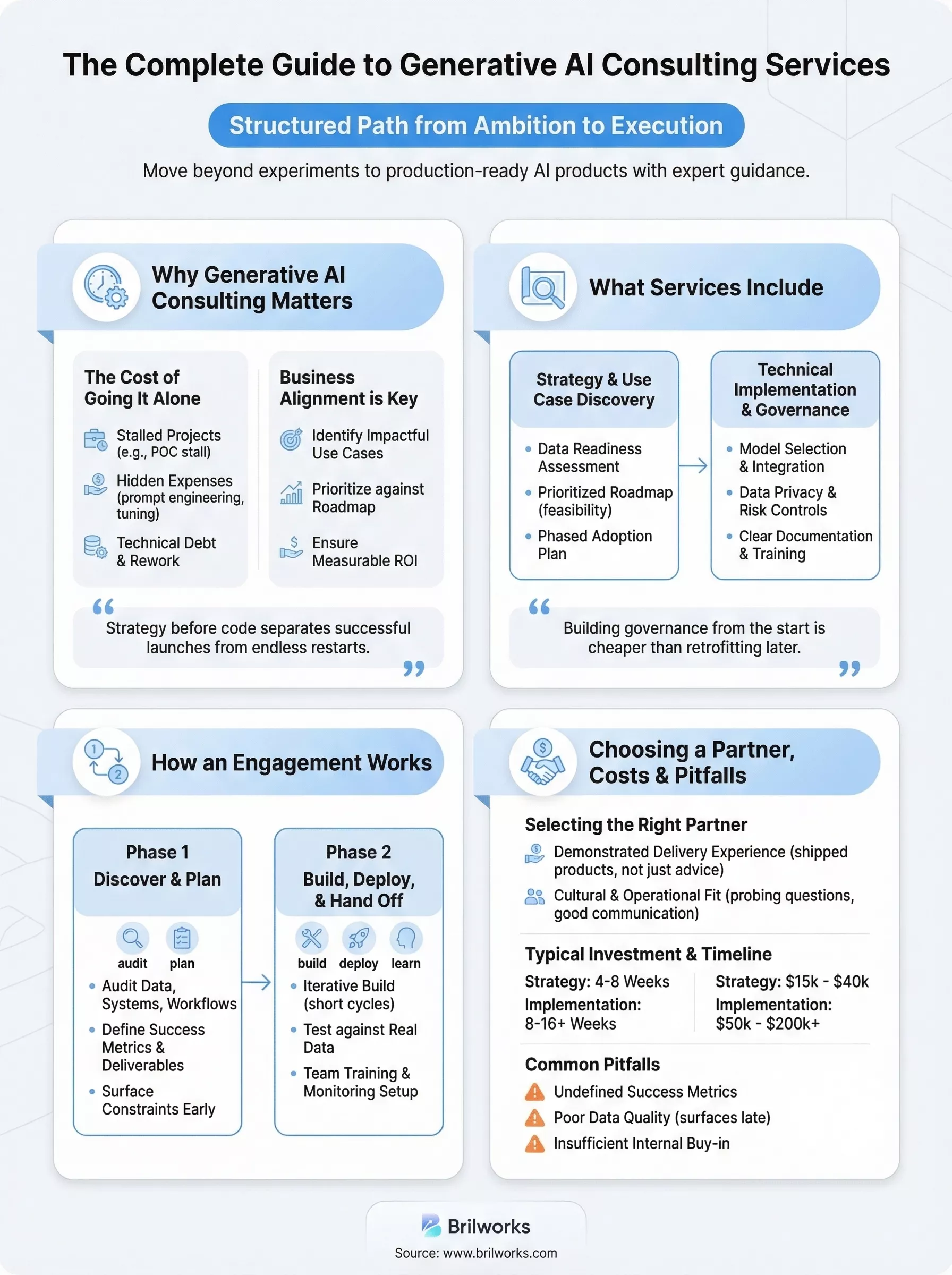
Most companies know they should be doing something with generative AI. Fewer know exactly what that something is. Between choosing the right models, building internal workflows, handling data privacy, and actually shipping something useful, the gap between "we want AI" and "we're using AI effectively" is wider than most leaders expect. That's where generative AI consulting services come in, not as a magic fix, but as a structured way to move from ambition to execution.
At Brilworks, we've helped startups and enterprises build and launch AI-powered products from the ground up, including rapid MVP development and full-scale integrations. That hands-on experience has given us a clear view of what works, what doesn't, and where most teams get stuck when adopting generative AI. This guide breaks all of that down, what generative AI consulting actually involves, who needs it, how engagements typically work, and what to look for in a consulting partner. Whether you're a CTO evaluating vendors or a founder trying to figure out your first AI use case, you'll walk away with a practical understanding of the space.
Generative AI is moving fast, and most internal teams simply don't have time to keep up while also shipping product, managing infrastructure, and handling daily operations. The result is a pattern that plays out across industries: companies run a quick proof-of-concept, see promising results, and then stall when it's time to scale that experiment into something that actually runs in production. If you've been through that cycle, you already know how much time and budget it can burn through before anyone admits the project has stalled.
Building on generative AI without outside guidance isn't impossible, but it's expensive in ways that aren't immediately visible at the start. Prompt engineering, model evaluation, and infrastructure tuning take far more time than most teams budget for, and small missteps early on tend to compound. A poorly scoped use case, a model that doesn't fit your data, or an integration that bypasses your security requirements can push your project back by months and create technical debt that slows everything that follows.
Getting the strategy right before you write a single line of code is what separates companies that successfully ship AI products from those that keep restarting them.
Generative AI consulting services exist because AI adoption is as much a business problem as it is a technical one. A qualified consulting partner helps you identify which use cases will actually move your key metrics, prioritize them against your existing roadmap, and build a deployment plan your team can realistically execute without derailing other work. Without that business-level alignment, even technically solid AI implementations often fail to deliver measurable ROI because the underlying use case was never validated against real operational constraints and user needs.
Generative AI consulting services go well beyond tool recommendations. A qualified partner guides you through strategy, technical build, and ongoing governance so you're not piecing together disconnected advice from multiple sources.
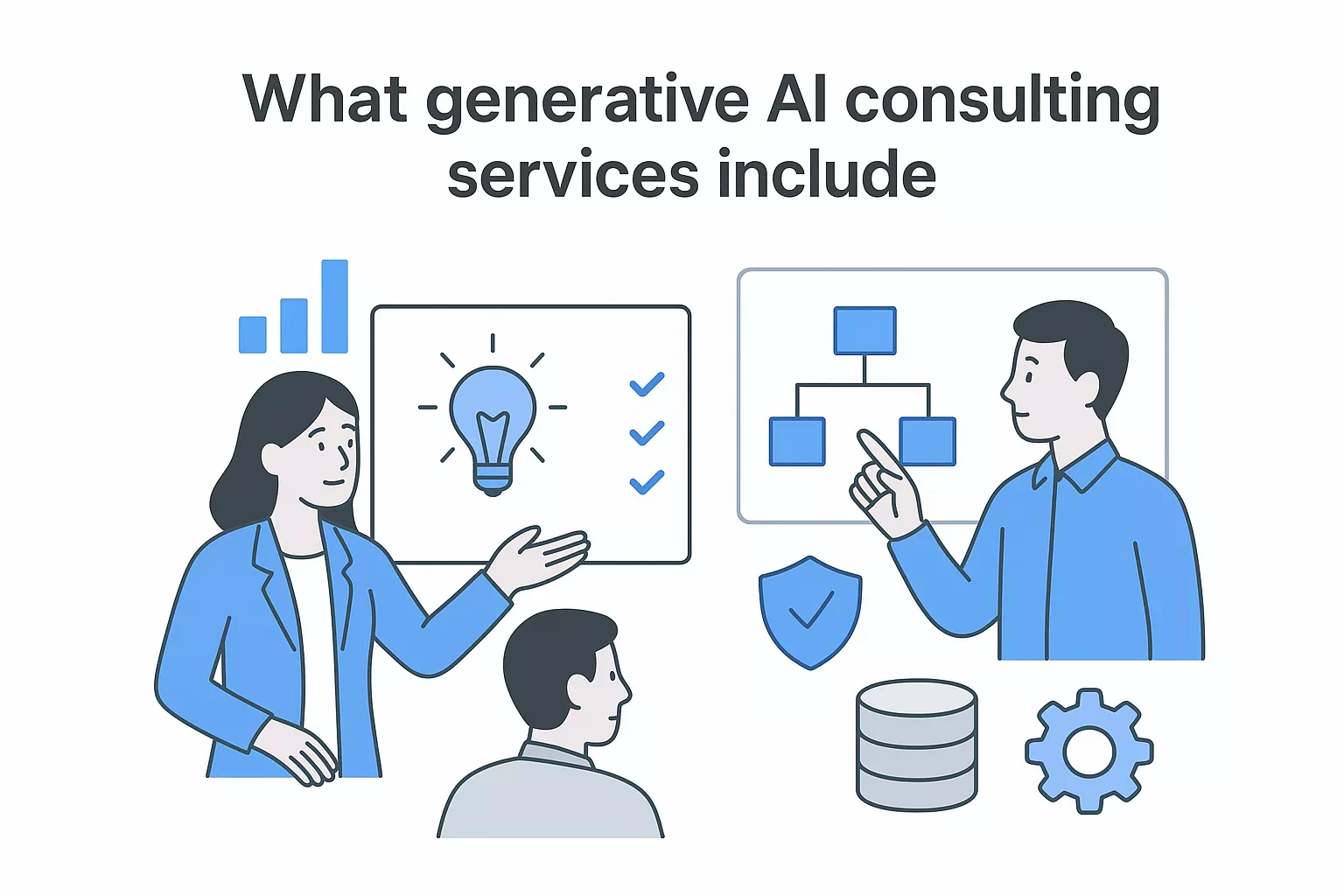
Consultants start by aligning AI opportunities to your actual business goals. They assess your data readiness and existing infrastructure, then build a prioritized roadmap based on feasibility and expected impact rather than what's trending. Common deliverables at this stage include:
This phase covers model selection, prompt engineering, integration work, and the compliance guardrails your business requires. Your partner connects AI capabilities to your existing systems and builds in data privacy and risk controls from day one, not as an afterthought.
Building governance into your AI system from the start is far cheaper than retrofitting controls after you've already shipped to production.
Strong consulting partners also deliver clear technical documentation alongside the deployment itself, so your internal team can maintain and iterate on the system without starting from scratch every time a business need changes.
Most generative AI consulting services follow a structured process that moves you from ambiguity to a working system in predictable, repeatable stages. Understanding those stages upfront helps you set clear expectations and keeps your team and your consulting partner aligned from start to finish.
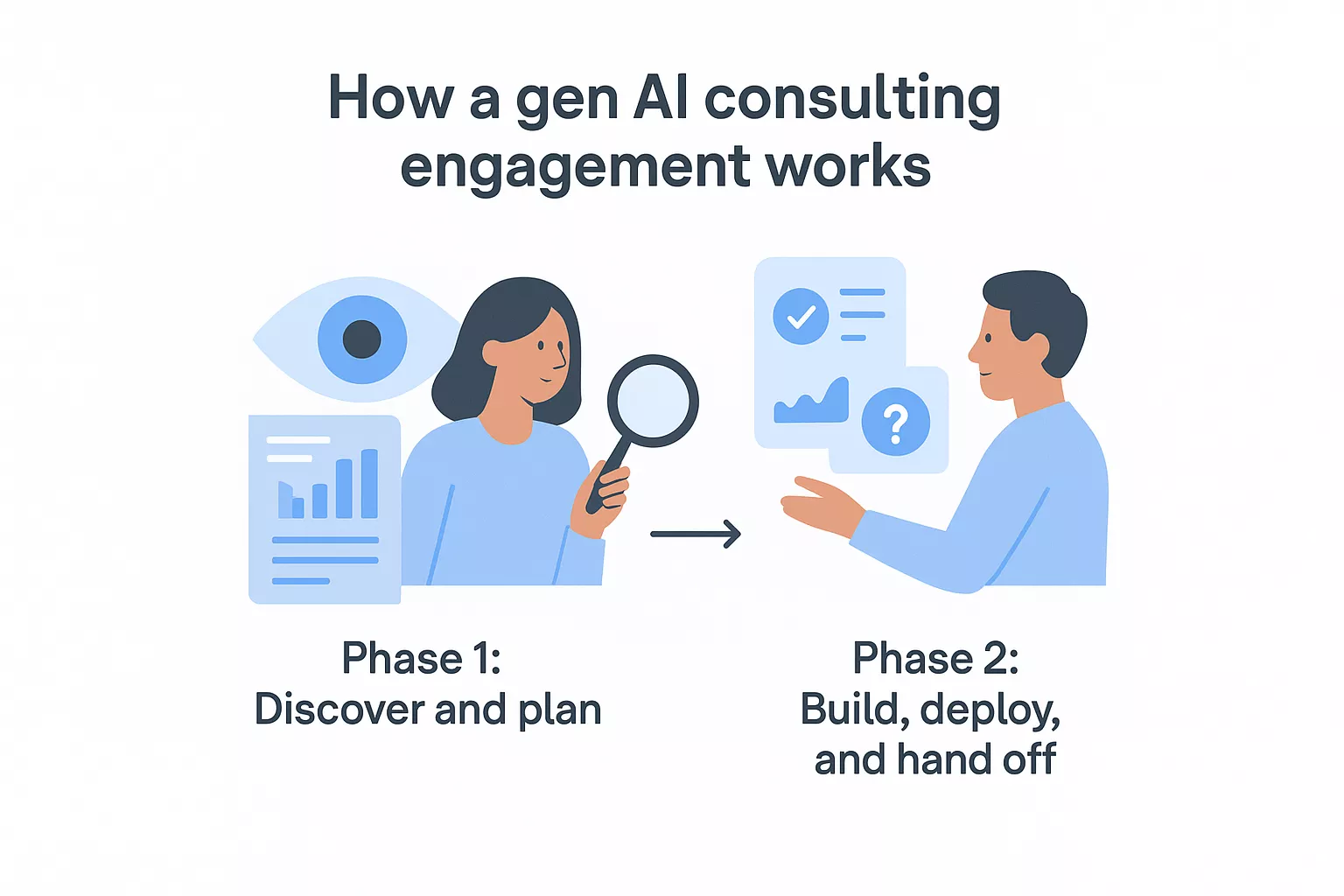
Your consultant begins by auditing your data, systems, and workflows to identify where AI delivers the most value. This phase ends with a scoped project plan that includes clear deliverables, timelines, and success metrics before any technical work starts.
Skipping discovery is one of the most common reasons AI projects run over budget and miss their original goals.
A proper discovery phase also surfaces integration requirements and compliance constraints early, so your team avoids expensive rework and timeline delays later in the project.
Your partner builds and iterates on the solution in short feedback cycles, testing against real data and defined benchmarks, refining until outputs meet your standards. This approach catches problems early, when fixes cost far less than post-launch corrections.
After deployment, a good consulting partner trains your internal team and provides clear documentation and monitoring setup so you can maintain and extend the system without starting over every time requirements change.
Not every firm offering generative AI consulting services can carry your project from strategy through production. The right partner combines technical depth with business fluency, and their track record should reflect both.
Ask for specific examples of shipped AI products, not just advisory engagements. A strong partner can point to use cases similar to yours and explain the tradeoffs they made.
A consulting partner who has never shipped production AI has no business advising you on how to do it.
Client references are the fastest way to separate real delivery experience from theoretical expertise. When you check them, ask about timeline accuracy and communication quality, not just technical outcomes.
Your consulting partner will work closely with your internal engineers and product team, so how they communicate matters as much as what they know. Look for partners who ask probing questions about your data and constraints during the sales process itself, because that behavior reveals how they'll operate once the engagement starts.
Generative AI consulting services vary widely in cost depending on scope, but most engagements follow predictable patterns. Understanding typical cost ranges and timelines before you sign a contract helps you budget accurately and avoid mid-project surprises.
A focused strategy and roadmap engagement usually runs four to eight weeks and costs between $15,000 and $40,000. Full implementation projects, from discovery through production deployment, typically range from $50,000 to $200,000 or more, depending on complexity, integrations, and team size. For most production-ready deployments, plan for eight to sixteen weeks as a realistic baseline.
Rushing a generative AI project to hit an arbitrary deadline is one of the fastest ways to accumulate technical debt that costs far more to fix later.
The most common mistakes are strategic and organizational, not technical. Teams frequently skip the discovery phase to save money upfront, then rebuild large portions of their system after the first real-world test. Three issues consistently appear across failed projects:
You now have a clear picture of what generative AI consulting services actually involve, from use case discovery through production deployment and the governance work that keeps everything running. The next move is deciding where you stand today. Map your current AI readiness against the phases covered in this guide, and identify the single use case most likely to deliver measurable impact in the next 90 days. That focus keeps your first engagement scoped, manageable, and far more likely to succeed.
If you're ready to move from planning to building, the right partner makes that transition significantly faster and less risky. Brilworks has helped startups and enterprise teams build production-ready AI products without the cycles of false starts that derail most internal efforts. Whether you need a strategy session or a full build, start the conversation with a team that has shipped real AI products. Reach out to Brilworks and tell us what you're trying to build.
Generative AI consulting services help businesses design, develop, and implement AI-powered solutions that can generate content, automate workflows, and improve decision-making. These services typically cover strategy, model selection, development, and deployment.
Businesses need generative AI consulting services to identify the right use cases, avoid costly mistakes, and accelerate implementation. With expert guidance, companies can adopt AI more efficiently and align it with their business goals.
Generative AI consulting services are widely used across industries such as healthcare, finance, eCommerce, marketing, and software development. Any business that relies on data, content, or automation can benefit from these services.
Generative AI consulting services typically include use case identification, data preparation, model development, integration, testing, and ongoing optimization. Some providers also offer compliance and security support.
To choose the right generative AI consulting services provider, look for proven experience, strong technical expertise, clear communication, and a structured approach to delivery. Reviewing past projects and client feedback can also help in making the right decision.
Get In Touch
Contact us for your software development requirements
Get In Touch
Contact us for your software development requirements

Hello, we are BRILLIAN’S. Trying to make an effort to put the right people for you to get the best results. Just insight !

 503, Fortune Business Hub, Science City Road, Sola, Ahmedabad, Gujarat, India Pincode- 380060
 + 91 9313644148
 sales@brilworks.com


