Last updated November 3, 2026
How to Become a Databricks Partner in 2026

9 mins read
Summarize with AI:


Data
AI
The Stack Underneath
You search for how to become a Databricks partner and land on a guide about Registered, Select and Elite tiers. Those tiers no longer exist. Databricks rebuilt its partner program in 2026 around four new tiers. They are Bronze, Silver, Gold and Platinum.
Advancement works differently now too. Your tier moves on a Partner Value Score built from certifications, registered use cases, customer satisfaction and published references. A team that applies without knowing this can sit at Bronze far longer than it needs to.
Brilworks went through this process as a consulting partner. So this guide follows the order we’d do it in again. Each step comes with the official Databricks link for the exact page you’ll need.
The program has three parts. You pick a program, you start at a tier, and a score decides when you move up.
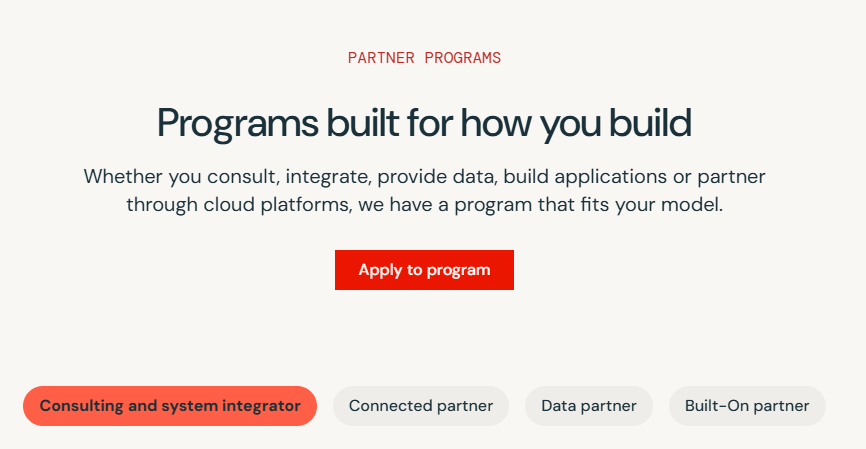
Databricks runs four partner programs, and each one fits a different business model. All four are listed on the Databricks Partner Program page.
|
Program |
Who it’s for |
What you do with Databricks |
|
Consulting and System Integrator (C&SI) |
Consultancies and systems integrators |
Deliver data and AI projects for joint customers |
|
Connected partner |
Software vendors whose product reads or writes Databricks data |
Build integrations through SQL, APIs, drivers and connectors |
|
Data partner |
SaaS platforms and data vendors |
Share datasets through Delta Sharing and list them on Databricks Marketplace |
|
Built-On partner |
Companies building B2B products |
Embed the Databricks platform inside your own product |
Plenty of companies fit more than one program. Databricks lets you apply to several at once. A consultancy that also sells its own connector could sit in C&SI and Connected together.
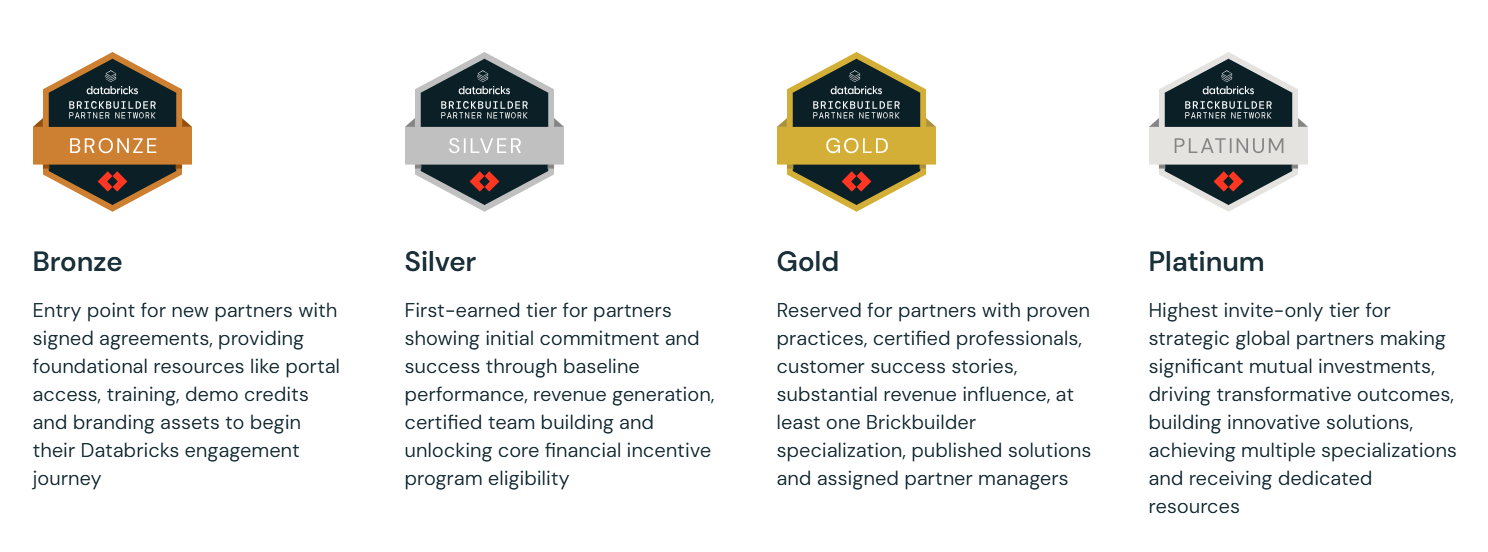
Every partner starts at Bronze and works up through Silver and Gold. Bronze comes with a signed agreement. It gives you portal access, training, demo credits and branding assets.
Silver is the first tier you have to earn. It rewards revenue generated, a certified team and steady baseline performance. Gold asks for proven practices, published customer stories and at least one Brickbuilder specialization. Platinum is invite-only. No application route.
ISV partners carry an extra cost here. Connected, Data and Built-On partners need a signed spend commitment of $100K or more to reach Silver. Gold needs a commitment of $1M or more. Built-On partners have to sign one just to get onboarded at Bronze. The published C&SI material doesn’t list a commitment at all.
The Partner Value Score (PVS) is the number Databricks uses to place you in a tier. It measures three pillars, which are growth, customer success and innovation. You earn points by doing four things.
Registering use cases, joint customers and sourced revenue in the Partner Portal
Registering consultants for certifications with their company email
Getting clients to complete a CSAT survey when a new use case goes live
Submitting public customer reference stories through the portal
The company email detail is easy to miss. A certification registered under a personal address may never get linked to your firm. Ask your engineers to sign up with their work email from day one.
ISV partners get scored on a slightly different set of pillars. Consumption driven by your integration carries the most weight there.
Picking the wrong program puts you on the wrong set of requirements. A consultancy that applies as a Connected partner ends up chasing integration validation and spend commitments it never needed. Settle this before you open the application.
Go to the Databricks Partner Program page.
Scroll down to the section called “Programs built for how you build.”
Click through all four tabs. Each one has a short description from existing partners.
Note which program matches how your company makes money. Hold off on the Apply button for now.
The simplest test is where your revenue comes from. Billable project work points to C&SI. Licences or subscriptions for your own software point to Connected or Built-On. Selling datasets points to the Data partner program.
That test gets messy for firms with a services arm and a product. In that case, apply to the services program first. Add the product program once the integration actually exists and can pass validation. If you still can’t tell which fits, the Databricks partner team answers program questions at partners@databricks.com.
The application decides how Databricks routes you. For ISVs, the partner path and category you pick here set where you appear in the Partner Finder and which Databricks teams you work with. Answer it with that in mind.
Gather these before you open the form.
Your company’s legal name, website and headquarters details
A work email address for the person who will own the partnership
The technical expertise your team brings to Databricks, including any certifications already held
The industries and customer types you target
For ISVs, your partner path (Connected, Data or Built-On) and the category your product fits, such as BI, data engineering, governance or AI agents
Click Apply now on the Partner Program page, or go straight to the partner application form. Fill in your organisation details, technical expertise and target customers. Use the work email from your list, since this account becomes your Partner Portal login.
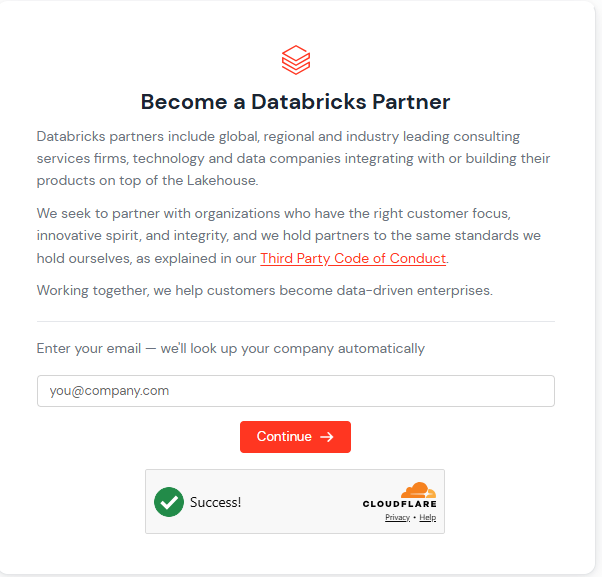
The last part is a click-through partner program agreement for the program you chose. Signing it is what puts you at Bronze. Read it before you click, especially if you’re an ISV. Built-On partners sign a spend commitment as part of onboarding, and that number deserves a conversation with your finance team first.
Approval isn’t always instant. Databricks can ask for extra diligence information before it confirms enrolment, which is spelled out in the Data Partner Program terms. Keep an eye on the inbox you applied from.
Bronze on its own does little for your pipeline. A named partner manager, co-sell support and the financial incentive programs all start at Silver. So treat Bronze as setup time for everything your score will need later.
Log in to the Databricks Partner Portal with the work email you applied with. Almost everything from here happens inside it, from training and use case registration to program updates.
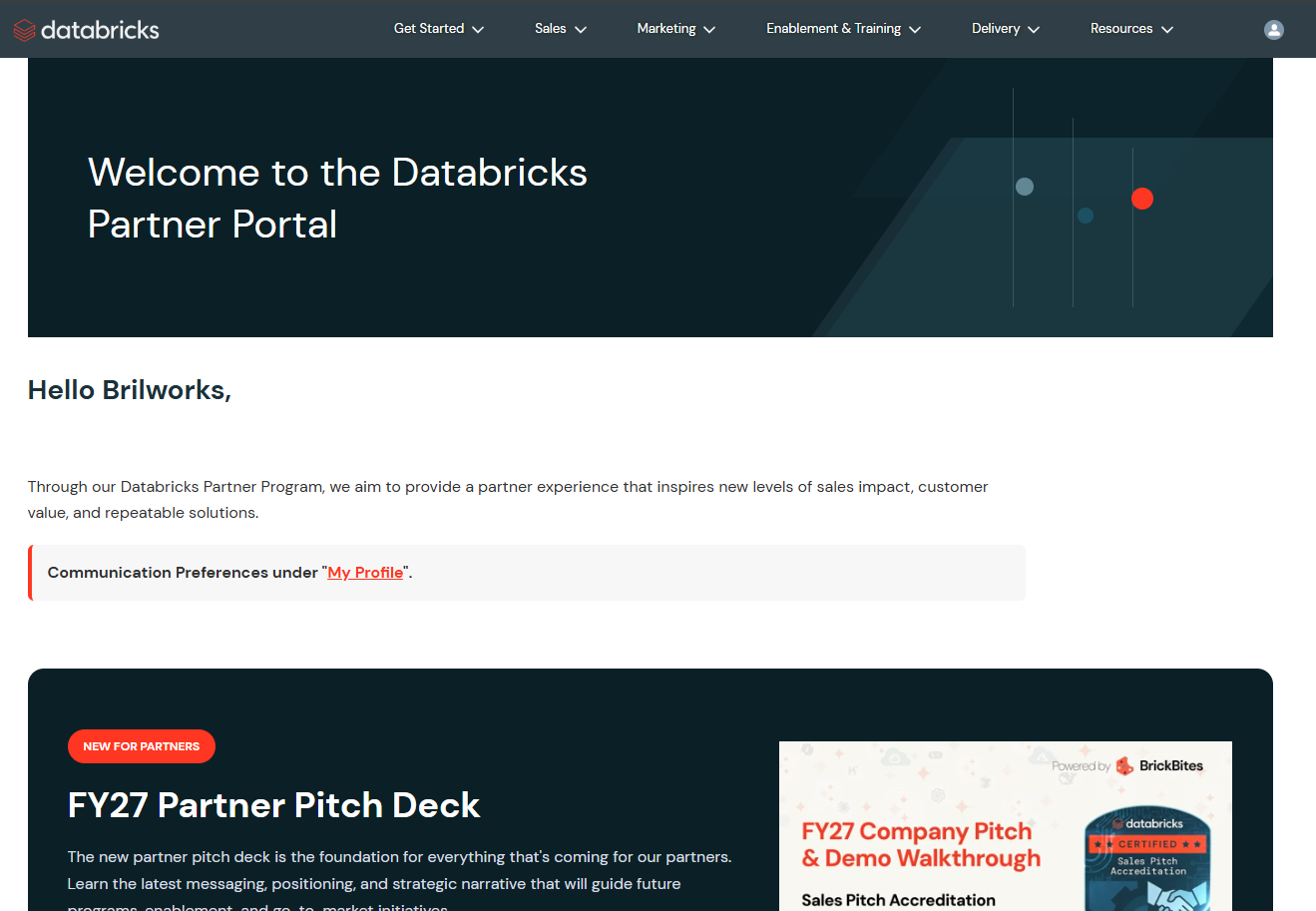
Bronze gives you a short list of starting resources.
Partner Portal access
Free Databricks training
Demo and sandbox credits for a test environment
A listing in the Databricks partner directory
The right to use the Databricks partner badge and logo
Start with your partner profile. Databricks’ field teams use it to understand what you do and to decide when to pull you into a customer conversation. A half-filled profile gives them nothing to work with. Write a clear value proposition, name the industries you serve and add your key contacts.
Then put the badge to work. Add it to your website and email signatures, following the Databricks brand guidelines in the portal. When you announce the partnership on LinkedIn, tag Databricks and use the #DatabricksPartner hashtag.
The sandbox credits are for building demos and training your team. Keep client workloads off them. Those belong in the client’s own Databricks account.
Certifications are the fastest lever you control on the Partner Value Score. Silver asks for a certified team and Gold asks for certified professionals across a proven practice. A partner with zero certified engineers stays at Bronze no matter how many projects it delivers.
Your engineers should register at Databricks Partner Academy, which is separate from the Customer Academy. The two look almost identical. Picking the wrong one is a common mistake, and moving an account across later means raising a support ticket. Have everyone sign up with their company email so their progress links to your firm.
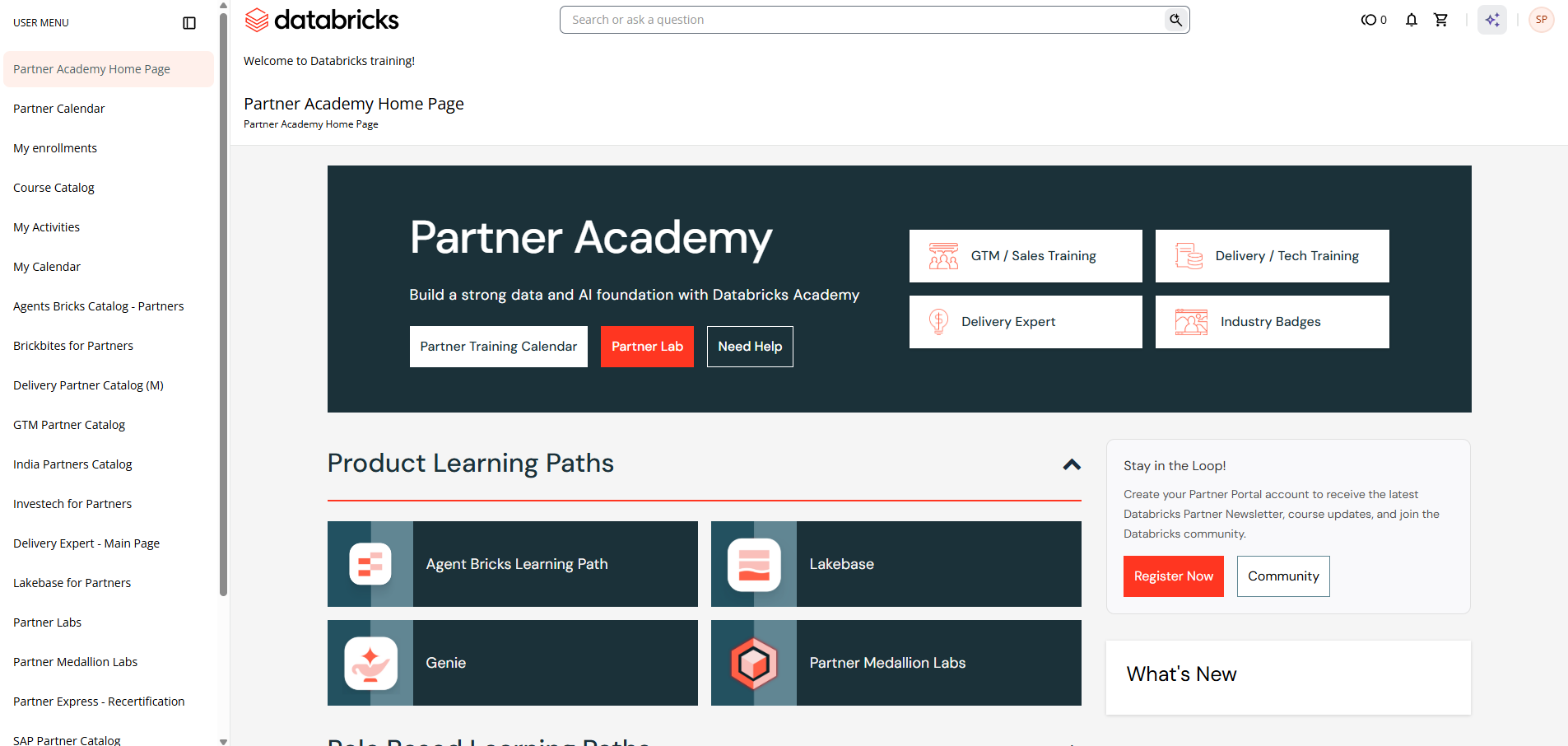
Courses inside Partner Academy are free for partners. The free Lakehouse Fundamentals accreditation is a sensible first badge for anyone new to the platform.
Each Databricks certification exam costs $200. Most C&SI teams get the most out of the data engineering track.
|
Team role |
Start with |
Move on to |
|
Data engineers |
Data Engineer Associate |
Data Engineer Professional |
|
Analysts and BI developers |
Data Analyst Associate |
Data Engineer Associate |
|
ML engineers |
Machine Learning Associate |
Machine Learning Professional |
|
AI and LLM engineers |
Generative AI Engineer Associate |
Machine Learning Professional |
Skip the data engineering default if your practice is mostly dashboards and reporting. Analyst certifications will match your delivery work better.
Partners can get discounted exam vouchers, but nothing applies them automatically. Databricks handles requests through a support ticket.
Open the Databricks Help Center and raise a Training ticket.
Choose “Certifications” as the training issue.
Use the subject line “Partner Certification Voucher Request” followed by the certification name.
In the message, name your partner company, the certification and the course you completed with its date.
The full steps are on the Databricks voucher request page. Book the exam only after the voucher arrives.
ISV partners have one more requirement here. Silver needs your sellers to earn the ISV Fundamentals Sales Badge, which sits in Partner Academy as well.
C&SI partners can skip this step. Brilworks hasn’t gone through it either, since validation applies to products and our partnership is services-led. Everything here comes from Databricks’ own ISV program guide.
Validation is where your consumption starts to count. The Partner Well-Architected Framework (PWAF) review includes lightweight telemetry that lets Databricks measure how customers use your integration. Until that’s in place, the usage your product drives doesn’t feed your tier. An ISV that delays validation is effectively building without a score.
Start at the Partner Architecture Center. It holds the PWAF guidance for each partner path, along with reference architectures, sample code and the validation requirements. Build in your sandbox workspace, and bring in a Databricks Partner Solutions Architect early for design reviews. The review checks security, performance, telemetry and reliability.
Submission happens inside the Partner Portal, which has the current instructions. Expect questions from the Solutions Architect before approval.
Databricks emails you the final setup steps after validation. Have these ready so the listing doesn’t stall.
A ZIP file of your logo as a PNG with a transparent background
A 50-word description of your company and integration
A link to a Databricks-specific page on your own website
Public technical documentation, reviewed and approved by a Databricks Solutions Architect, stating which clouds you support among AWS, Azure and Google Cloud
A completed partner profile covering your value proposition, architecture, target customers and key contacts
One validated path is enough for Silver. Gold needs two, chosen from Connected, Data and Built-On. Databricks’ own tip is that Connected and Built-On partners usually reach a second path fastest through a Delta Sharing use case.
Unregistered work doesn’t count toward your tier. A team can deliver ten Databricks projects and still sit at Bronze if none of them went into the Partner Portal.
In the Partner Portal, go to Sales and click Register a New Deal. This is how you submit a customer use case to Databricks. The same menu has a how-to page with a tutorial, and a Deal Dashboard to track what you’ve submitted.
Have these ready before you start.
Customer company and contact details
Opportunity summary and expected business outcome
Databricks products and cloud provider
Budget and timeline
Register early, but keep it honest. Speculative leads that never progress add little to your score and waste the Databricks account team’s time.
When a use case goes live, ask the client to complete the Databricks CSAT survey. When a client is happy to go public, submit their story as a customer reference through the portal. Both feed your PVS.
ISVs get a published checklist for Silver.
A named partner manager and an executive sponsor
A signed commitment of $100K or more
At least one seller with the ISV Fundamentals Sales Badge
A First Call Deck for Databricks sales teams
Two GTM activities and two win wires a year
Two use cases progressing each quarter
C&SI partners don’t get a public checklist. Databricks shares thresholds on request, so ask your partner contact for your current PVS gap.
Gold has one requirement you can’t buy or grind your way into. Databricks asks for at least one Brickbuilder specialization, and each one is awarded only after an independent assessment. Partners who reach Silver without planning for this often stall there.
The Brickbuilder name covers three different things, and they’re easy to mix up.
|
Brickbuilder type |
What it is |
What it proves |
|
Specialization |
An assessed status in an industry or product area |
Your team has certified people, live customer work and named success stories |
|
Solution |
An end-to-end offering for a migration or industry use case |
You can package and repeat a delivery |
|
Accelerator |
Pre-built code or frameworks for one Databricks capability |
You’ve built reusable IP on the platform |
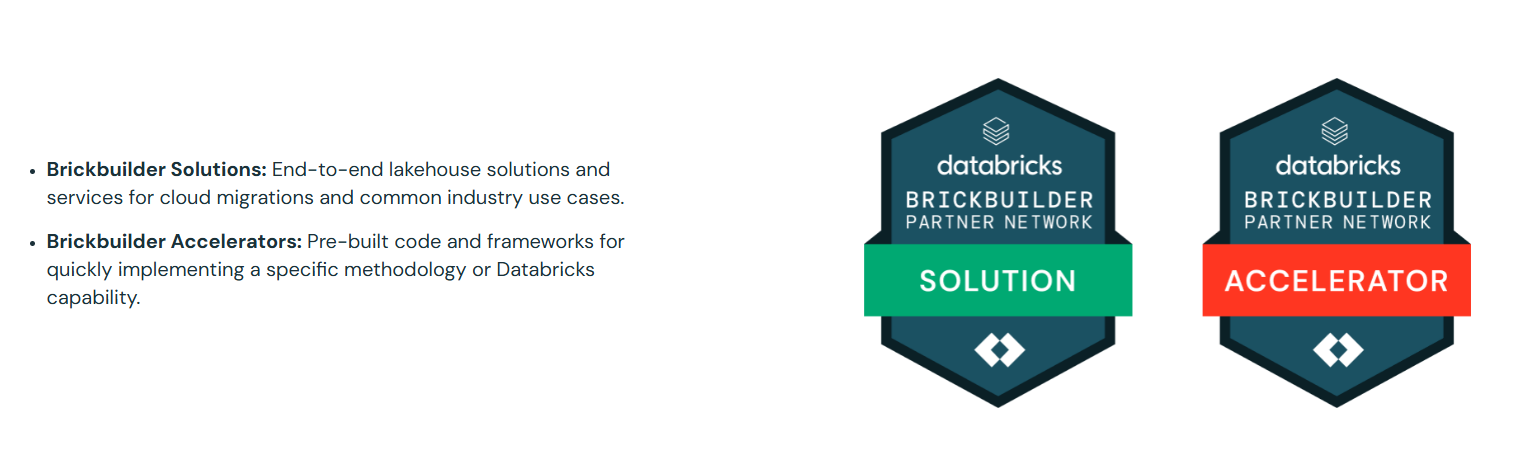
Each specialization has its own checklist, found under Sales then Brickbuilder Specializations in the Partner Portal. A Databricks solution architect describes the typical requirements as follows.
Being at Silver tier or above
A minimum number of technical delivery badges and sales or presales badges
Live customer implementations on Databricks
Named customer success stories
Some go further. The Security and Governance specialization includes a live technical walkthrough in front of Databricks’ Unity Catalog specialists.
Choose based on where you already have live customers and stories you can publish. A firm doing regular Databricks migration work has a natural route through a migration specialization. Avoid chasing a vertical where you have no referenceable clients yet. The assessment will expose it.
Once you’ve picked one, ask your Databricks partner contact for the current checklist and book the assessment through them.
Each tier asks for more and gives more back. The table pulls together the requirements and benefits from Databricks’ Partner Program page and its 2026 ISV program guide.
|
Tier |
How you get there |
What it unlocks |
|
Bronze |
Sign the partner agreement. Built-On partners also sign a spend commitment |
Partner Portal, free training, demo and sandbox credits, directory listing, Databricks badge and logo |
|
Silver |
Generate revenue, build a certified team and hit baseline performance. ISVs also need a $100K+ commitment and one validated integration path |
A named partner manager, expanded co-sell support, early access to new features, core financial incentive programs |
|
Gold |
Show a proven practice with certified professionals, published customer stories, substantial revenue influence and at least one Brickbuilder specialization. ISVs need a $1M+ commitment and two validated paths |
Assigned partner managers, VP-level executive sponsorship, proactive pipeline generation, roadmap previews, MDF eligibility |
|
Platinum |
Invite-only, for strategic global partners making significant mutual investments across multiple specializations |
Dedicated Databricks resources |
Tiers aren’t permanent. Databricks reassesses partners on a regular cadence. A partner that slips below its tier’s requirements gets a grace period to recover before losing it.
Becoming a Databricks partner takes one form and a signed agreement. Moving past Bronze takes steady work. The order that works is to pick the right program, get your engineers certified under company emails, register every deal in the portal, and plan a Brickbuilder specialization early enough that your customer references can support it by the time you reach Silver.
The 2026 tier change makes the score the thing to manage. Certifications, registered deals, CSAT responses and published stories all count toward it, and none of them count if they never reach the Partner Portal. Teams that record their work from the first project move up faster than teams that deliver more but log less.
If you’d rather work with a team that has already been through this process, Brilworks is a certified Databricks partner delivering lakehouse, migration and data engineering projects for clients in fintech, healthcare and manufacturing.
There’s no published fee to apply or join at Bronze as a consulting partner. Costs show up later. Certification exams cost $200 each, and ISV partners sign spend commitments of $100K or more for Silver and $1M or more for Gold. Built-On partners sign a commitment just to be onboarded.
Databricks doesn’t publish a timeline. Applying and signing the agreement can move quickly, though Databricks may ask for extra diligence information before confirming enrolment. Moving from Bronze to Silver or Gold depends on your Partner Value Score, which builds over months of certifications, registered deals and customer references.
The Databricks partner tiers are Bronze, Silver, Gold and Platinum. They replaced the older Registered, Select, Elite and Global Elite labels in 2026. Bronze comes with a signed agreement, Silver and Gold are earned through performance, and Platinum is invite-only.
Databricks certification exams aren’t free for partners, but partners can request a discounted voucher. The request goes through a training ticket in the Databricks Help Center. Courses in Databricks Partner Academy are free for partner employees.
Yes, a small consultancy can join the Databricks Consulting and SI program. The public material lists no minimum company size for Bronze. Tier progress depends on certified engineers, registered deals and customer references, so a small team with real Databricks projects can move up. Gold still needs a Brickbuilder specialization backed by live customer work.
You might also like

Hello, we are BRILLIAN’S. Trying to make an effort to put the right people for you to get the best results. Just insight !