Last updated May 26, 2026
50+ Node.js Statistics Covering Usage, Adoption, and Performance

5 mins read
Summarize with AI:


Data
AI
The Stack Underneath

For the longest time, JavaScript stayed on the client side. It powered millions of websites but the backend? That was someone else's territory. Node.js changed that.
Ryan Dahl built it as an open-source project back in 2009, a runtime that let JavaScript run on the server for the first time. Under the hood it's written in C++ and JavaScript, runs on a single-threaded, event-driven architecture, and was designed specifically to give developers an environment where they could build real-time features without the performance falling apart under load. It got its name that same year and has seen 23 major releases since.
And it stuck. Nearly two decades later, close to half of all JavaScript developers still reach for it daily. Most adopted backend technology in the JS ecosystem. It's inspired over 10 frameworks built specifically around it.
It got its name in 2009, and since then, there have been 23 major releases.
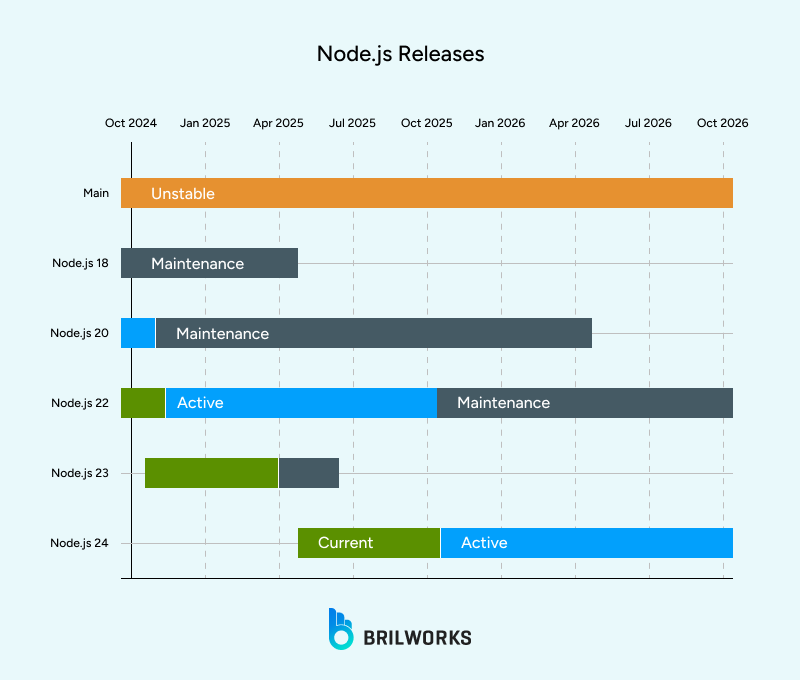
What Node.js really did was push JavaScript out of the browser and into territory it had no business being in, server-side development. Suddenly it was sitting at the same table as PHP and Python. These days tools like Express.js get mentioned in the same breath as backend frameworks across completely different languages. That's not something anyone predicted in 2009. Source
Backend trends keep shifting. But Node.js keeps showing up, influencing how teams think about tooling, what they expect from performance, and how they experience day-to-day development.
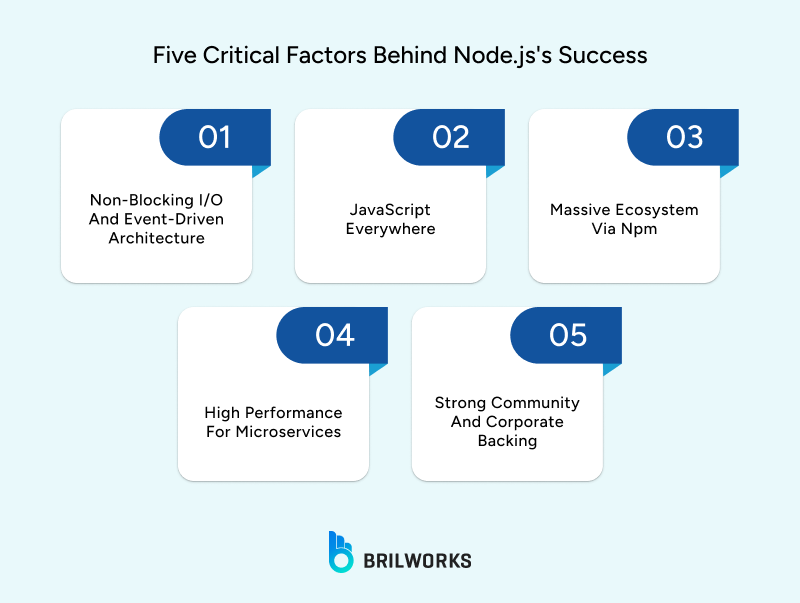
Right now, over 40% of JavaScript developers are building with Node.js.
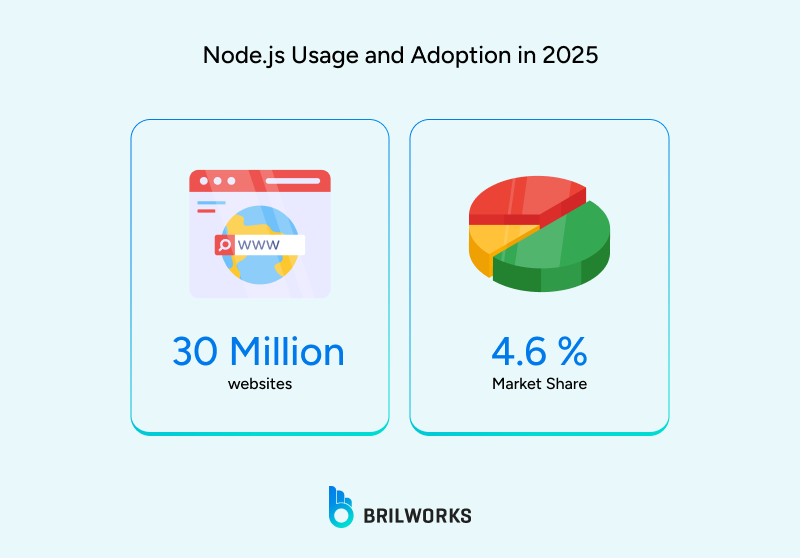
Node.js has been downloaded 147.5 million times since 2014 and used in over 30 million websites in 2025 [Node.js.Org]
Major companies, such as Amazon, PayPal, eBay, AliExpress, and Netflix, rely on Node.js for building scalable, high-performance applications.
Node.js reduces web page loading times by 50-60%, enhancing user experience and performance.
Node.js is used by 4.6% of all the websites whose web servers we know. [W3Techs]
According to the Stack Overflow Developer Survey, which received responses from 48,503 developers, Node.js was the most commonly used web technology, cited by 40.8% of respondents.
31.8% of developers said they want to use Node.js, while 64.2% said they admire it. [Stack Overflow Developer Survey 2024]
27.1% of developers who use Node.js said they want to continue using it, based on responses from 46,781 developers. [Stack Overflow Developer Survey 2024]
Over time, it's inspired the development of more than 10 frameworks focused on simplifying backend workflows, ranging from building APIs to handling high-throughput systems. Some of the most interesting work is happening in open source, here are the best Node.js open source projects on GitHub worth following right now.
Node.js pushed JavaScript beyond the browser and into server-side development — territory that belonged to PHP and Python for years. That shift put it in the same conversation as backend staples that had been around far longer. Today, Express.js gets mentioned alongside frameworks from completely different language ecosystems. If you're trying to pick the right one, our breakdown of NestJS vs Next.js covers exactly where each one earns its place.
That's how far it's travelled.
Backend trends keep moving. But one number stays consistent, over 40% of JavaScript developers are actively building with Node.js right now. If you're looking to hire experienced Node.js developers, that talent pool is deep, and growing. For a runtime that's nearly two decades old, that's not maintenance mode. That's dominance.
Netflix.com
Vk.com
X.com
Cnn.com
Spotify.com
Github.com
Adobe.com
Nytimes.com
Vimeo.com
Forbes.com
Node.js is widely used across industries like finance, e-commerce, healthcare, and enterprise applications.
W3Techs reports Node.js usage rising from 3.1% to 4.6% in 2025.
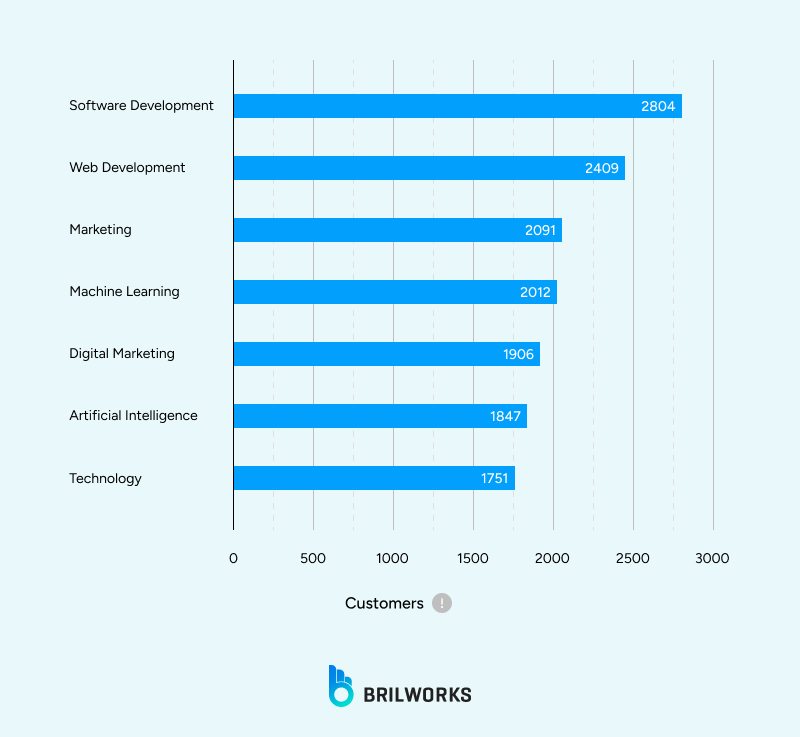
Node.js adoption is strongest in Software Development (38.5%), followed by Web Development (33.1%) and Marketing (28.7%). It is widely used in technology-driven sectors that prioritize speed and scalability.
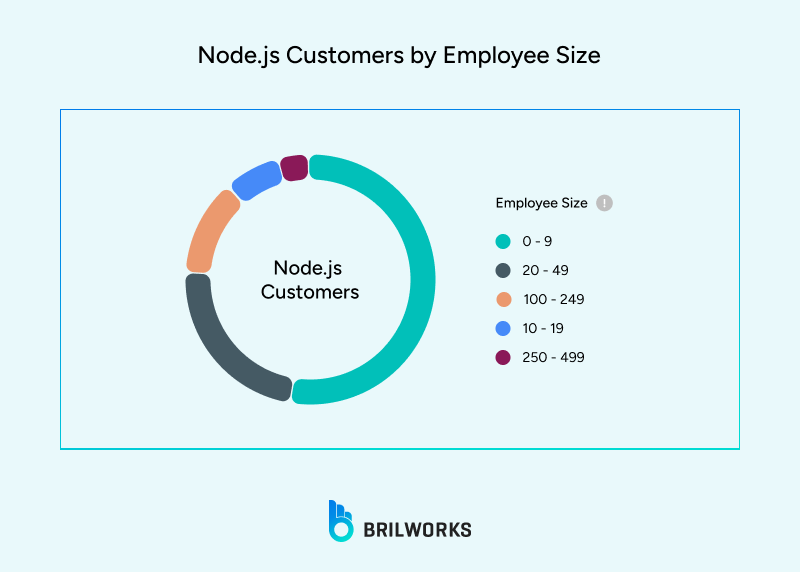
Most companies using Node.js for programming fall into smaller employee groups, with 116,000 companies having 0–9 employees, followed by 51,560 companies in the 20–49 employee range, and 26,246 companies with 100–249 employees. Node.js's highly popular among startups and mid-sized businesses.
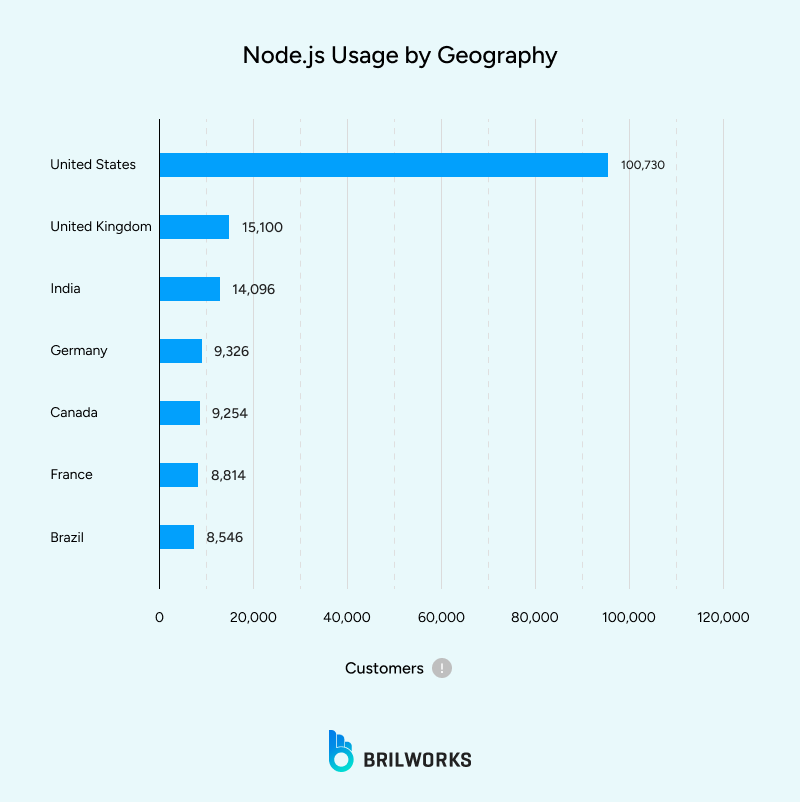
Node.js is most widely adopted in the United States (55.54%, 100,730 customers), followed by the United Kingdom (8.33%, 15,100 customers) and India (7.77%, 14,096 customers).
Node.js hit more than one Billion Downloads in 2018 [Source: Medium/Node]
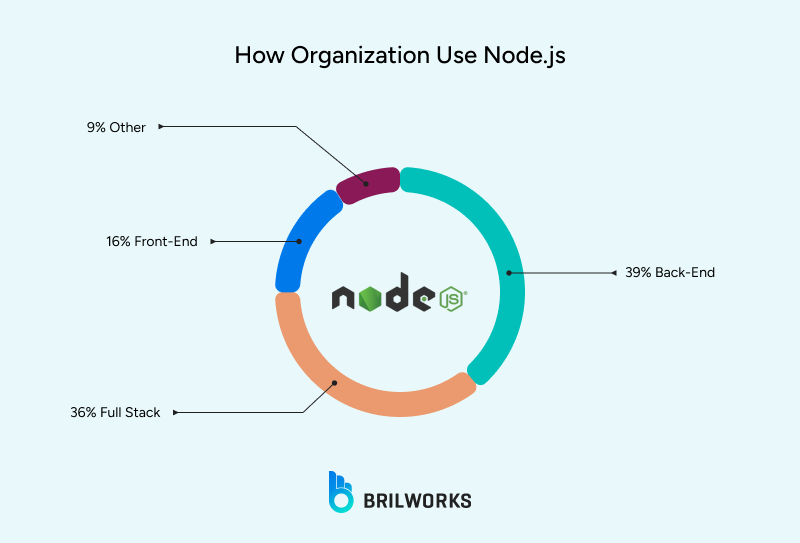
Organizations primarily use Node.js for development in the following areas:
39% for Back-End development
36% for Full Stack applications
16% for Front-End projects
9% for other purposes.
43% of Node.js developers use it for enterprise applications.
Remote hiring for Node.js developers is increasing globally, with companies in the U.S., Canada, and Australia offering more positions to attract top talent without geographical limitations.
The United States leads, followed by Germany, France, and Ukraine. India also shows a growing presence in the Node.js ecosystem.
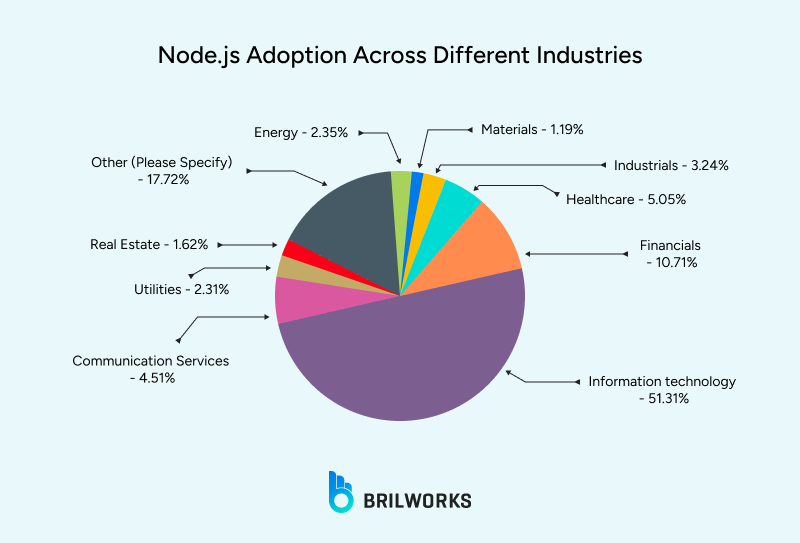
Nodejs is popularly used in information technology, healthcare, finance, and communication sectors.
Node.js remains primarily a tool for application development, with over 70% of participants identifying as app developers. However, it's also used by library maintainers, DevOps operators, and direct end users.
APIs, especially those built with microservices, remain the dominant use case. Frontend deployment (including frameworks like Next.js and Remix) is also high on the list. Node.js is popular in full-stack workflows.
macOS is currently the most popular development OS, followed by Windows and Linux. When it comes to production environments, Linux and Docker together account for over 84% of usage, showing clear preference for containerized and Unix-based deployments.
Most developers work on the x64 architecture (68%), but ARM adoption is significant, especially with the rise of Apple Silicon and cloud-native ARM instances. A notable portion still lacks awareness of their system's architecture.
npm continues to lead as the go-to package manager, used by over 60% of respondents. However, pnpm is on the rise, now used by nearly 22%. Older versions of Yarn still linger in the ecosystem, though newer alternatives are catching up.
More than half of developers have used experimental dotenv support (--env-file). Watch mode and async hooks are also getting traction. Interestingly, over 28% have adopted Corepack for package manager interoperability.
The native Fetch API has become a standard part of Node.js workflows, with 87% of developers already using it. The built-in test runner and Web Crypto APIs are also gaining steady adoption.

Trello used Node.js to handle 10K+ WebSocket connections, enabled fast prototyping with async events, powered real-time updates, and scaled from 300 to 50K users in one week post-launch.
PayPal reduced development time by unifying frontend and backend teams.
Netflix improved load times by 70% by using Nodejs.
PayPal switched to Node.js, seeing 2x faster performance, 33% less code, and 35% quicker response times. Smaller teams built apps faster, unifying frontend and backend with full-stack JavaScript. [PayPal blog]
LinkedIn shifted from Ruby on Rails to Node.js for mobile, cutting infrastructure needs by over 10x. Node.js helped simplify the codebase, boost scalability, and unify frontend and backend development using JavaScript. [Source: Medium Blog]
Walmart migrated from Java to Node.js and React.js, cutting update cycles, boosting performance, and powering 95% of traffic through Electrode. This shift enabled agility, scalability, and faster customer response. [InformationWeek]
According to Statista, as of 2024, Node.js overtook React.js to become the most widely used web framework. Over 40% of developers reported using Node.js, compared to 39.5% who opted for React.js.
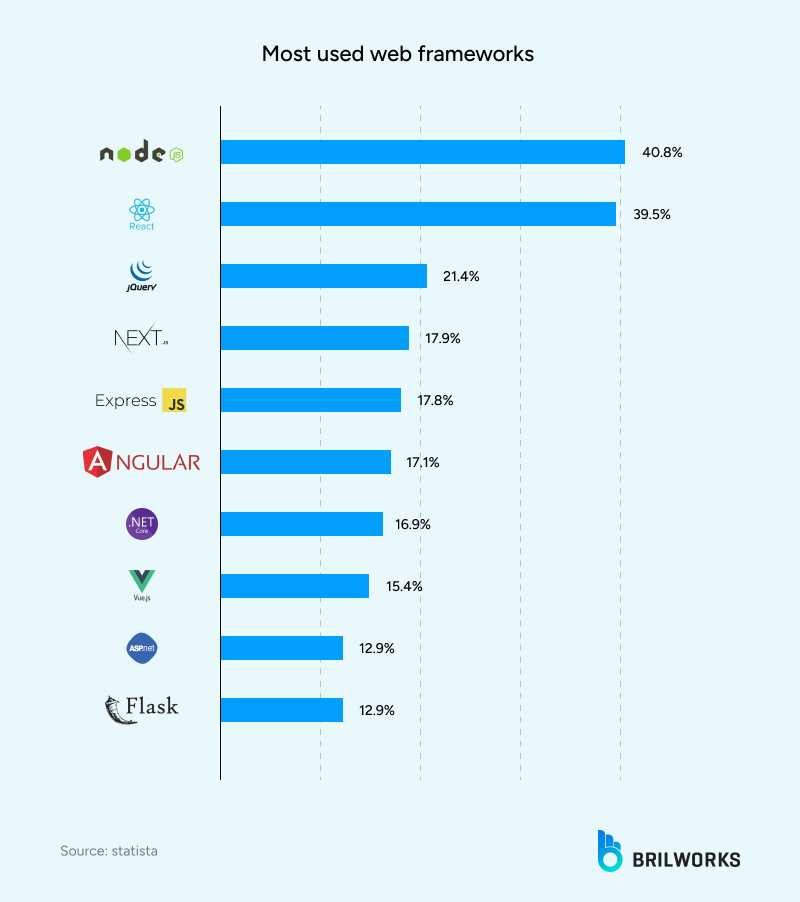
Node.js is used in over 85 countries and supports 45 different languages, making it a truly global technology.
The creator of Node.js, Ryan Dahl, was inspired by Gmail's real-time capabilities and wanted to build a system that could handle push-based interactions.
As per the Stack Overflow Developers Survey, the United States leads developer participation, contributing 18.9% of responses.
Node.js remains one of the most active open-source projects, with significant contributions from developers worldwide.
TypeScript adoption has surged, growing from 12% in 2017 to 35% in 2024, showing its increasing role in Node.js projects.
Node.js ranks high in site adoption and traffic, outpacing Nginx (W3Techs, 2025).

From startups to Fortune 500 companies, Node.js adoption is accelerating.
85% of enterprises using Node.js report improved developer productivity, thanks to its JavaScript-based full-stack capabilities.
Uber reduced processing time by 50% for its payment systems by adopting Node.js, showcasing its impact on mission-critical applications.
1.8 million npm packages are available in 2025, fueling rapid adoption by providing pre-built solutions for developers.
Disclaimer: The statistics and trends mentioned in this blog are based on publicly available data from sources like developer surveys, usage reports, and industry publications as of 2025. While we strive to keep the information accurate and up to date, the numbers may change as new data becomes available. Readers are encouraged to cross-reference with official sources for the latest updates.
Node.js is a runtime environment that allows JavaScript to run on the server side. It is popular because of its event-driven architecture, high performance, and ability to handle real-time applications efficiently.
Yes, and the numbers back it up. W3Techs reports Node.js usage climbing from 3.1% to 4.6% of all websites, npm now hosts over 1.8 million packages, and over 40% of JavaScript developers are actively building with it. For a runtime that's nearly two decades old, the growth curve is still pointing up.
Major companies like Amazon, Netflix, PayPal, LinkedIn, and Walmart use Node.js to build scalable and high-performance applications.
Node.js is commonly used for backend development, APIs, real-time applications, microservices, and full-stack development. Its non-blocking architecture makes it ideal for scalable and data-intensive applications.
You might also like

Hello, we are BRILLIAN’S. Trying to make an effort to put the right people for you to get the best results. Just insight !