COOPERATION MODEL
ARTIFICIAL INTELLIGENCE
PRODUCT ENGINEERING
DevOps & Cloud
LOW-CODE/NO-CODE DEVELOPMENT
INDUSTRY
FRONTEND DEVELOPMENT
CLOUD DEVELOPMENT
MOBILE APP DEVELOPMENT
LOW CODE/ NO CODE DEVELOPMENT
EMERGING TECHNOLOGIES



 6 mins read
 Last updated February 23, 2026
A polished interface means nothing if users can't figure out how to complete their goals. Before you launch that new app feature or website redesign, usability testing services give you real feedback from actual users, revealing friction points you'd never catch on your own.
At Brilworks, our UI/UX design work is deeply informed by testing principles. We've watched products stumble post-launch because teams skipped this step, and we've seen user experience improvements drive measurable business results when testing is done right. Choosing the right testing partner can genuinely make or break your timeline.
This guide covers seven usability testing services worth your attention in 2026. Whether you need moderated sessions with live facilitators, automated testing tools for quick iterations, or access to global participant panels, you'll find options here that fit different budgets and project requirements.
Brilworks brings product engineering expertise directly into the testing process, combining usability research with technical implementation knowledge that most standalone testing services lack. You get a partner who understands both the user experience side and the backend complexities that can affect how solutions actually ship.
Your testing engagement includes strategic UI/UX design that goes beyond surface-level findings. Brilworks delivers actionable insights tied to your product roadmap, identifying not just what frustrates users but how to fix it within your technical constraints. Their team works with AWS infrastructure and AI capabilities, so recommendations account for what's actually feasible given your stack.
Testing becomes most valuable when recommendations can be implemented quickly without additional vendor coordination.
Brilworks conducts moderated usability sessions alongside prototype testing during the design phase, catching issues before development starts. You'll work with researchers who understand mobile app development patterns for both iOS and Android, plus web application flows. Their approach includes task-based testing, accessibility evaluations, and cross-device verification that aligns with modern development frameworks like React Native and ReactJS.
This option works best if you need usability testing services integrated with actual product development, not just isolated research. Startups building their first MVP benefit from Brilworks' ability to test and iterate rapidly, while enterprise teams appreciate their experience with Fintech, Healthcare, and EdTech applications that demand high security and compliance. You should consider Brilworks when your testing needs to inform immediate design decisions and technical implementation.
Brilworks operates on a partnership model rather than per-test pricing, which means you typically engage them for ongoing product development that includes testing as a core component. Your investment covers dedicated team members who learn your product deeply, delivering consistent insights across multiple testing cycles. Engagements are customized based on project scope, with transparency around deliverables and timelines from the start.
UserTesting operates as a self-service platform that connects you with a large participant network for quick feedback cycles. The service focuses on video-based insights where you watch real users interact with your designs, prototypes, or live products while they verbalize their thought process.
You receive recorded sessions showing participants completing tasks you define, along with demographic filtering to match your target audience. The platform includes quantitative metrics like task completion rates and time-on-task data alongside the qualitative video feedback. Your team can review sessions immediately after they complete, which speeds up iteration cycles significantly.
UserTesting supports unmoderated remote testing as their primary method, where participants complete tasks independently without a live facilitator. You can test websites, mobile apps, prototypes, or even competitor products through comparative studies. The platform offers card sorting, tree testing, and preference tests beyond standard task-based scenarios. Their contributor panel spans multiple countries and demographics for targeted recruitment.
Fast turnaround becomes critical when you're validating designs under tight sprint deadlines.
This platform works well when you need rapid feedback loops without coordinating live sessions. Product teams running continuous discovery benefit from the ability to launch tests quickly and review results asynchronously. Your researchers can scale testing volume without adding facilitator time, making it efficient for teams testing multiple concepts simultaneously.
UserTesting charges through subscription tiers based on the number of tests you run annually and features you need. Enterprise plans include dedicated customer success support and advanced analytics tools. You typically commit to annual contracts, with per-seat pricing that scales as your research team grows.
Testlio specializes in managed testing services through a vetted network of professional testers spread across multiple time zones and device types. Your project gets assigned to experienced testers who conduct real-world scenario testing on actual devices rather than emulators, which catches edge cases that automated tools miss.
You receive comprehensive bug reports with detailed reproduction steps, screenshots, and device specifications from tests conducted on your target platforms. Testlio's team manages the entire testing workflow, including test case creation and execution coordination, so you avoid the overhead of building internal QA infrastructure. Their reporting dashboard organizes findings by severity and provides clear prioritization for your development sprints.
Testlio combines functional testing with usability evaluations through their global tester network, covering mobile apps, web applications, and connected devices. Your tests can include exploratory testing sessions where testers navigate your product freely to discover issues, alongside structured test scenarios for critical user flows. They offer accessibility testing, localization verification, and payment flow validation across different regions and payment methods.
Professional testers with domain expertise often uncover nuanced issues that general user panels might overlook.
This service fits best when you need continuous testing coverage for products launching across multiple markets simultaneously. Companies with complex mobile applications requiring device fragmentation testing benefit from Testlio's physical device lab. Your team should consider this option if you lack dedicated QA resources but need enterprise-grade testing reliability.
Testlio operates on monthly retainer contracts where you purchase testing hours or credits based on anticipated volume. Custom enterprise agreements include dedicated test leads and integration with your development tools. You typically engage them for ongoing testing cycles rather than one-off projects, with pricing that reflects the complexity and coverage breadth you require.
Userlytics provides end-to-end remote testing through both moderated and unmoderated sessions, giving you flexibility based on your research needs. Their platform combines video recordings with advanced analytics, offering quantitative metrics alongside qualitative feedback from participants worldwide.
You receive detailed video recordings showing participants interacting with your product, including facial expressions and verbal commentary that reveal emotional responses to your design. The platform generates automated transcripts and sentiment analysis, making it easier to identify patterns across multiple sessions. Your team gains access to both raw footage and processed insights through their analytics dashboard.
Userlytics supports moderated live sessions where you guide participants through specific scenarios in real time, plus unmoderated tests that run independently. You can conduct card sorting, tree testing, prototype evaluations, and 5-second tests to measure first impressions. Their participant panel covers over 140 countries with demographic filtering that matches your target audience precisely.
Remote moderated sessions give you the ability to probe deeper when participants struggle with specific features.
This platform works well when you need comprehensive usability testing services with both qualitative depth and quantitative rigor. Product teams validating international designs benefit from Userlytics' global reach and multilingual testing capabilities. You should consider this option if your research requires detailed emotional insights beyond basic task completion metrics.
Userlytics charges through credit-based subscriptions where you purchase testing credits that cover participant compensation and platform fees. Custom enterprise plans include dedicated research consultants and priority support. Your investment scales based on the number of tests you run and whether you choose moderated or unmoderated sessions.
TryMata combines affordable pricing with professional usability testing features, making comprehensive research accessible to smaller teams without enterprise budgets. The platform offers video-recorded sessions with participants from their panel, plus tools for analyzing results and identifying patterns across multiple tests.
You receive screen recordings with audio commentary from participants navigating your website or prototype, along with written summaries of their experience. TryMata generates automated metrics including task success rates, time on task, and navigation paths through your interface. Their dashboard organizes findings by severity and provides sentiment scores based on participant feedback, helping you prioritize improvements quickly.
TryMata supports unmoderated remote testing as their core offering, allowing participants to complete tasks on their own schedule while recording their screen and thoughts. You can run A/B preference tests to compare design variations, conduct prototype evaluations before development, and test competitor products for benchmarking analysis. Their participant panel includes demographic filtering options that match your target user profiles across multiple countries.
Quick setup and fast turnaround times matter when you're validating design decisions between sprint cycles.
This platform works best for small to midsize product teams needing reliable usability testing services without complex procurement processes. Startups validating MVPs benefit from TryMata's straightforward approach and quick results. Your team should consider this option if you need consistent testing capability without the overhead of managing participant recruitment independently.
TryMata operates on pay-per-test pricing with transparent costs published on their website, making budgeting straightforward. You purchase test credits individually or through monthly subscriptions that reduce per-test costs. Plans scale based on testing volume, with options for both occasional research needs and ongoing testing programs.
Maze operates as a product research platform built specifically for designers and product teams who want to test prototypes continuously throughout the design process. The platform integrates directly with Figma, Sketch, and Adobe XD, allowing you to launch tests on your actual design files without additional setup or exporting steps.
You receive quantitative insights from prototype testing that measure user behavior through heatmaps, click paths, and drop-off points within your designs. Maze generates automated reports that highlight where users succeed or struggle, complete with metrics like misclick rates and time to completion. Your team can review results as they come in through the live dashboard, making it possible to spot issues while tests are still running.
Maze supports unmoderated prototype testing where participants navigate through your design files following tasks you create. You can run usability tests, preference tests, card sorting exercises, and five-second tests to gauge first impressions. The platform includes survey capabilities that capture qualitative feedback alongside behavioral data, giving you both what users do and why they do it.
Testing prototypes before development starts saves significant engineering time by catching usability issues early.
This platform fits design teams running continuous discovery who need usability testing services embedded in their workflow rather than separate research projects. Product designers validating interface changes between iterations benefit from Maze's speed and direct integration with design tools. Your team should consider this option when you prioritize testing frequency and design-specific insights over comprehensive research depth.
Maze offers tiered subscription pricing starting with a free plan for basic testing needs, scaling up to enterprise packages with unlimited tests and advanced features. Paid plans charge per seat with annual or monthly billing options. Your costs increase based on team size and whether you need features like priority support or custom branding for participant-facing pages.
UXtweak offers a complete research toolkit that combines multiple testing methods into one platform, eliminating the need to juggle separate tools for different research activities. The service provides both quantitative analytics and qualitative insights through a unified interface that handles everything from prototype testing to live website analysis.
You receive a comprehensive research suite that includes heatmaps, session recordings, and user journey analytics alongside traditional usability testing features. UXtweak generates detailed reports with visual data presentations showing exactly where users click, scroll, and hesitate throughout your interface. Their platform captures both task-based testing results and exploratory session data that reveals unexpected user behaviors.
UXtweak supports unmoderated studies through their participant panel and also allows you to recruit your own users for testing. You can conduct card sorting, tree testing, preference tests, and prototype evaluations alongside website testing on live environments. Their survey tools integrate with testing sessions to capture qualitative feedback that explains quantitative patterns, giving you complete context for user decisions.
Multiple research methods in one platform reduce tool fatigue and consolidate insights across different testing approaches.
This platform works best for UX researchers and product teams who need diverse usability testing services without maintaining separate subscriptions for each method. Companies conducting ongoing research programs benefit from UXtweak's ability to run multiple study types simultaneously. Your team should consider this option when you value research versatility and want all findings stored in one centralized location.
UXtweak operates on tiered subscriptions that include different feature combinations and participant limits based on your research volume. Free plans offer basic functionality for small teams, while paid tiers unlock advanced analytics and larger participant pools. Enterprise contracts provide custom configurations with dedicated support and team training options.
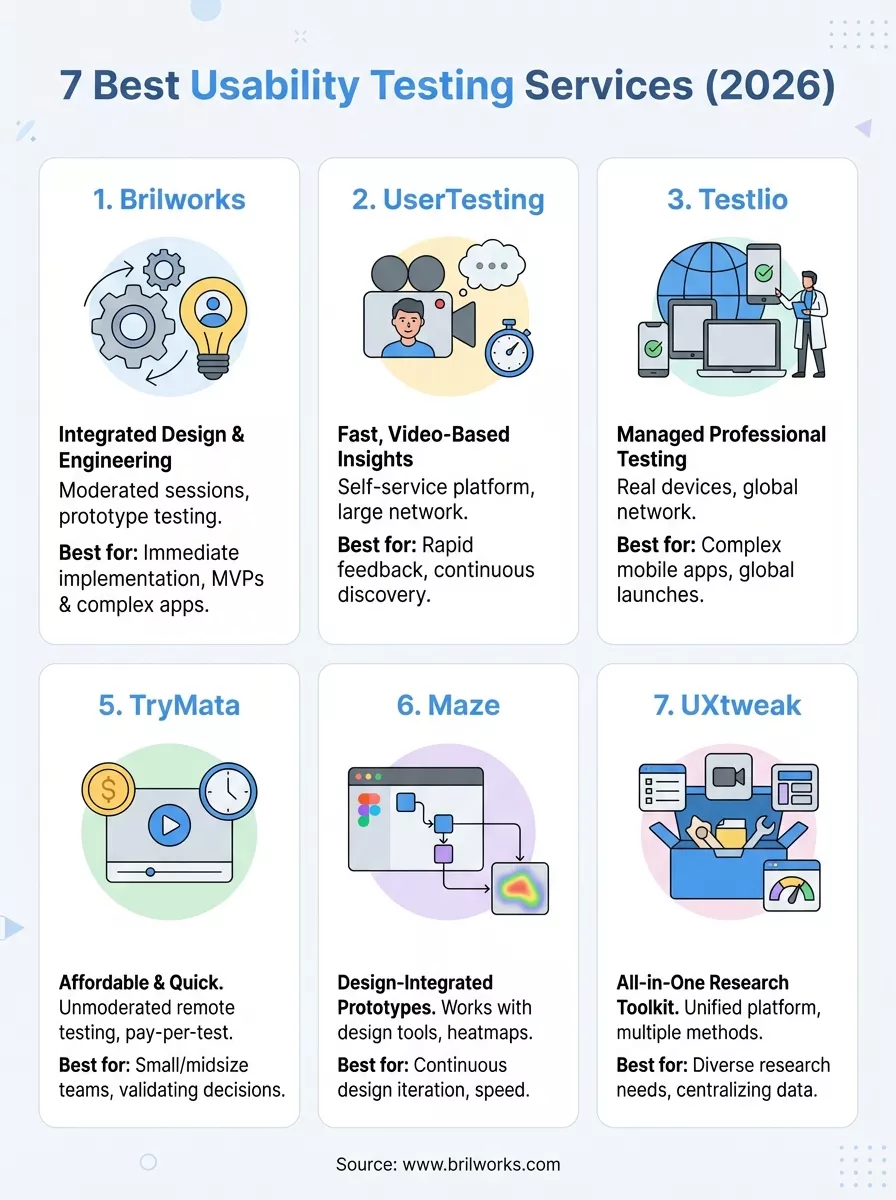
You now have seven solid options for usability testing services that match different team sizes, budgets, and research needs. The right choice depends on whether you prioritize speed over depth, seamless integration with your existing design tools, or comprehensive support throughout the entire product development cycle. Each platform brings distinct strengths to different project contexts and team configurations.
Most teams benefit from running a pilot test with their top choice before committing to annual contracts or large-scale testing engagements. Start with one critical user flow or feature that your team debates internally, then see how real users actually interact with it. The insights from real participants often settle internal disagreements faster than any amount of speculation or assumptions about user behavior.
If your project requires testing integrated with actual product development rather than isolated research reports that sit unused, Brilworks combines usability research with technical implementation that turns findings into shipped improvements. Your testing reveals problems, but solutions require both design expertise and engineering capability working together from the start.
Usability Testing Services are platforms and tools that help businesses evaluate how real users interact with their websites, apps, or digital products. These Usability Testing Services connect you with test participants, provide recording and analysis tools, and deliver insights to identify user experience issues and improve product usability.
Usability Testing Services work by recruiting real users who match your target audience, having them complete specific tasks on your website or app while recording their screen, voice, and interactions. Most Usability Testing Services provide video recordings, heatmaps, analytics, and written feedback that reveal usability problems and user behavior patterns.
There are several types of Usability Testing Services including moderated remote testing platforms, unmoderated testing tools, card sorting services, tree testing platforms, first-click testing tools, and comprehensive research platforms. Different Usability Testing Services specialize in various testing methodologies to suit different research goals and budgets.
Usability Testing Services pricing varies widely: basic plans start at $50-$100 per month for limited tests, mid-tier Usability Testing Services range from $200-$500 monthly, and enterprise solutions can cost $1,000-$5,000+ per month. Per-test pricing from Usability Testing Services typically ranges from $30-$150 per participant depending on targeting requirements.
The best Usability Testing Services for small businesses include UserTesting, Maze, UsabilityHub, and Lookback, which offer affordable plans, quick turnaround times, and user-friendly interfaces. These Usability Testing Services provide essential features without requiring extensive research experience or large budgets.
Get In Touch
Contact us for your software development requirements
Get In Touch
Contact us for your software development requirements

Hello, we are BRILLIAN’S. Trying to make an effort to put the right people for you to get the best results. Just insight !

 503, Fortune Business Hub, Science City Road, Sola, Ahmedabad, Gujarat, India Pincode- 380060
 + 91 9313644148
 sales@brilworks.com


