COOPERATION MODEL
ARTIFICIAL INTELLIGENCE
PRODUCT ENGINEERING
DevOps & Cloud
LOW-CODE/NO-CODE DEVELOPMENT
INDUSTRY
FRONTEND DEVELOPMENT
CLOUD DEVELOPMENT
MOBILE APP DEVELOPMENT
LOW CODE/ NO CODE DEVELOPMENT
EMERGING TECHNOLOGIES



 6 mins read
 Last updated March 6, 2026
Every business leader eventually faces the same question: should we build an app? Before you can answer that, you need to understand what is mobile app development, the end-to-end process of designing, building, and launching software for smartphones and tablets. It's more than just writing code; it involves strategic decisions about platforms, technologies, user experience, and ongoing maintenance.
At Brilworks, we've helped startups and enterprises navigate these decisions while building custom iOS and Android applications. That hands-on experience has shown us what founders and CTOs actually need to know before starting a mobile project, and what they can skip.
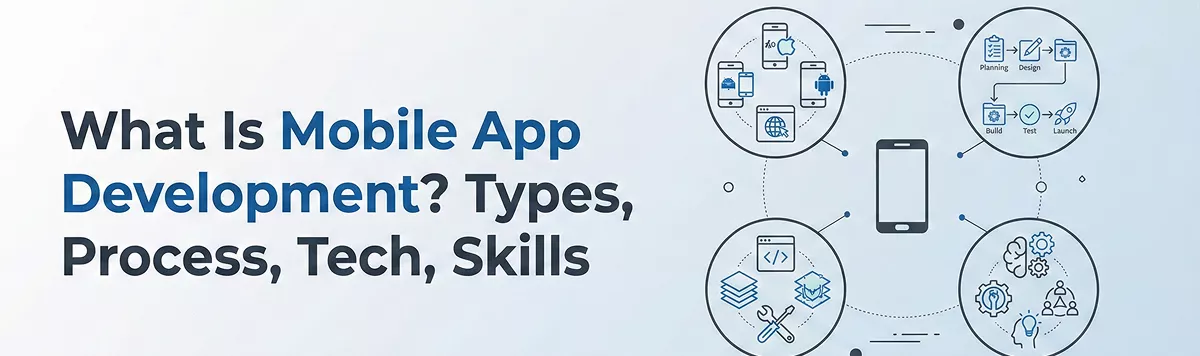
This guide breaks down the types of mobile development approaches (native, hybrid, cross-platform), walks through each phase of the development lifecycle, and covers the core technologies and skills involved. By the end, you'll have a clear framework for evaluating your own mobile app strategy.
Mobile applications have shifted from nice-to-have marketing assets to core business infrastructure. Your customers expect instant access to your services through their phones, and your competitors are already meeting that expectation. Understanding what is mobile app development becomes critical when you realize that consumer spending on mobile apps reached over $170 billion in 2025, and that figure continues to climb as mobile-first behavior becomes the default across all age groups.
Apps create new revenue streams through direct transactions, subscriptions, and in-app purchases that traditional websites struggle to match. You can push notifications directly to users' devices, driving higher engagement rates compared to email or social media. Payment integration with Apple Pay and Google Pay removes friction from checkout, increasing conversion rates by 20 to 30 percent for most retail categories.
The retention advantage matters more than most executives realize. Mobile users who download your app demonstrate 30 to 40 percent higher lifetime value than those who only visit your website. You gain persistent visibility on their home screens, which translates to more frequent interactions and stronger brand recall. Push notifications let you re-engage dormant users with personalized offers based on their previous behavior.
Internal mobile applications transform how your teams work in the field. Service technicians access real-time inventory data, sales representatives update CRM records instantly, and managers approve requests without returning to their desks. These efficiency gains compound quickly; businesses typically see 15 to 25 percent productivity improvements after deploying custom field apps for operational teams.
Your competitors who ship mobile apps first establish the user experience standard in your industry.
Market positioning becomes harder to defend without a mobile presence. When your direct competitors offer seamless mobile experiences, customers view your business as outdated regardless of your actual capabilities. This perception gap costs you deals, especially in B2C sectors where mobile convenience drives purchase decisions more than price or features.
Mobile apps give you first-party data that third-party cookies and web analytics cannot match. You track exactly how users navigate your features, where they struggle, and what drives conversions or churn. This behavioral data feeds into product improvements and marketing optimization with precision that web-only businesses cannot achieve.
Location services add another dimension to your customer understanding. You analyze geographic usage patterns, optimize delivery routes, and trigger location-based promotions when users enter specific areas. Combining this location data with purchase history and app behavior creates detailed customer profiles that drive personalized experiences at scale.
When you ask what is mobile app development, you need to understand that three distinct approaches exist, each with specific technical trade-offs and business implications. Your choice between native, hybrid, and cross-platform development affects everything from development speed to user experience quality. Most CTOs make this decision based on budget and timeline without fully considering the long-term maintenance costs and performance limitations.
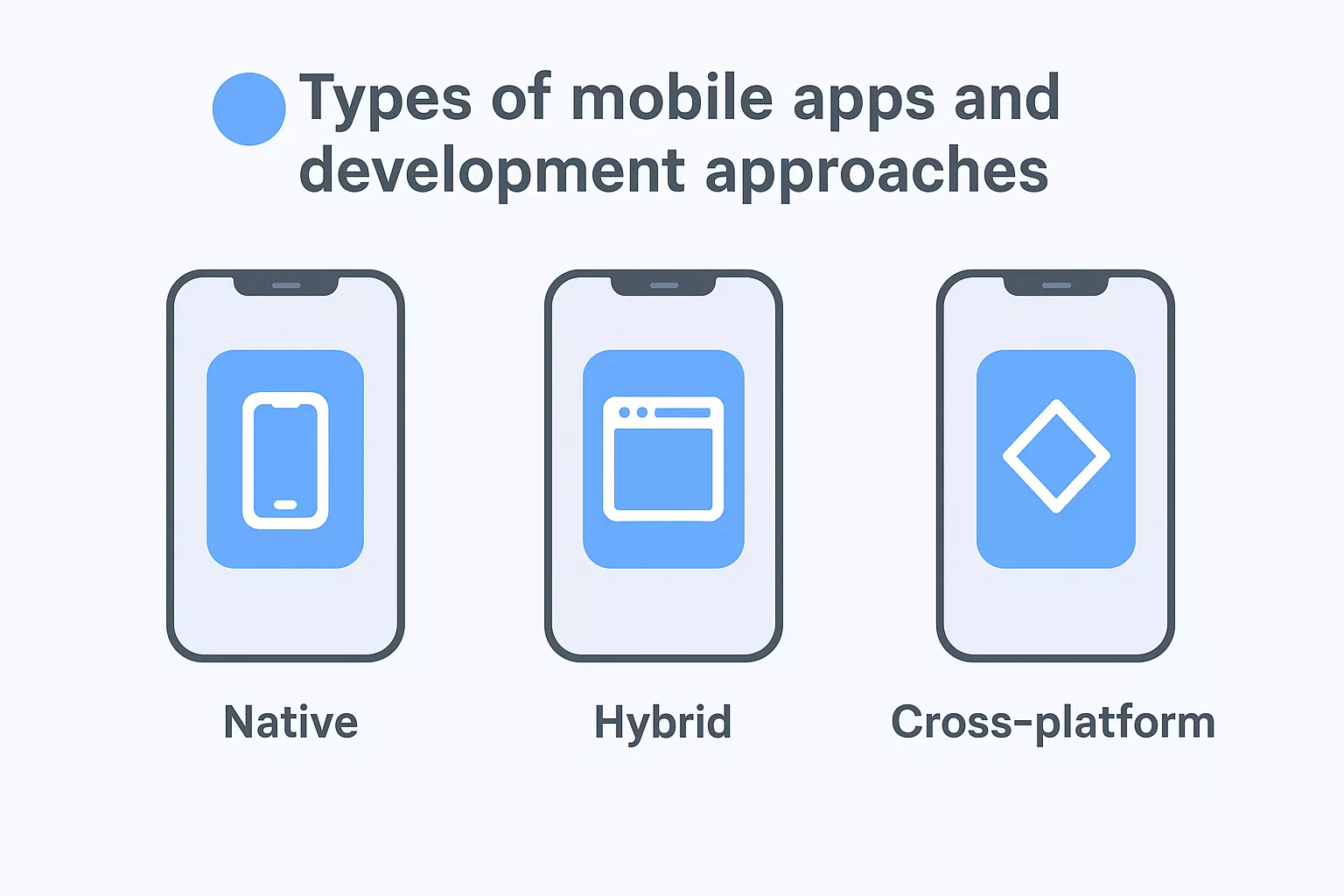
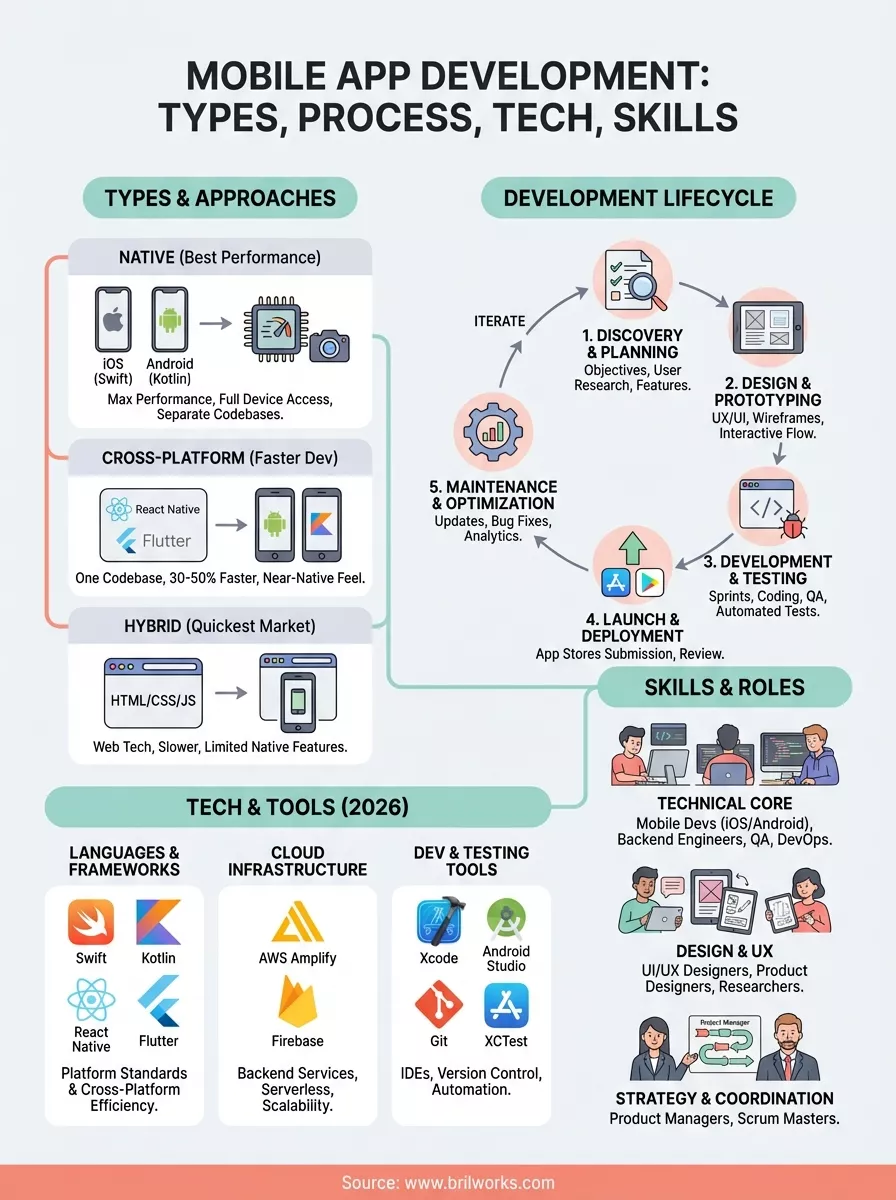
Native apps run directly on a specific operating system using platform-specific programming languages: Swift or Objective-C for iOS, and Kotlin or Java for Android. You build separate codebases for each platform, which doubles your initial development effort but delivers superior performance and user experience. Native development gives you complete access to device features like cameras, GPS, and sensors without workarounds or compatibility layers.
Building native means investing in the highest quality user experience at the cost of longer development cycles.
Financial apps, gaming applications, and enterprise tools with heavy data processing typically require native development. The performance difference becomes obvious when you handle complex animations, process large datasets, or need offline functionality that feels instant. You also ship updates faster through each platform's store because native code integrates seamlessly with OS updates.
Cross-platform frameworks like React Native and Flutter let you write one codebase that compiles for both iOS and Android. You cut development time by 30 to 50 percent compared to building two native apps, which matters when you need to validate your concept quickly or operate with limited engineering resources. These frameworks have matured significantly; many users cannot tell the difference between well-built cross-platform apps and native ones.
Hybrid apps use web technologies wrapped in native containers, offering the fastest path to market but with noticeable performance limitations. You sacrifice some native features and experience slightly slower rendering speeds, which becomes problematic for apps requiring smooth animations or intensive graphics processing.
Understanding what is mobile app development requires breaking down the end-to-end process into distinct phases that every successful project follows. Most failed apps skip or rush through early planning stages, then struggle to recover when fundamental assumptions prove wrong. You need a structured approach that balances speed with strategic thinking, especially when stakeholders push for immediate launches without proper validation.
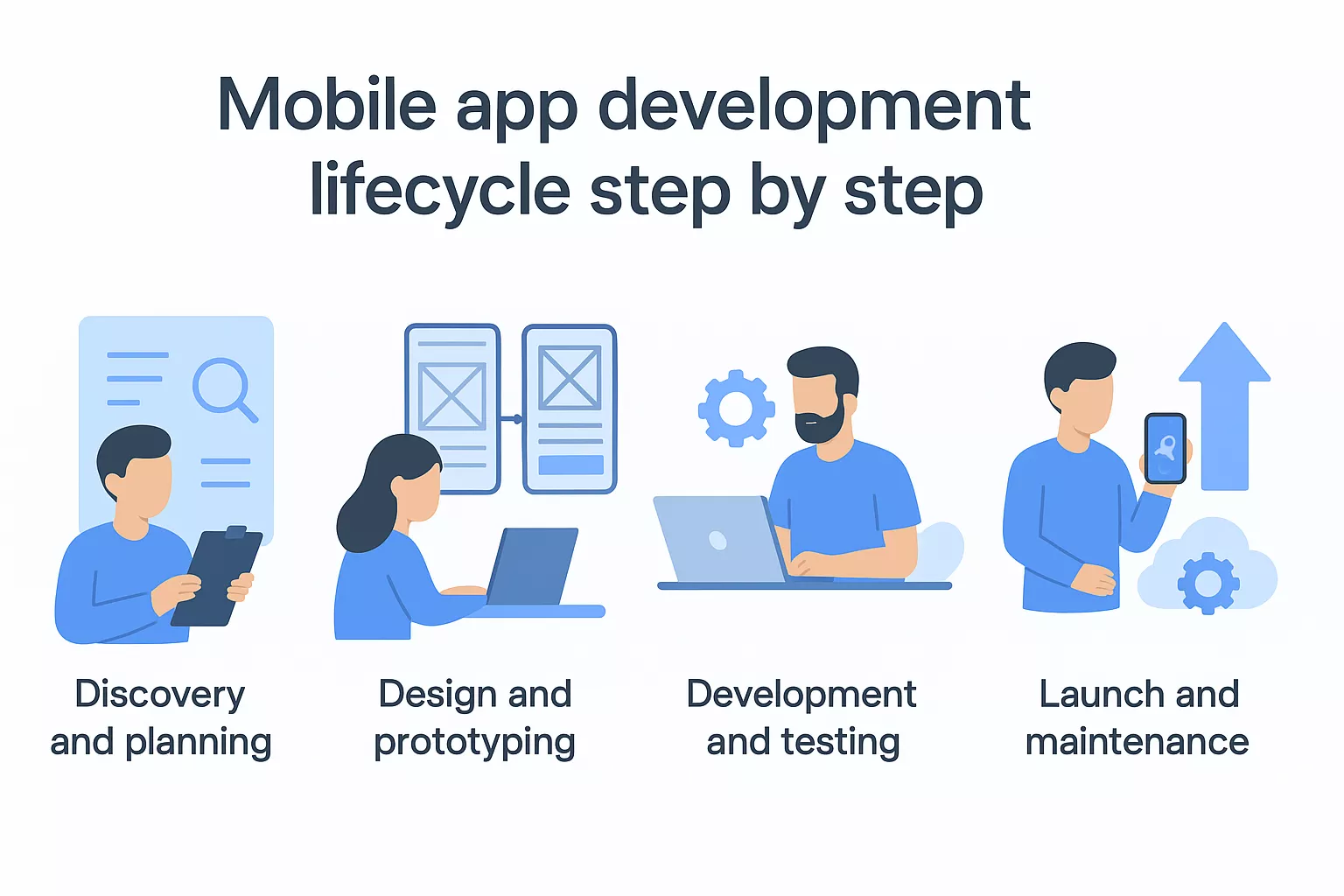
Your team starts by defining core objectives and identifying your target users through research and competitive analysis. You document specific features, prioritize them based on business impact, and estimate resource requirements. This phase typically takes two to four weeks but prevents months of wasted development on features nobody needs.
Market research reveals what similar apps already offer and where gaps in user satisfaction exist. You validate assumptions through user interviews and analyze app store reviews of competitors to understand what frustrates their customers most.
Designers create wireframes and interactive prototypes that let stakeholders test the user flow before any code gets written. You iterate on these designs based on feedback, refining the interface until navigation feels intuitive and information architecture makes sense to actual users. Investing three to five weeks in design prevents expensive rebuilds during development.
Prototyping catches usability problems when fixing them costs hours instead of weeks.
Engineers build the app in sprint cycles, typically two weeks each, delivering working features you can test continuously. Quality assurance teams write automated tests and manually verify that each function works across different devices and operating systems. Backend integration happens in parallel, connecting your app to databases and third-party services.
Beta testing with real users uncovers issues that internal teams miss, from confusing button placement to performance problems on older devices. You fix critical bugs and collect usage data that guides final optimizations before launch.
You submit your app to the App Store and Google Play, following each platform's specific guidelines and review processes. Post-launch monitoring tracks crash rates, user behavior, and performance metrics that inform your update roadmap. Regular maintenance includes security patches, OS compatibility updates, and feature improvements based on user feedback and analytics.
The technology stack you choose determines both immediate development speed and long-term maintenance complexity. Understanding what is mobile app development in 2026 means recognizing that the ecosystem has consolidated around proven frameworks while adding AI-powered development assistance. Your technical decisions lock you into specific upgrade paths and talent pools, so you need to evaluate technologies based on your team's existing skills and five-year product roadmap.
Swift remains the standard for iOS development, offering seamless integration with Apple's ecosystem and access to the latest iPhone features. Google officially recommends Kotlin for Android apps, which reduces boilerplate code compared to Java while maintaining full compatibility with existing Android libraries. Both languages receive regular updates that improve performance and developer productivity.
Cross-platform development has matured significantly. React Native lets JavaScript developers build mobile apps using familiar web development patterns, while Flutter delivers near-native performance through compiled code and its own rendering engine. Flutter's widget system produces consistent interfaces across platforms without platform-specific adjustments, which speeds up UI development by 40 to 50 percent compared to maintaining separate native designs.
Your app needs reliable backend infrastructure to handle user authentication, data storage, and API integrations. AWS provides the most comprehensive mobile services through AWS Amplify, offering authentication, storage, and serverless functions that scale automatically. Firebase remains popular for rapid prototyping because its real-time database and built-in authentication reduce backend development time.
Cloud infrastructure choices in 2026 focus less on features and more on AI integration capabilities.
Modern apps leverage serverless architectures that eliminate server management overhead while reducing costs for applications with variable traffic patterns. You deploy backend functions that respond to specific events, paying only for actual compute time rather than maintaining constantly running servers.
Integrated development environments like Xcode for iOS and Android Studio handle code editing, debugging, and performance profiling in unified interfaces. Teams use Git-based version control through GitHub or GitLab to manage code changes and coordinate across distributed developers. Automated testing frameworks including XCTest and Espresso catch bugs before users encounter them, running hundreds of test scenarios in minutes.
Building a successful mobile app requires specialized talent across multiple disciplines, each contributing unique skills to transform your concept into a functioning product. Understanding what is mobile app development from a team perspective means recognizing that you need both technical expertise and strategic thinking, not just programmers who write code. Your hiring decisions determine whether your project ships on time, scales effectively, and delivers the experience users expect.
Mobile developers write the application code using platform-specific languages or cross-platform frameworks like React Native and Flutter. iOS developers master Swift and Apple's development patterns, while Android developers work with Kotlin and Android Studio. You need backend engineers who build APIs, manage databases, and handle server-side logic that powers your app's features and stores user data securely.
Quality assurance engineers test your app across different devices and operating systems, identifying bugs before users encounter them. DevOps specialists set up continuous integration pipelines that automate testing and deployment, reducing the time between code commits and app store releases from days to hours.
Technical depth matters more than team size when building mobile applications that need to perform reliably at scale.
UI/UX designers create interface mockups and user flows that balance visual appeal with intuitive navigation. They conduct user research, build prototypes, and iterate based on feedback and usability testing. Product designers think beyond individual screens to map entire user journeys, ensuring every interaction supports your business objectives while meeting user needs.
Product managers define feature priorities and maintain the roadmap, making trade-off decisions when technical constraints conflict with business goals. They communicate between stakeholders and engineers, translating business requirements into technical specifications that development teams can execute. Scrum masters or project coordinators keep teams synchronized, removing blockers and ensuring consistent progress toward launch milestones.
You now understand what is mobile app development encompasses, from choosing between native and cross-platform approaches to assembling the right team and navigating each phase of the development lifecycle. The strategic decisions you make early about technology stacks, development methodologies, and cloud infrastructure determine both your time to market and long-term maintenance costs. This knowledge gives you a framework for evaluating vendors, setting realistic budgets, and understanding what timeline expectations make sense for your project scope.
Starting your mobile project requires matching your business objectives with the right technical approach and experienced partners who understand your industry's specific requirements. Brilworks specializes in building custom mobile applications for iOS and Android using React Native and Flutter, delivering MVPs in accelerated timeframes while maintaining code quality and scalability. Our team combines AI integration expertise with AWS infrastructure knowledge to build apps that perform reliably under real-world conditions and adapt to growing user demands.
Ready to discuss your mobile app requirements? Connect with our product engineering team to explore how we can transform your concept into a launched application.
Mobile App Development is the process of creating software applications that run on mobile devices like smartphones and tablets. Understanding what is Mobile App Development involves knowing it encompasses planning, designing, coding, testing, and deploying apps for iOS, Android, or cross-platform environments. Mobile App Development combines technical skills, user experience design, and business strategy to create functional, engaging mobile applications.
When exploring what is Mobile App Development, there are three main types: Native App Development (platform-specific apps built with Swift/Kotlin), Cross-Platform Development (single codebase using React Native/Flutter), and Hybrid Development (web technologies wrapped in native containers). Each type of Mobile App Development offers different advantages in terms of performance, cost, and development speed.
The Mobile App Development process typically includes these stages: ideation and research, planning and strategy, UI/UX design, development and coding, quality assurance testing, deployment to app stores, and ongoing maintenance. Understanding what is Mobile App Development means recognizing that each phase is crucial for creating successful, user-friendly applications that meet business objectives.
Technologies in Mobile App Development include programming languages like Swift and Objective-C for iOS, Kotlin and Java for Android, JavaScript for cross-platform frameworks, and tools like Xcode, Android Studio, React Native, and Flutter. Knowing what is Mobile App Development requires familiarity with these technologies, backend services, databases, APIs, and cloud platforms that power modern mobile applications.
Essential skills for understanding what is Mobile App Development include programming proficiency in relevant languages, UI/UX design principles, problem-solving abilities, knowledge of mobile platforms and guidelines, API integration, database management, version control (Git), testing methodologies, and soft skills like communication and project management. Mobile App Development requires both technical expertise and creative thinking.
Get In Touch
Contact us for your software development requirements
Get In Touch
Contact us for your software development requirements

Hello, we are BRILLIAN’S. Trying to make an effort to put the right people for you to get the best results. Just insight !

 503, Fortune Business Hub, Science City Road, Sola, Ahmedabad, Gujarat, India Pincode- 380060
 + 91 9313644148
 sales@brilworks.com


