CASE STUDY

How Brilworks Doubled Coding Speed at Two Clients with Claude Code

Brilworks's anonymized case study on rolling out Claude Code at two product engineering teams: ~2x coding-speed lift, the four-step playbook, and where the agent does and doesn't compound.

Category: Engineering Enablement / B2B SaaS
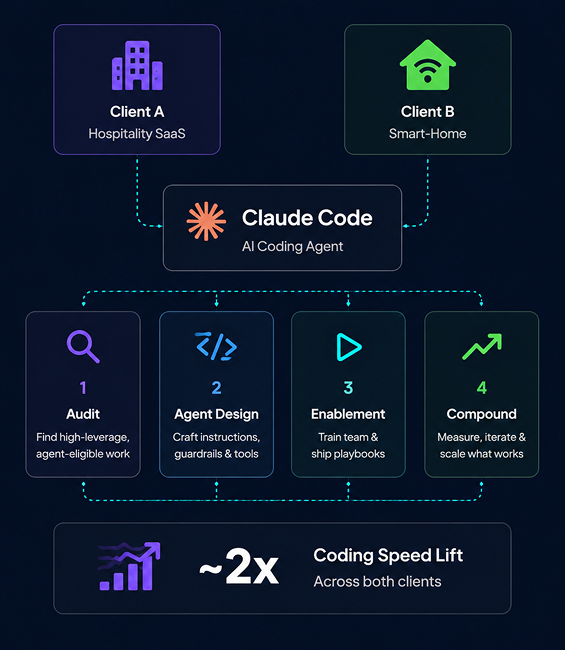
~2x
Productivity gain on agent-eligible tasks (both clients)
2
Clients across different industries (hospitality SaaS + smart-home)
3
Stage rollout: audit, agent design, enablement
Overview

The Challenge & Vision

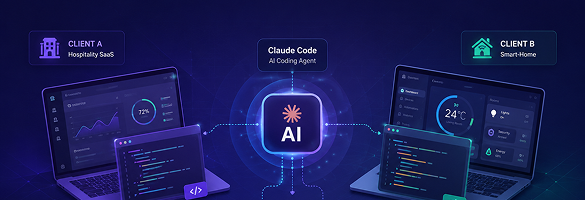
Two of our clients adopted Claude Code with Brilworks's help in the last two quarters. One was a hospitality / restaurant-tech SaaS we'll call HostCo; the other was a smart-home and connected-device platform we'll call HomeCo (real names withheld under NDA). Different industries, different stacks, but the same engineering reality: senior-engineer leverage was getting eaten by integration boilerplate, deferred refactors, and — at HomeCo — cross-runtime tickets touching firmware, backend, and mobile in a single change. Both teams had tried ad-hoc AI assistants; the results were uneven. They wanted leverage, not novelty. By the end of each engagement, both teams reported a roughly 2x productivity improvement on agent-eligible tasks.

Get the Full Case Study

Architecture decisions, design process, and detailed results — in a shareable PDF.

No spam — just the case study PDF.

5★ ClutchNDA Available120+ Products

Where senior engineering time was going

Across both engagements, the same patterns kept eating throughput. Different industries, different stacks — same shape of bottleneck:

  • Customer-specific integration scaffolding — payment gateways, POS connectors, loyalty platforms, marketing-automation hooks at HostCo: important per deal but boilerplate per ticket.
  • Long-deferred refactors blocked behind capacity constraints — at both clients, large refactors slipped quarter after quarter because nobody had a free week to take them on.
  • Test coverage gaps in older modules at HostCo — every change in those modules ran slower than it should have because of missing safety nets.
  • Cross-runtime tickets at HomeCo — telemetry fields, alert types, permissions touching firmware, cloud, and mobile in a single change, with domain knowledge concentrated in a few senior engineers.
  • Hardware compatibility constraints at HomeCo — legacy modules accumulated faster than in pure-cloud SaaS because rewrites were expensive.
  • No standard at either team for which tasks were worth handing to an AI assistant and which were not.
img-c
Solution

What We Built

Building Something Similar?

We Take on 3-4 New Mobile Projects Per Quarter

Tell us about your app idea — we'll show you how we'd approach the architecture, design, and launch.

More Success Stories

Work That Speaks For Itself

Named clients. Verified outcomes. Not just pretty screenshots.