8 mins read
Summarize with AI:


Data
AI
The Stack Underneath
Two teams pull revenue numbers from the same warehouse table and get two different answers. Nobody can say why. That's usually the moment a data governance framework stops being a nice-to-have and becomes the thing standing between your data team and a very uncomfortable meeting.
Before that moment, governance is whatever the most senior person in the room remembers from the last audit. It holds up fine. Right up until two teams touch the same table with different assumptions about what "clean" means, and then ownership is the first thing that goes missing.
This is where we get into what actually makes a framework work: the components, the ownership model, how DAMA-DMBOK, DCAM, and COBIT differ from the custom builds most enterprises land on, and a real starting point if you're building from zero. Whether you're the executive asking why the numbers don't match or the person on the hook for fixing it, the answer's in here somewhere.
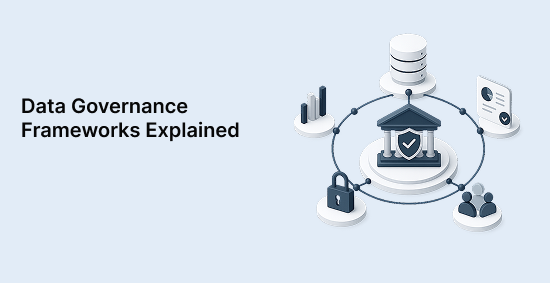
A data governance framework is the structure that ties data ownership, policies, quality standards, and accountability into one operating model. It defines who owns which data, what rules apply to it, how quality gets measured, and who answers for it when something breaks.
It's not a tool you buy. It's not a document that sits in a shared drive after the kickoff meeting. It's the thing that makes governance something a company actually does, day to day, instead of something it talks about doing once a year during audit season.
Most companies don't build a data governance framework because they want to. They build one because the alternative already cost them something. A compliance fine. A decision made on numbers nobody verified. A merger that stalled because two systems couldn't agree on what "customer" meant. We've seen clients arrive at this point after their third failed audit, not their first.
Data governance is not the same as data management. Data management is the doing. It's moving data, storing it, processing it, building the pipelines. Governance is the deciding: who's allowed to touch what, what "good" data looks like, and who's accountable when it isn't. You can have excellent data management and zero governance. Plenty of companies do, right up until two departments disagree on a number in a board meeting.
A working data governance strategy is built around a few clear goals:
Make ownership explicit, so "who owns this table" has a one-word answer, not a Slack thread.
Keep data consistent enough that teams stop re-verifying each other's numbers before every meeting.
Meet compliance obligations without a fire drill every time an auditor asks a question.
Give the business, and the AI systems now sitting on top of that data, something reliable to run on.
Get these right, and governance stops being a project with an end date. It becomes how the company runs.
AI systems don't catch bad data. They amplify it. A model trained on inconsistent, duplicated, or poorly labeled data doesn't fail loudly, it just makes confidently wrong decisions that look reasonable until someone checks the source. Governance is what stands between an AI initiative and that outcome.
The numbers back this up. 97% of organizations that had an AI-related security incident lacked proper AI access controls, and 63% had no AI governance policies in place at all to manage AI or prevent shadow AI, according to IBM's Data Breach Report. Before a team runs an AI readiness audit to check whether their infrastructure can support this, the data governance strategy underneath it needs to be solid first. Otherwise the audit just confirms a problem nobody's fixed yet.
Regulatory pressure on data isn't slowing down. GDPR set the baseline in Europe, India's DPDP Act is now active and applies to any company handling Indian users' personal data, and sector-specific rules keep stacking on top for healthcare, finance, and fintech companies. A data governance framework isn't optional anymore. It's the mechanism that keeps a company from finding out about a violation from a regulator instead of from its own audit.
Most companies don't run on one system anymore. Data lives in a warehouse, a lake, a handful of SaaS tools, and at least one cloud platform, often more than one. A team running Databricks for data engineering and Snowflake for analytics has to govern both consistently, or the two platforms drift into two different versions of the truth. Every additional platform is another place data can get duplicated or lose its lineage entirely. Governance is what keeps a single source of truth possible when the data itself is scattered across six different places.
A dashboard is only as trustworthy as the data behind it. Without governance, two teams pulling from the same source can land on two different numbers, and nobody can say which one is right without a manual audit. With it, the business stops re-verifying its own reports and starts acting on them.
The global average cost of a data breach in 2025 was $4.4 million, a 9% decrease from the year before, driven largely by faster identification and containment. That drop didn't happen by accident. Organizations with mature data governance find and contain incidents faster because they already know what data they have, where it lives, and who's responsible for it. Governance doesn't just reduce the chance of a breach. It shortens how long one stays open.
Every dataset needs a named owner, not a team, not a department, an actual person accountable for its accuracy and use. Without this, "who's responsible for this table" turns into a Slack thread that goes nowhere. Ownership means someone signs off on changes, answers for quality issues, and has the authority to enforce policy on that data.
Policies define what's allowed: who can access what, how data gets classified, how long it's retained, and what "acceptable use" actually means in practice. Standards are the specifics underneath the policy, like naming conventions, required fields, and format rules. Without both, every team ends up inventing its own version of "good enough."
Bad data doesn't announce itself. It sits in a report looking exactly as credible as good data until someone downstream makes a decision on it. Data quality management is the ongoing discipline of checking for accuracy, completeness, consistency, and duplication before that happens, not after. Running a data quality assessment on your existing datasets is usually the fastest way to find out how deep the problem actually goes before building policy around it.
Metadata is data about your data: where it came from, when it was last updated, who touched it, and what it means in business terms. Without it, even accurate data is hard to trust, because nobody can verify its lineage or confirm what a field actually represents. Metadata management is what makes a dataset explainable instead of a black box.
A data steward is the person who does the day-to-day work that ownership requires. Owners are accountable at a high level. Stewards are the ones actually enforcing standards, fixing quality issues, and answering the specific questions that come up when someone else tries to use the data. Most frameworks fail at this layer, not because the policy was wrong, but because nobody was assigned to actually carry it out.
This component controls who can access data, how personal information gets protected, and how the company meets obligations like GDPR or the DPDP Act. It overlaps with policy, but it deserves its own place in the framework because a security gap doesn't just break a rule, it exposes the company to real financial and legal risk.
None of the components above work without a process that ties them together: how new data gets classified, how policy exceptions get approved, how quality issues get escalated and resolved. A framework without process is just a list of good intentions. The process is what turns governance from a document into something the company actually runs on.
Most companies don't build a governance framework from a blank page. They start from one of a handful of established models, then adapt it to fit how their teams actually work. Here's what the major ones actually offer, and where each one tends to fall short.
DAMA-DMBOK is the closest thing the industry has to a comprehensive reference. It covers eleven knowledge areas, from data architecture to metadata to data security, and most other frameworks borrow from it in some form. The tradeoff is size. It's dense enough that most companies use it as a reference to build from, not something to implement wholesale.
DCAM is built around a maturity model, scoring an organization across capability areas so leadership can see exactly where the gaps are. It's popular in financial services, where regulators expect measurable proof of governance maturity, not just a policy document. Outside heavily regulated industries, it can feel like more structure than the problem needs.
COBIT approaches governance from the IT and risk management side rather than the data side specifically. It's strong for companies that already run their technology function on COBIT for other reasons and want data governance to plug into the same model, rather than running two separate governance systems side by side.
Most mid-size companies end up here eventually. They take pieces of DAMA-DMBOK for structure, borrow DCAM's maturity scoring to track progress, and drop the parts that don't match their size or industry. A custom framework isn't a shortcut. It's usually the more disciplined path, because it forces a company to decide what governance actually needs to cover instead of implementing a framework's full scope by default.
Building a framework isn't a single project with a finish line. It's a sequence of decisions, each one making the next step possible. Here's the order that actually works.
Start with why governance matters to your company specifically, not a generic mission statement. Is it AI readiness, regulatory compliance, better analytics, a merger that needs clean data on both sides? The goal decides everything downstream, including how strict the framework needs to be.
Before writing a single policy, find out what you're actually working with: where data lives, how many systems touch it, and how bad the quality problem really is. A data quality assessment at this stage tells you whether you're building a framework or fighting a fire first.
Write the rules for access, classification, retention, and acceptable use based on what step 2 actually revealed, not a template pulled from another company's framework.
Every dataset gets a named owner and, where the volume justifies it, a steward who handles the daily work. Skip this step and every other step above it stops mattering within a quarter.
Fix the specific issues the maturity assessment surfaced. This is usually the slowest step and the one companies most want to skip. Don't.
Data catalogs, lineage tools, and policy enforcement software make the framework operational instead of aspirational. Technology comes after the policy and ownership work, not before it. Buying a governance platform before deciding who owns what just gives you an expensive place to store confusion.
Governance isn't a project that ends. Track data quality scores, policy compliance, and how fast issues get resolved, then revisit the framework as the business and its data actually change.
A framework only works if specific people are accountable for specific parts of it. Here's who needs to be in the room.
An executive sponsor is the person who gives governance actual authority inside the company, usually a CDO, CIO, or someone at that level. Without one, governance policies are suggestions that teams follow when convenient and ignore when a deadline gets tight.
Data owners are accountable for a specific dataset or domain, not the whole governance program. They approve access requests, sign off on quality standards, and answer for that data when something goes wrong. This role sits with someone who understands the business context, not necessarily someone in IT.
Data stewards handle the daily execution that ownership requires: enforcing standards, fixing quality issues, and answering the specific questions that come up when someone else tries to use the data. Most governance programs that stall did assign owners. They just never assigned stewards to do the actual work underneath them.
IT and engineering build the infrastructure that governance runs on: access controls, data catalogs, lineage tracking, and the pipelines that move data in the first place. They implement the policy. They don't usually write it, which is a distinction that avoids a lot of friction later.
Business users are the reason governance exists in the first place. They're the ones pulling reports, building dashboards, and making decisions on the data underneath. Leaving them out of the process is how companies end up with a framework built for compliance that nobody on the ground actually finds useful.
These are the practices that separate a governance program that actually runs from one that exists on paper. Most of them sound obvious. Most companies still get them wrong.
Anchor the governance program to a specific business outcome, not a compliance checkbox. We've seen companies write a 40-page governance policy before anyone asked what problem it was solving. It got approved. It never got followed, because nobody could explain what it was actually for. A data governance strategy tied to "we need clean data for the AI system we're building this quarter" survives budget cuts. One tied to "governance is best practice" doesn't.
Don't try to govern every dataset in the company on day one. Pick the data that drives revenue decisions, regulatory reporting, or customer trust, and get that right before expanding. Trying to govern everything at once is how most programs stall out in month two.
Every dataset needs a name attached to it, not a department. "The analytics team owns this" isn't ownership. It's a description of who to email when something breaks and wait three days for a reply. A real owner has a name, answers for quality issues directly, and has the authority to say no to a bad access request.
Track data quality scores, policy compliance rates, and time-to-resolution on data issues. Without numbers, governance is just an opinion about whether things are going well, and opinions don't survive a budget review. Pick two or three metrics that actually connect to the business goal from step one. Tracking twenty metrics nobody reads is worse than tracking none.
Use consistent naming conventions, definitions, and classifications across every system that touches the data. Inconsistent metadata is one of the fastest ways a governance program quietly falls apart, because two teams end up building reports on fields they think mean the same thing and don't.
Manual policy enforcement doesn't scale past a handful of datasets. It works fine in a pilot with three tables. It falls apart at three hundred. Automated data quality checks, access controls, and lineage tracking are what let the framework hold up as the company's data grows, not another headcount request.
A framework built for last year's data volume and last year's regulations won't fit this year's. Revisit the policies, the ownership assignments, and the KPIs on a set schedule, not only when something breaks. Quarterly is usually often enough. Annually is usually too slow.
We touched on this distinction earlier: management is the doing, governance is the deciding. Here's the full comparison.
|
Data Governance |
Data Management | |
|
Purpose |
Sets the rules for who can access, use, and trust data |
Executes the technical work of moving and storing data |
|
Scope |
Policy, accountability, compliance, quality standards |
Pipelines, databases, storage, integration |
|
Ownership |
Business-side owners and stewards |
IT and data engineering teams |
|
Success metrics |
Policy compliance, data trust scores, audit readiness |
Uptime, pipeline reliability, query performance |
The two aren't competing functions. Data management builds and runs the systems. Data governance decides what those systems are allowed to do and who answers for it when they don't. A company can have flawless data pipelines and still fail an audit, because pipelines don't decide who's allowed to see what. That decision belongs to governance.
Most governance programs that fail didn't fail on the technical side. They failed because someone assumed good data management was the same thing as governance, and nobody assigned an owner until it was already a problem.
A data governance framework isn't a document you finish and file away. It's ownership assigned to real people, policies tied to an actual business goal, and a process that gets revisited as the data changes. Skip any of those three, and the framework looks complete on paper while doing nothing in practice.
If your team is further along than "we need a framework" and closer to "we have policies nobody follows," the fix isn't more documentation. It's going back to step four: assign real owners, not departments, and see how much of the current dysfunction clears up on its own.
A data governance framework is the structure that ties data ownership, policies, quality standards, and accountability into one operating model. It defines who owns what data, what rules apply to it, and who answers for it when something breaks.
Most frameworks build around five pillars: data quality, data stewardship, data security and privacy, metadata management, and policy and compliance. Different frameworks name them slightly differently, but the core coverage stays consistent across DAMA-DMBOK, DCAM, and most custom builds.
The 5 C's are consistency, completeness, compliance, confidentiality, and control. It's a simpler way some organizations frame governance goals, especially when communicating them to non-technical stakeholders who don't need the full DAMA-DMBOK vocabulary.
Data management is the doing: moving data, storing it, processing it, building the pipelines. Data governance is the deciding, meaning who's allowed to touch what, what "good" data looks like, and who's accountable when it isn't. You can have strong data management and zero governance, and plenty of companies do.
Most mid-size companies see a working framework in three to six months, covering the maturity assessment, policy creation, and ownership assignment. Full maturity, where the framework runs without constant manual intervention, usually takes twelve to eighteen months. Companies that skip the maturity assessment and jump straight to policy tend to take longer, not shorter, because they end up rebuilding policies that didn't match reality.
Executive sponsorship typically sits with a CDO or CIO, but ownership at the dataset level belongs to business-side data owners, not IT by default. IT and engineering build the infrastructure governance runs on. They don't usually own the policy itself.
Financial services, healthcare, and fintech see the sharpest impact, since they carry the heaviest regulatory load and the highest cost of getting data wrong. That said, any company running AI on top of its data gets a real return from governance now, regardless of industry, because bad data undermines AI systems faster than it undermines a static report.
You might also like

Hello, we are BRILLIAN’S. Trying to make an effort to put the right people for you to get the best results. Just insight !