Last updated May 6, 2026
Spring Boot 3 vs Quarkus 3 vs Micronaut 4: Performance and Use Case Guide (2026)

5 mins read
Summarize with AI:


Data
AI
The Stack Underneath
Comparing Spring Boot, Quarkus, and Micronaut is a favorite topic among developers evaluating Java frameworks. While they often solve similar problems, their approaches, performance, and developer experience vary significantly.
Spring Boot has long been the go-to framework. It works well out of the box and is familiar to most teams. Quarkus, on the other hand, emphasizes container-first thinking with faster startup times and reduced memory usage. Micronaut focuses on compile-time processing to keep runtime lean and avoid reflection.
Though all three support core Java concepts, the differences under the hood affect everything from performance to debugging in production. This guide walks you through these nuances with a focus on real-world usage, not just idealized scenarios.
If you're planning to build a high-performance Java application and unsure which framework to go with, our team can help. We’ve worked extensively with Spring Boot, Quarkus, and Micronaut in real-world projects, and can guide you toward the right architecture. If you're looking to scale your team or need expert support, hire Java developers from us who bring deep technical insight and practical experience.
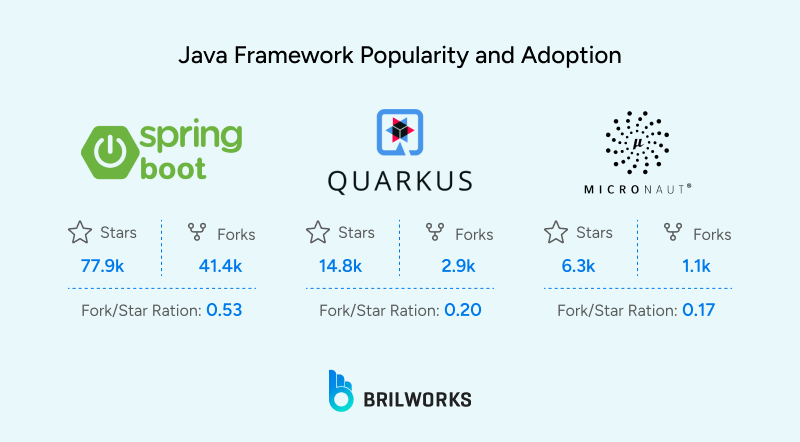
GitHub stats reveal the relative adoption of these frameworks. Spring Boot leads in both community size and activity, reflecting its long-standing presence in enterprise systems. Quarkus and Micronaut are growing steadily but remain smaller in reach.
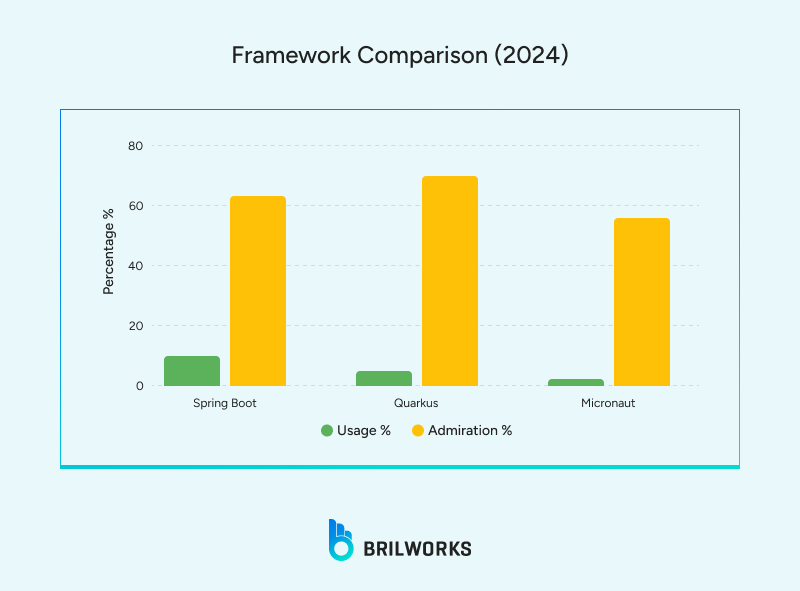
The Stack Overflow survey 2024 further illustrates usage. Spring Boot is widely adopted, while Quarkus scores high on developer admiration, highlighting a positive developer experience. Micronaut remains niche, particularly in embedded and resource-constrained environments.
As of May 2026: Spring Boot 3.4.x (Spring Framework 6.2). Java 17+ minimum; Spring Boot 2.x is end-of-life. AOT and Spring Native are stable.
Spring Boot is built on the Spring platform and simplifies application setup by automating most configurations. It is especially popular in enterprise environments and backend systems. The Spring ecosystem includes tools for web development, security, data access, messaging, and cloud integration, all seamlessly compatible with Spring Boot.
Auto-configuration: Reduces manual setup by configuring dependencies automatically.
Embedded Servers: Supports Tomcat, Jetty, and other servers without separate WAR deployment.
Spring Ecosystem Integration: Works smoothly with Spring Security, Spring Data, and Spring Cloud.
Production Readiness: Includes actuator endpoints, metrics, and health checks.
Dependency Management: Starter packages handle transitive dependencies cleanly.
Spring Data repositories return Stream<T> first-class, so request-handling logic leans on functional data processing with the Stream API by default — .filter() / .map() / .collect(toList()) rather than imperative loops.

Ideal Use Cases
Enterprise Applications: Stable libraries and complex business logic.
Monolithic Services: Internal modularization rather than distributed systems.
API Backends: REST APIs for web and mobile apps; consider Node.js and Spring Boot trade-offs.
Legacy System Integration: Fits environments reliant on the broader Spring stack.
Pros
Mature, well-documented, and widely adopted.
Broad library support for databases, messaging, and cloud-native features.
Strong integration with enterprise security standards.
Cons
Slower startup and higher memory usage.
Auto-configuration may complicate debugging.
Can feel heavy for small services.
As of May 2026: Quarkus 3.35.2 (LTS line on 3.33). Java 17+ required. GraalVM CE 23+ for native compilation.
Quarkus is optimized for fast startup, low memory usage, and container-first development. Created by Red Hat, it works well in serverless and cloud-native environments. Quarkus supports both JVM and native builds via GraalVM.
Fast Startup & Low Memory: Ideal for Kubernetes and serverless environments.
GraalVM Native Image Support: Compiles Java apps into native executables.
Reactive & Imperative Programming: Flexible approach depending on project needs.
Live Coding: Hot reload lets developers see changes instantly.
Extension Ecosystem: REST, Kafka, security, OpenAPI, and database support.
Ideal Use Cases
Cloud-Native Applications: Optimized for containers.
Serverless Functions: Short-lived processes benefit from minimal cold-start latency.
Microservices at Scale: Efficient for running many small services.
Native Builds: Reduced runtime overhead.
Pros
Very fast startup and low memory footprint.
First-class native image support.
Developer-friendly live reload experience.
Cons
Smaller ecosystem than Spring Boot.
Native builds require extra setup.
Less mature integration for some libraries.
Not ideal for large monolithic or legacy migrations.
As of May 2026: Micronaut 4.10.13. Java 17+ required. GraalVM 22.3+ for native; Micronaut AOT is a first-class build path.
Micronaut is a lightweight Java framework that reduces runtime overhead by shifting work to compile-time. Developed by the creators of Grails, it avoids reflection and is optimized for fast startup and low memory usage. It supports Java, Kotlin, and Groovy, with growing cloud-native capabilities.
Ahead-of-Time Compilation: Reduces runtime costs.
No Reflection: Keeps memory low, essential for native builds.
Minimal Runtime Overhead: Loads only required components.
Built-in HTTP Client and Server: Eliminates the need for external libraries for basic networking.
Multi-language Support: Works with Java, Kotlin, and Groovy.
Ideal Use Cases
Microservices in Lightweight Environments: Small memory footprint and fast startup.
GraalVM Native Images: Efficient for native builds.
Reactive Systems: Event-driven or non-blocking applications.
IoT or Embedded Systems: Fits resource-constrained devices.
Pros
Fast startup and low memory consumption.
Predictable runtime behavior.
Strong native image support.
Built-in tools for common tasks.
Cons
Smaller ecosystem and limited third-party extensions.
Documentation improving but not yet comprehensive.
Learning curve for AOT concepts.
Community smaller than Spring or Quarkus.
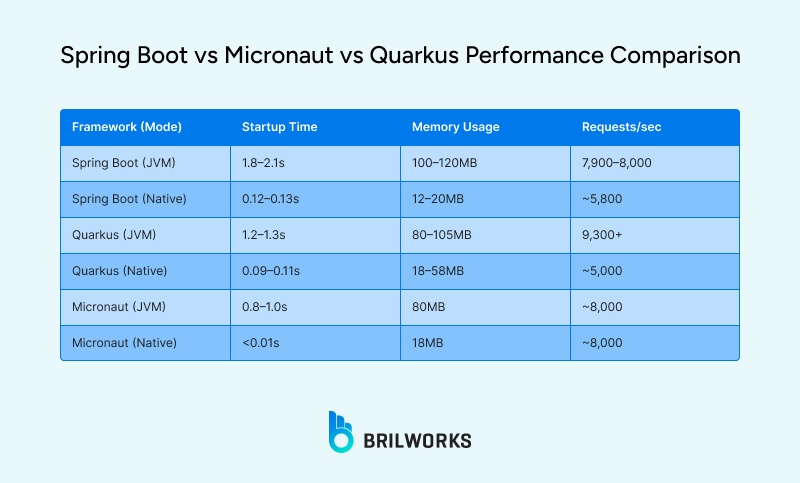
Performance is crucial for microservices or cloud-native projects. Startup time, memory footprint, and throughput vary between frameworks and deployment modes (JVM vs native).
|
Feature |
Spring Boot |
Quarkus |
Micronaut |
|
Startup Time (JVM) |
Moderate |
Faster than Spring |
Fastest |
|
Startup Time (Native) |
Fast |
Faster than Spring |
Fastest overall |
|
Memory Usage (JVM) |
High |
Moderate |
Low |
|
Native Image Support |
Spring AOT |
First-class GraalVM |
Built-in |
|
Developer Productivity |
High |
High |
Good (some learning curve) |
|
Documentation |
Extensive |
Well-organized |
Clean but limited |
|
Ecosystem & Libraries |
Broadest |
Solid |
Focused |
|
Community Support |
Very large |
Active |
Smaller but responsive |
|
Best Use Cases |
Enterprise apps, APIs |
Cloud-native apps |
Serverless, lightweight |
|
Learning Curve |
Gentle |
Medium |
Medium |
Key Notes:
Startup Time: Micronaut is fastest in native mode (<10ms), ideal for serverless workloads. Quarkus follows closely; Spring Boot is better suited for long-running services.
Memory Usage: Spring Boot consumes the most memory; Micronaut and Quarkus are more efficient, especially in native builds.
Throughput: Quarkus delivers top JVM throughput; Micronaut is competitive in both JVM and native modes. Native builds reduce memory and startup costs but may slightly impact throughput.
Mature tooling (Spring Initializr, IntelliJ/Eclipse support) and wide adoption make Spring Boot predictable. However, cold start times and runtime reflection can slow development cycles in large projects.
Across all three frameworks, modern Java idioms — lambda expressions and method references — are the default coding style for handlers, filters, and reactive pipelines.
Developer-friendly with hot reload via Dev Mode, CLI tools, and fast builds. Some unlearning needed for Spring developers. Ecosystem is growing, but tutorials for edge cases may be limited.
Compile-time processing ensures fast builds and predictable runtime. CLI tools simplify boilerplate generation. Some IDE integrations may require workarounds. Ideal for modern, annotation-driven microservices.
Spring Boot: Deep integrations with databases, messaging, cloud providers, and Spring Cloud. Reliable for enterprise-grade systems
Quarkus: Solid extensions for REST, gRPC, Kafka, Hibernate, OpenTelemetry, and Kubernetes. Smooth GraalVM support
Micronaut: Focused integrations for HTTP, gRPC, Kafka, RabbitMQ, Redis, and cloud providers (AWS, GCP, Azure). Less breadth but lean builds and efficient runtime.
Spring Boot: Large monoliths, distributed systems, APIs, batch jobs, internal tooling. Strength lies in stability and enterprise integration
Quarkus: Cloud-native, container-first microservices, serverless, and scale-to-zero workloads
Micronaut: Lightweight microservices, serverless apps, mobile backends, IoT, and edge computing. Prioritizes minimal startup and memory usage.
Framework choice is one of half a dozen decisions a microservices team has to get right — see our deeper guide to building Java microservices for the surrounding work (service discovery, observability, CI/CD, deploy targets) that compounds with the framework pick.
Spring Boot, Quarkus, and Micronaut each have strengths shaped by their design philosophies. Spring Boot offers reach, stability, and a massive ecosystem. Quarkus focuses on performance, speed, and cloud-native readiness. Micronaut remains lean, fast, and ideal for memory-sensitive, serverless, or embedded services.
Your choice should depend on project requirements, deployment environment, and team expertise, not just benchmarks. For expert guidance on evaluating these frameworks or scaling your Java development projects, you can hire Java developers with real-world experience in Spring Boot, Quarkus, and Micronaut.
Quarkus 3 and Micronaut 4 both compile to native images via GraalVM and deliver the fastest cold starts in the JVM ecosystem — typically 20–50 ms startup and ~20–40 MB resident memory in native mode, vs ~2–4 s and 150–300 MB for Spring Boot 3 on the JVM. Spring Boot 3 closes most of the runtime-throughput gap once warmed up; Spring AOT (since 3.0) and Spring Native lower the startup gap further but still trail Quarkus and Micronaut for serverless cold starts. If "fastest" means cold-start latency, Micronaut 4 is the smallest and quickest off the line; if it means peak request throughput on long-running pods, the three are within margin of error after warmup.
In Lambda / Cloud Functions / Knative, Micronaut 4 with GraalVM native image is the cheapest and fastest — sub-50 ms cold starts and ~30 MB memory keep you under the cheapest Lambda tier and avoid timeouts on warm-pool eviction. Spring Boot 3 with Spring Native is now viable on serverless — cold starts have dropped from "10+ seconds" (the legacy reputation) to ~200–400 ms — but you trade reflection-heavy libraries and some Spring Cloud features for that. Rule of thumb: pick Spring Boot if your team already runs Spring everywhere and you're willing to accept ~5x the cold-start latency; pick Micronaut if cold-start cost or per-invocation latency dominates the bill.
Pick Quarkus when you're on Red Hat / OpenShift, deploying as a long-running service that benefits from Quarkus's dev-mode hot reload, and want first-class Kubernetes-native + reactive stack support out of the box. Pick Micronaut when you want the smallest possible footprint, AOT compilation without GraalVM-specific quirks, and a simpler dependency-injection model — especially for serverless functions, sidecars, and edge workloads. Both compile to native; the differences are ecosystem fit (Quarkus = Red Hat / Camel / Kogito; Micronaut = polyglot, AWS-leaning, no opinionated ecosystem) and reactive defaults (Quarkus pushes reactive harder).
Yes, but it's a rewrite, not a refactor — none of the three are drop-in replacements for each other. Spring Boot 3 → Quarkus 3 is the easiest path because Quarkus offers Spring DI, Spring Web, and Spring Data API compatibility extensions that let you keep @RestController / @Autowired / Spring Data interfaces intact while swapping the runtime; expect 1–4 weeks for a typical microservice. Spring Boot 3 → Micronaut 4 is more invasive — annotations, configuration, and DI semantics differ — but rewards you with smaller binaries and cheaper serverless bills. The migration is worth it when cold-start cost, memory pressure, or container-density economics dominate; it's not worth it for stable monoliths that already perform fine on Spring Boot.
Spring Boot wins on raw size — 80k+ GitHub stars, two decades of Stack Overflow answers, and almost every Java consultancy on earth has Spring Boot engineers. Quarkus has the most active corporate backer (Red Hat / IBM) and a fast-moving release cadence (~quarterly). Micronaut is the smallest community of the three but is funded by the Micronaut Foundation and Object Computing; its docs are notably the cleanest of the three. For hiring and "I just need to find an answer on Stack Overflow" velocity, Spring Boot is unbeaten; for cutting-edge native / Kubernetes / reactive patterns, Quarkus's release notes and blog cadence are denser.
You might also like

Hello, we are BRILLIAN’S. Trying to make an effort to put the right people for you to get the best results. Just insight !