Last updated July 30, 2026
ETL vs ELT: The Definitive Guide to Data Integration

5 mins read
Summarize with AI:


Data
AI
The Stack Underneath
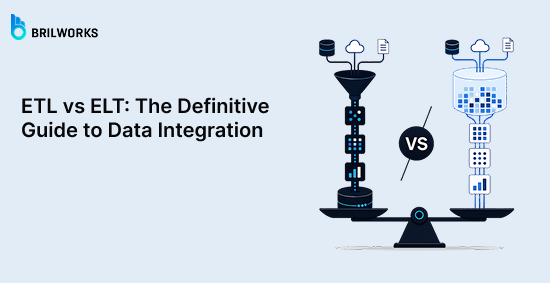
The choice between ETL vs ELT decides where your data gets cleaned, and that single decision shapes cost, speed, and how much control your team keeps over quality. Both approaches move raw data from source systems into a place analysts can use. The difference is the order of operations, and that order has consequences most teams don't feel until they're six months into a build.
Here's where it bites. One team picks ETL because that's how data pipeline development has always worked, then watches transformation jobs choke every time volume doubles. Another picks ELT to move fast, dumps everything raw into a cloud warehouse, and a year later nobody can tell which version of a table is the trustworthy one. Neither made a dumb call. They just matched the pipeline to a mental model of their data that stopped being true.
This post breaks down what each approach does, compares them directly, and shows you when to reach for one over the other.
ETL and ELT describe the same journey with one step reordered. ETL stands for extract, transform, load. ELT stands for extract, load, transform. That reordering sounds trivial. It isn't.
In ETL, data gets pulled from source systems, cleaned and reshaped on a separate processing engine, and only the finished result lands in the warehouse. The warehouse receives data that's already analysis-ready. In ELT, raw data lands in the warehouse first, and the transformation happens inside the warehouse itself using its own compute.
So the real question isn't which acronym you prefer. It's where you want the heavy lifting to happen, and what your destination system can handle. ETL grew up in an era when storage was expensive and warehouses couldn't transform data at scale, so you cleaned data before it arrived. ELT showed up once cloud warehouses like Snowflake and BigQuery made in-warehouse compute cheap and elastic enough to do the work after loading.
That history matters because it explains why the two coexist instead of one replacing the other. Legacy stacks and tight compliance needs still favor cleaning data before it lands. Cloud-native stacks with heavy analytical workloads lean the other way. Both are live decisions teams make every day, and the rest of this post gives you the detail to make yours.
ETL is the approach where data gets transformed before it reaches its destination. The name maps to three stages:
Extract: Pull data from source systems like databases, APIs, and flat files.
Transform: Clean, filter, deduplicate, and reshape it on a dedicated processing engine.
Load: Write the finished, analysis-ready result into the warehouse.
The defining trait is that the warehouse never sees raw data. By the time anything lands, it's already been validated and shaped to match the target schema. Analysts query a table that was cleaned upstream, so what they pull is what they trust.
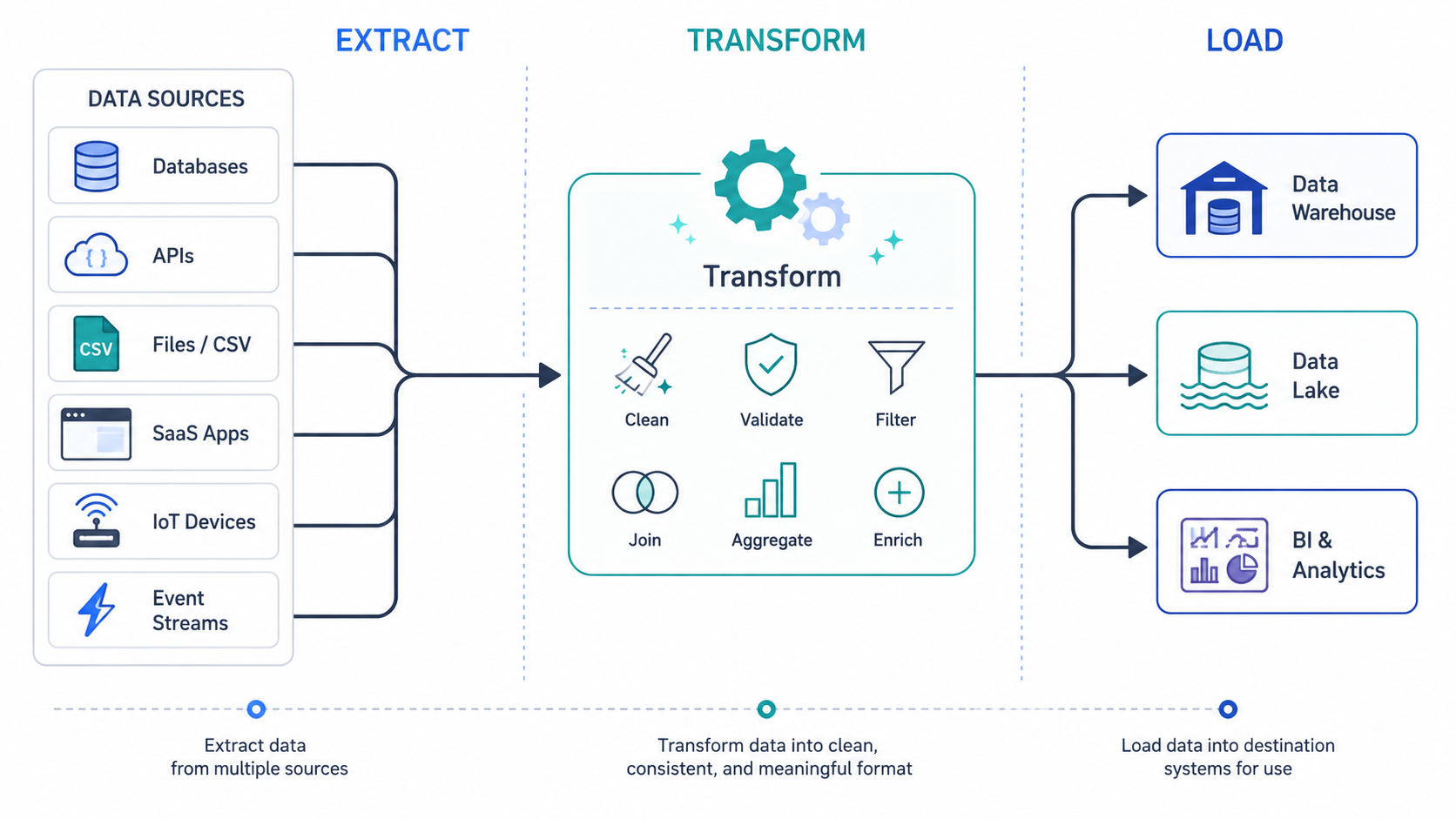
This order has a real advantage for sensitive data. If you're stripping personally identifiable information or enforcing rules before anything hits the warehouse, ETL catches it at the transform stage. Nothing non-compliant ever gets stored.
That's why regulated industries like healthcare and finance leaned on ETL for years, and why it still anchors a lot of data governance programs where control over what gets stored is the whole point.
The cost shows up in flexibility. Transformation logic is fixed before loading, so when a business question changes and you need the data shaped differently, you rewrite the pipeline and reprocess. The transform engine is also a separate system to run and maintain. For a stable reporting workload, that's a fair trade. For fast-changing analytics, it starts to drag.
ELT reorders the last two steps so transformation happens after the data is already in the warehouse:
Extract: Pull data from source systems, same as ETL.
Load: Write the raw, untouched data straight into the warehouse.
Transform: Reshape it inside the warehouse, using the warehouse's own compute.
The defining trait here is the opposite of ETL. The warehouse holds everything, raw and unfiltered, and transformation runs on demand against that raw store. You load first and decide what to do with the data later.
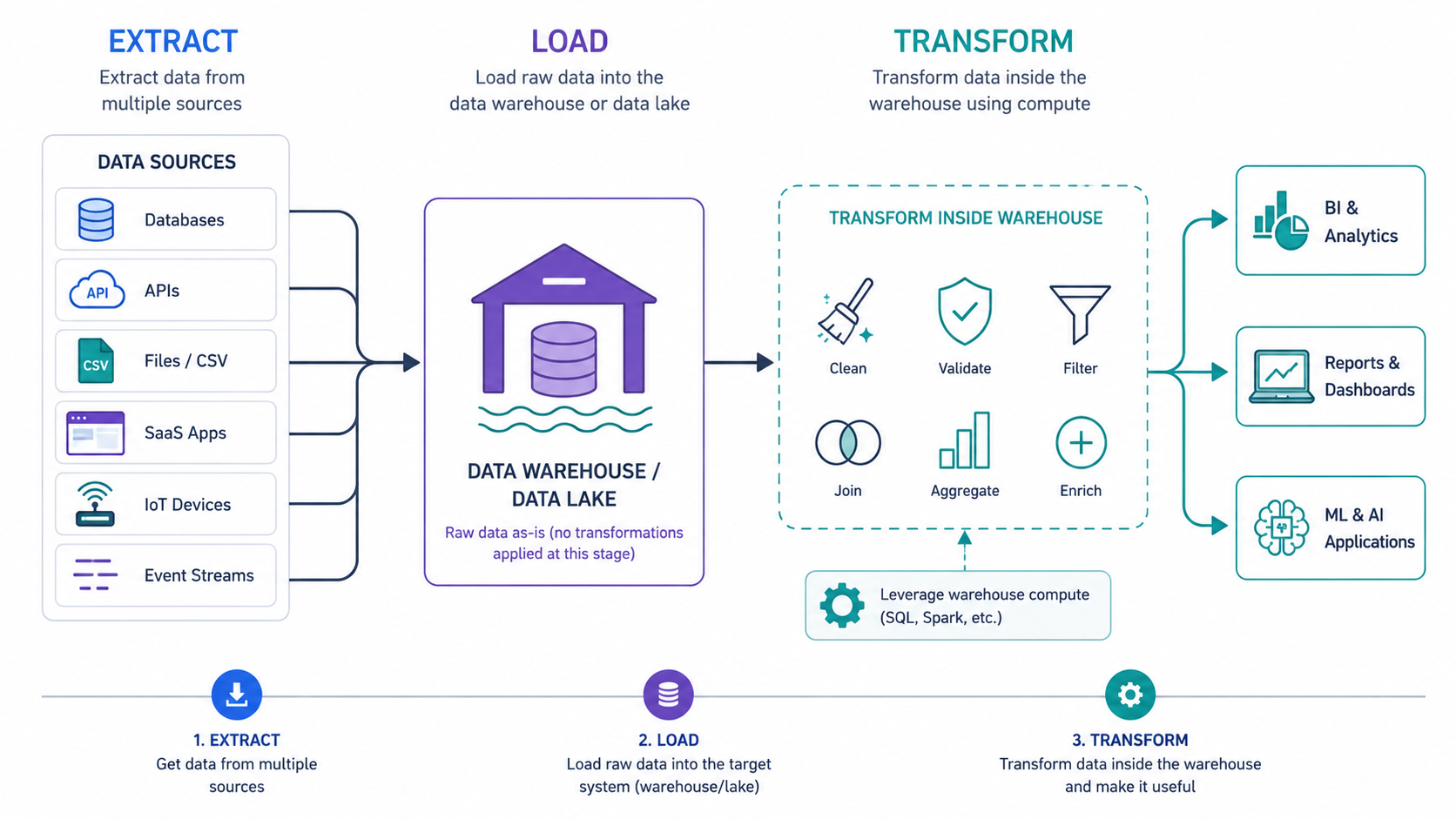
This is what modern cloud warehouses were built for. Platforms like Snowflake and BigQuery separate storage from compute and scale each independently, so loading a firehose of raw data and transforming it in place stops being the bottleneck it once was. Cheap storage plus elastic compute is the whole reason ELT went mainstream.
The upside is flexibility. Because the raw data is always sitting there, a new business question doesn't mean rebuilding the pipeline. You write a new transformation against data you already have. Analysts and engineers can reshape the same raw source five different ways without re-extracting anything.
The cost is control. Raw data lands in the warehouse before anyone cleans it, which means sensitive data touches storage before it's filtered, and quality issues live in the warehouse until a transform catches them. Without discipline, the raw layer turns into a swamp nobody trusts. That puts more weight on your data management practices, not less, because the guardrails move downstream instead of disappearing.
The difference between ETL and ELT comes down to one question: where does transformation happen, before the warehouse or inside it? Everything else flows from that. Here's the side-by-side:
|
Factor |
ETL |
ELT |
|
Transformation location |
Separate processing engine, before load |
Inside the warehouse, after load |
|
Data in the warehouse |
Cleaned, analysis-ready |
Raw, transformed on demand |
|
Compute cost |
Dedicated transform engine to run and scale |
Uses warehouse compute you already pay for |
|
Flexibility |
Rewrite pipeline to reshape data |
Query raw data new ways anytime |
|
Speed to load |
Slower, transform is a gate before landing |
Faster, load happens first |
|
Compliance fit |
Filters sensitive data before storage |
Sensitive data lands raw, filtered later |
|
Best-fit era |
On-prem, storage-expensive stacks |
Cloud-native, elastic-compute stacks |
The table gives the shape. The four differences below are the ones that actually change your architecture.
ETL: Data is cleaned on a separate engine and only the finished result enters the warehouse.
ELT: Raw data enters first, and the warehouse itself does the transforming.
This is the root difference every other one branches from. Pick where the heavy lifting lives and most of the other trade-offs are already decided for you.
ETL: You run and scale a dedicated transformation layer separate from storage.
ELT: Transformation borrows the warehouse's compute, which you're already paying for.
ETL means two systems to maintain. ELT folds the work into one, but a heavy transform job now competes with your analysts' queries for the same compute. Neither is free. The cost just sits in a different place.
ETL: Transformation logic is locked in before loading, so a new question means reworking the pipeline.
ELT: The raw data is always there, so you write a new transform without re-extracting anything.
This is where ELT earns its reputation with fast-moving analytics teams. When requirements shift weekly, reprocessing a whole data pipeline every time is a real tax that ELT sidesteps.
ETL: Sensitive data can be stripped before anything is stored, and only clean data lands.
ELT: Raw data lands first, so filtering and quality checks happen after it's already in the warehouse.
For regulated data, ETL's ordering is a genuine advantage. ELT can meet the same bar, but the guardrails have to be built into the transform layer and enforced, not assumed.
There's no universal winner here. The right choice depends on your stack, your data, and what you're legally on the hook for. Here's how the decision usually breaks down.
You're working with sensitive or regulated data that has to be filtered or masked before it's ever stored.
Your destination is a traditional on-prem warehouse that can't transform at scale.
Your reporting needs are stable and well-defined, so fixed transformation logic isn't a burden.
Data quality has to be guaranteed before anything downstream can touch it.
You're on a cloud warehouse like Snowflake, BigQuery, or Redshift with elastic compute.
Your analytics questions change often and you need to reshape the same data multiple ways.
You're dealing with large volumes of raw or semi-structured data you want to keep in full.
Speed to load matters more than having perfectly clean data on arrival.
Most teams don't live purely in one camp. A common pattern is ELT for the bulk analytical workload and ETL for the specific streams that carry compliance weight, so sensitive fields get handled before storage while everything else loads raw and fast. Matching the method to the data instead of picking one for the whole data pipeline is usually the more honest answer.
One caution worth stating plainly. Teams often pick ELT purely because it's the modern default, then skip building the quality and governance layer the raw-first model depends on. ELT doesn't remove the need for clean data. It moves the responsibility downstream, and if nobody owns it there, the warehouse fills with data no one trusts.
ETL and ELT aren't rivals where one wins. They're two answers to a single question about where transformation should happen, and the right answer depends on what your data has to do and what rules it has to follow.
If you take one thing from this: don't pick based on which sounds more modern. Pick based on your stack and your data. Cloud warehouse with shifting analytics needs points to ELT. Regulated data that must be cleaned before storage points to ETL. And plenty of teams end up running both, matched to the workload.
Whichever way you lean, the transformation step doesn't get easier because you moved it. In ETL it lives before the load. In ELT it lives after. The work is still there either way, and so is the responsibility for keeping the data trustworthy. Get that part right and the acronym barely matters.
The difference between ETL and ELT is where transformation happens. ETL cleans and reshapes data on a separate engine before loading it into the warehouse, so only finished data lands. ELT loads raw data into the warehouse first and transforms it there using the warehouse's own compute.
No. ELT has grown fast because cloud warehouses made in-warehouse compute cheap and elastic, but ETL is still the better fit when sensitive data has to be filtered before it's stored or when the destination can't transform at scale. Most mature teams run both, matched to the workload.
ELT loads faster because data lands raw without waiting on a transformation step. ETL is slower to load since cleaning happens before anything enters the warehouse. Speed after that depends on your warehouse compute and how heavy the transforms are, so faster loading doesn't always mean faster analysis.
Not by default. ETL has a built-in compliance advantage because it can strip or mask sensitive data before storage, so nothing non-compliant ever lands. ELT can meet the same standard, but the filtering and quality controls have to be built into the transform layer and actually enforced, since raw data hits the warehouse first.
Choose ELT when you're on a cloud warehouse with elastic compute, your analytics questions change often, and you want to keep large volumes of raw data you can reshape multiple ways. Lean toward ETL when your data is regulated, your reporting needs are stable, or your destination can't handle transformation at scale.
You might also like

Hello, we are BRILLIAN’S. Trying to make an effort to put the right people for you to get the best results. Just insight !