Data modernization strategy work usually starts with a bill nobody can explain. Storage costs climb every quarter, three teams keep their own copy of the same customer data, and the analytics roadmap stalls because the underlying systems cannot feed it. Nothing has failed outright. It has just gotten harder to move.
The problem is rarely one broken tool. It is the absence of a plan that says what to fix, in what order, and why. Teams that skip that plan buy a platform first and end up modernizing the same data twice.
A data modernization strategy is the plan that prevents that. It is the planning layer inside a broader data modernization effort, the part that decides what to fix before anything moves. This guide covers the core components a strategy needs, how to build one step by step, the practices that keep it on track, and how to measure whether it worked.
What Is Data Modernization?
Data modernization is the process of moving data, and the systems that store and manage it, off outdated technology onto modern cloud-based platforms that handle current analytics, AI, and real-time workloads. It covers the databases, the pipelines that move data, the storage underneath, and the governance rules around all of it.
It is not the same as migration. Migration moves data from one place to another. Modernization changes how the data is structured, processed, and served so the business can actually use it differently afterward. A legacy data migration can be one step inside a modernization effort, but copying data onto cloud servers without redesigning anything leaves you with the same old system and a monthly bill.
The scope is wider than most teams expect. It reaches the data warehouse, the pipelines feeding it, the tools sitting on top, and the policies that decide who touches what. A data warehouse modernization is often the biggest piece, but a strategy has to account for the parts around it too.
Done right, modernization turns data from something you maintain into something you build on.
Key Components of a Data Modernization Strategy
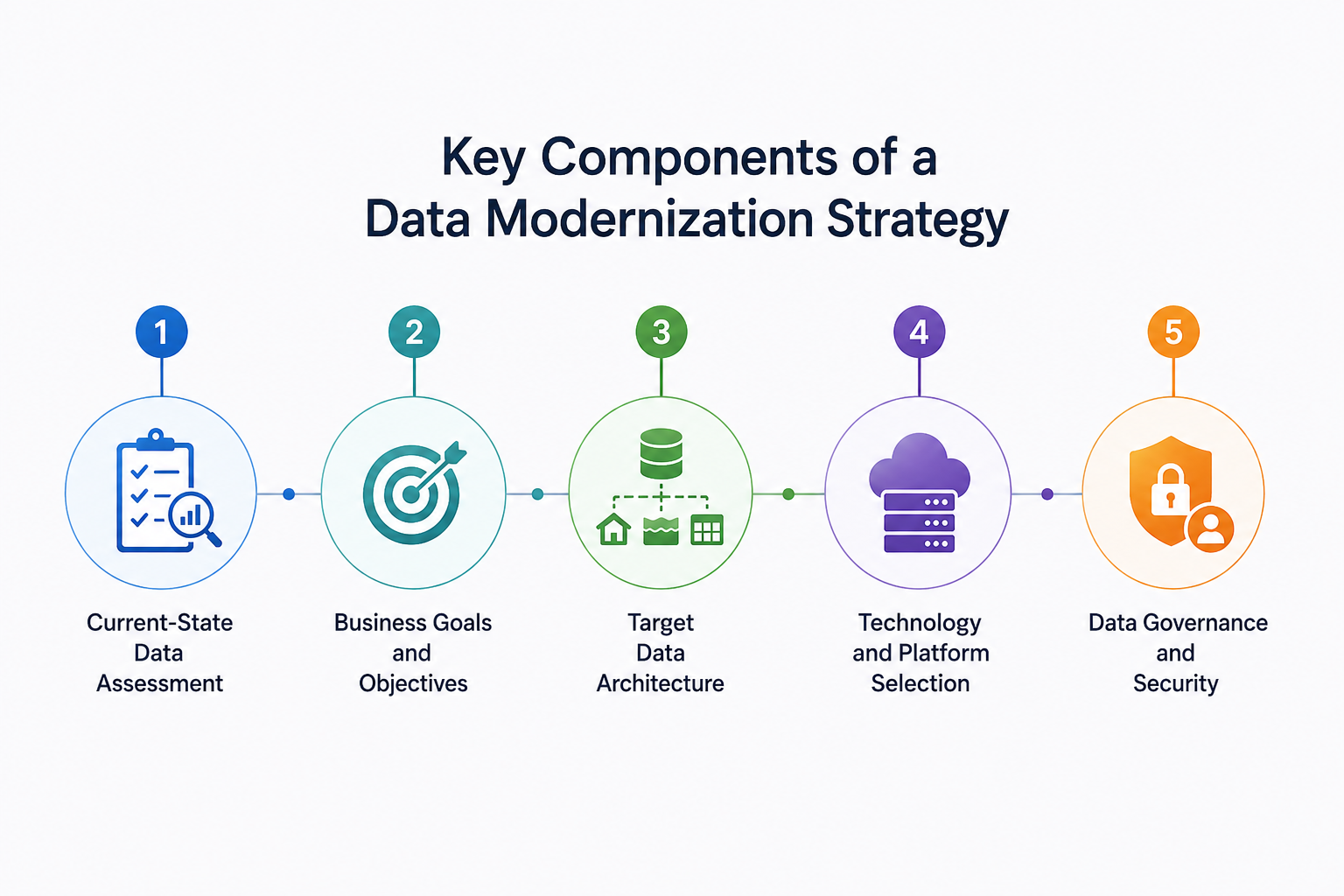
A data modernization strategy stands on five components. Skip any one and the plan develops a blind spot that surfaces later as rework. Each component answers a different question, and together they decide what the modernization actually does.
1. Current-State Data Assessment
The current-state assessment is a full inventory of the data you have, where it lives, how it moves, and what depends on it. It maps every source, pipeline, database, and report, and flags which ones the business cannot run without.
This is the component teams most want to rush. It is also the one that, done poorly, wrecks everything downstream. You cannot decide what to modernize until you know what you are holding, and the assessment is where a hidden dependency shows up before it becomes an outage.
2. Business Goals and Objectives
The goals component ties the modernization to outcomes the business actually cares about. Lower infrastructure cost, faster reporting, real-time analytics, and AI readiness are different goals, and they pull the design in different directions.
Write them as numbers. "Cut month-end close from five days to one" is a goal you can test against later, and "improve our data" is not. Goals set here become the KPIs you measure at the end, so vague goals produce a strategy nobody can grade.
3. Target Data Architecture
The target architecture is the blueprint for where data will live and how it will flow once modernization is done. It defines how storage and compute separate, how pipelines load and transform data, and whether workloads land in a warehouse, a data lake, or both.
This is where the data lake vs data warehouse decision gets made, driven by the data types and workloads the goals demand. Design the destination before moving anything into it, because retrofitting the architecture after the data has landed is how timelines double.
4. Technology and Platform Selection
Platform selection is choosing the specific tools and services that implement the target architecture. Snowflake, Databricks, BigQuery, and Redshift all work, and the right pick depends on your workloads, your team's skills, and your budget, not on which vendor demoed best.
Pick the platform after the architecture, never before. Teams that choose a platform first end up bending the architecture to fit the tool, which is how you inherit constraints you never needed. The platform matters less than the plan it serves.
5. Data Governance and Security
Governance and security define who can access what data, how quality is maintained, and how compliance holds up through the change. It covers access controls, data ownership, quality standards, and the regulatory rules the business answers to.
Build this in from the start. A sound data governance strategy designed during modernization saves years of cleanup, while governance bolted on afterward means chasing ownership and quality problems across a system already in production.
How to Build a Data Modernization Strategy
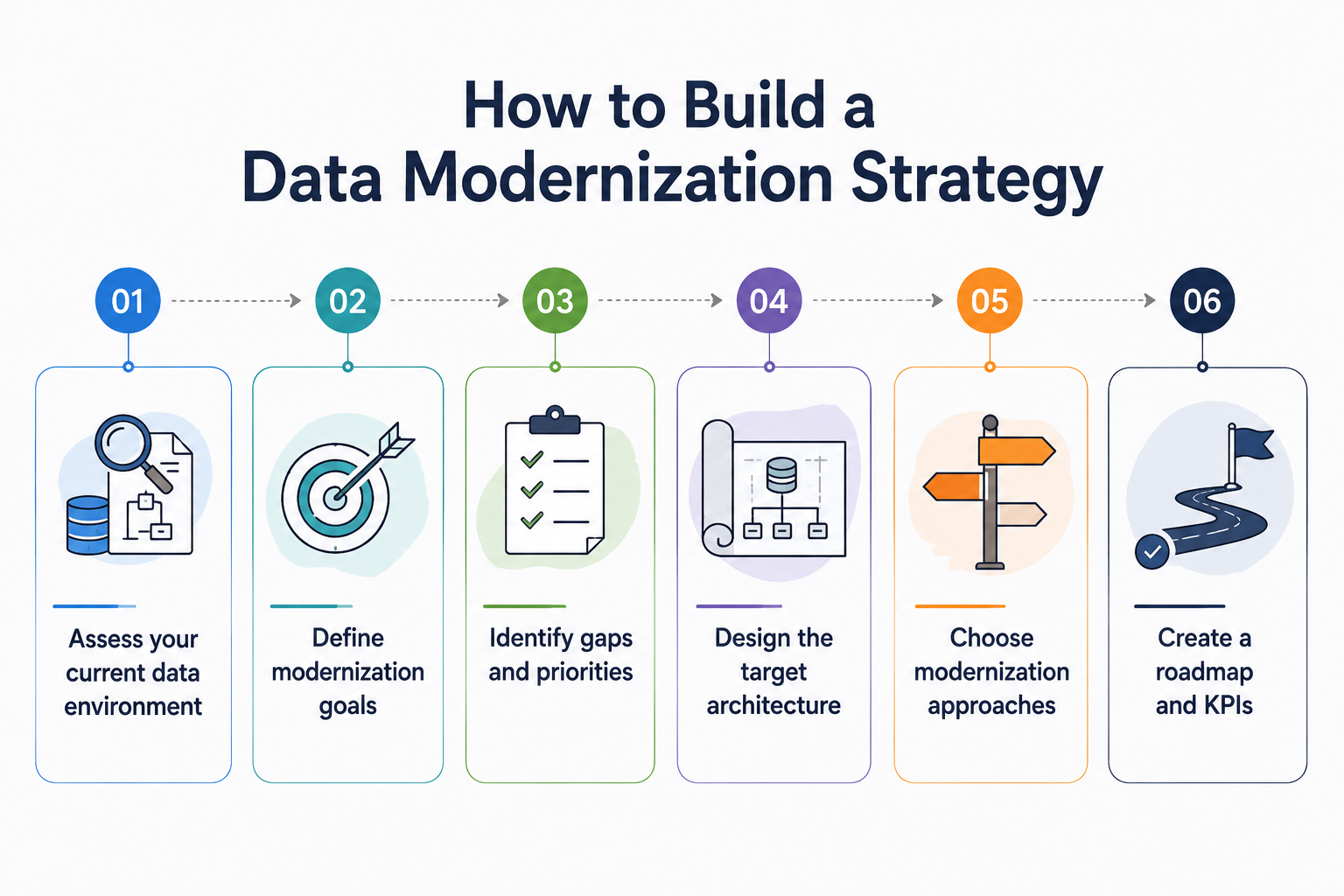
The components tell you what a strategy contains. This is the order you build them in, where each step de-risks the one after it. Most strategies that fail were sequenced wrong, not researched badly.
1. Assess your current data environment
Start by mapping every data source, pipeline, database, and report, then flag the ones the business cannot run without. Skip this and you will decommission something load-bearing three weeks before you learn what depended on it. Give this step the time it wants, because everything after it inherits its gaps.
2. Define modernization goals
Turn the business outcomes into numbers you can measure before any technology enters the conversation. Lower cost, faster queries, real-time analytics, and AI readiness point at different architectures, so the goals decide the design rather than follow it. Write each one as a target you can test against later.
3. Identify gaps and priorities
Compare where your data is now against where the goals need it to be, and the gaps become your work list. Not every gap is worth closing, so rank them by business impact and sequence the high-value, lower-risk ones first. This is the step that keeps a modernization from trying to fix everything at once and finishing nothing.
4. Design the target architecture
Draw the destination before moving any data into it, covering how storage and compute separate, how pipelines load and transform, and where governance lives. A cloud data migration only pays off when the architecture on the other end is designed for it, not when data lands in the same shape it left. Build access control and quality standards in here, not after.
5. Choose modernization approaches
Match an approach to each workload instead of forcing one path across all of them. Some systems get migrated as-is, some get rebuilt, and some legacy pieces stay in place while modern components run alongside them. A data warehouse modernization might be a full rebuild while a stable operational database just moves, and both decisions can live in the same strategy.
6. Create a roadmap and KPIs
Turn the approaches into a phased timeline with measurable checkpoints tied back to the goals from step two. Sequence the phases so each delivers a usable win rather than banking all the value on a final cutover. The KPIs you set here are what you will measure the whole effort against later.
Measuring the Success of Your Strategy
A data modernization strategy succeeds or fails against the goals you set in step two, measured in numbers, not impressions. If you wrote those goals as targets, this is where you check them. These are the metrics that tell you whether the effort actually moved the business.
-
Query and report speed: Compare how long key reports and queries take now against the legacy baseline. This is the most visible win, and the one business users feel first.
-
Total cost of ownership: Track infrastructure, licensing, and maintenance spend against what the old system cost at rest. A modern platform should shift a fixed capital bill toward an operating cost that tracks real usage.
-
Data freshness: Measure the lag between when data is created and when it is available to query. Modernization that moved you from overnight batch to near real-time should show up clearly here.
-
Pipeline reliability: Watch failure rates and recovery times on the pipelines feeding the warehouse. Fewer failures and faster recovery mean the redesign held.
-
Adoption and self-service: Count how many teams query the new platform directly instead of routing requests through a data team. Rising self-service is the sign the data got genuinely more usable.
-
AI and analytics readiness: Check whether the workloads the legacy system could not feed are now running. If the point was to unblock machine learning and real-time analytics, this is the metric that confirms it.
Conclusion
A data modernization strategy is worth building the moment your data starts costing more than it returns, in slow reports, rising bills, or workloads the current systems cannot feed. If your data still answers the questions the business asks, on time and on budget, you can wait. The strategy earns its place when the old way stops keeping up.
When that happens, the mistake to avoid is starting with the platform. The teams that struggle pick a tool first and reverse-engineer the plan around it. The teams that succeed assess what they have, write goals as numbers, close the gaps that matter in priority order, and phase the work so each stage delivers something usable.
The platform matters less than the plan. Snowflake, Databricks, and BigQuery are all capable, and a sound strategy on any of them beats a rushed rollout onto the best of them.
If you are mapping where your data sits today and which approach fits, our data modernization services team can help you assess the current environment and build the roadmap before any data moves.