Last updated August 26, 2026
The Definitive Guide to Data Modernization Services

7 mins read
Summarize with AI:


Data
AI
The Stack Underneath
Data modernization has become a priority for organizations whose legacy systems can no longer keep pace with the demands of analytics, reporting, and AI. Older data warehouses are slow to query, data sits trapped in disconnected systems, and each new data request turns into a long integration effort. These systems continue to operate, which is why replacing them is often delayed until the cost of maintaining them outweighs the cost of change.
Data modernization is the process of moving off that legacy foundation onto modern, cloud-based platforms that support faster processing, better scalability, and advanced analytics. It covers the data itself, the data warehouse, the pipelines, and the surrounding architecture. The goal is a data environment that supports business decisions rather than slowing them down.
This guide explains what data modernization involves, how to build a modernization strategy, the common challenges organizations face, and the data modernization services Brilworks provides to help teams complete the transition without data loss or business disruption.
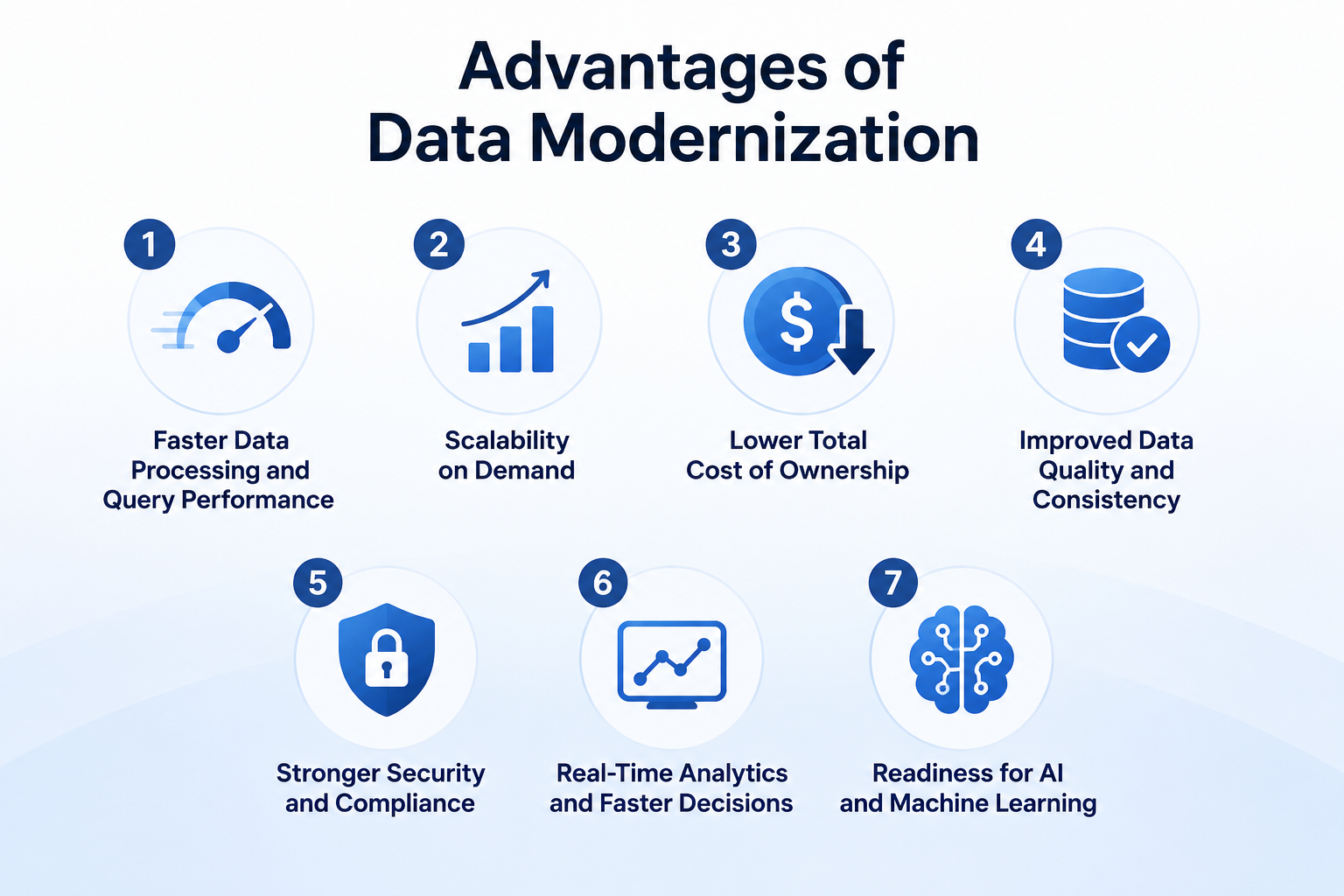
Modernizing a data environment changes how quickly a business can access, trust, and act on its data. The advantages below are the ones organizations report most consistently after moving off legacy systems.
Modern platforms process and return data far faster than legacy systems. Cloud data warehouses separate storage from compute, which lets queries scale across more processing power on demand. Reports that once took hours on an on-premise warehouse can return in seconds. This directly shortens the time between a business question and a reliable answer.
Modern data infrastructure scales with data volume without hardware upgrades. Legacy systems require new servers and capacity planning every time data grows, which adds cost and delay. A cloud data warehouse expands storage and compute as needed and contracts when demand falls. Businesses pay for what they use rather than provisioning for peak load year-round.
Modernization reduces the long-term cost of running a data environment. Legacy systems carry ongoing expenses for hardware maintenance, software licensing, patching, and specialist support. Moving to managed cloud platforms shifts most of that operational burden to the provider. The upfront migration cost is offset over time by lower infrastructure and maintenance spend.
Modernization creates a single, consistent view of data across the organization. Legacy environments scatter data across disconnected systems, which produces duplication and conflicting records. Consolidating that data into a unified platform removes silos and establishes one source of truth. Cleaner data leads to more accurate reporting and fewer decisions based on flawed inputs.
Modern platforms provide security and compliance controls that older systems cannot match. Cloud providers offer encryption, access control, audit logging, and built-in support for regulations such as GDPR and HIPAA. Legacy systems often run on unsupported software with known vulnerabilities and no clear compliance path. Modernization brings data protection in line with current regulatory standards.
Modern architecture supports analytics on live data rather than overnight batches. Older systems rely on scheduled batch processing, which means reports reflect data that is already hours or days old. Modern data pipelines can ingest and process data continuously, giving teams current information to work from. This shift lets businesses react to events as they happen rather than after the fact.
Modernization prepares data infrastructure to support AI and machine learning workloads. These models depend on large volumes of clean, accessible, well-structured data, which legacy systems rarely provide. A modern data foundation gives AI initiatives the quality and scale of data they need to produce reliable results. For most organizations, AI readiness is now one of the main reasons to modernize.
Data modernization is not a single project. It covers several distinct areas of work, and most organizations tackle them in stages rather than all at once. The five areas below are where the work usually concentrates.
Legacy data migration moves the data itself out of outdated databases and into modern platforms. The work centers on mapping old schemas to new ones, cleaning and validating records, and transferring everything without loss or corruption. This is the part most projects underestimate, since legacy data is often inconsistent, poorly documented, or tangled in logic that has to be untangled before it can move. Getting the data across intact is the foundation everything else depends on.
Data warehouse modernization replaces a rigid legacy warehouse with a flexible cloud-based one. The goal is to move off slow, on-premise systems onto platforms like Snowflake, BigQuery, or Redshift that scale on demand and support modern analytics. This usually involves redesigning how data is modeled and loaded, since a modern cloud data warehouse works differently from the legacy systems it replaces. The payoff is faster queries, lower running costs, and a warehouse that can handle machine learning workloads alongside standard reporting.
Data platform modernization upgrades the wider system that manages, governs, and serves data across the organization. A warehouse handles analytics, but a full data platform also covers integration, governance, security, and access for different teams. Modernizing at the platform level means building a unified cloud data management platform rather than upgrading one component in isolation. This is the layer that turns scattered tools into a single, governed data environment.
Legacy system migration to cloud moves entire applications and their infrastructure off on-premise servers. Unlike data migration, which focuses on the data, this work deals with the systems and applications around it. Teams decide whether to rehost each system as is, replatform it with some changes, or refactor it for the cloud, and each option trades speed against long-term benefit. This is often the largest and most disruptive part of a modernization program, which is why it follows a well-planned migration approach.
Modern data pipelines move data between systems reliably and, where needed, in real time. Legacy pipelines are usually built on batch processing, which means data arrives hours or days late and cannot support live analytics. Rebuilding them around modern data pipeline development brings in continuous ingestion, better error handling, and architectures that keep data flowing as it is generated. This is what makes real-time reporting and current data possible across the modernized environment.
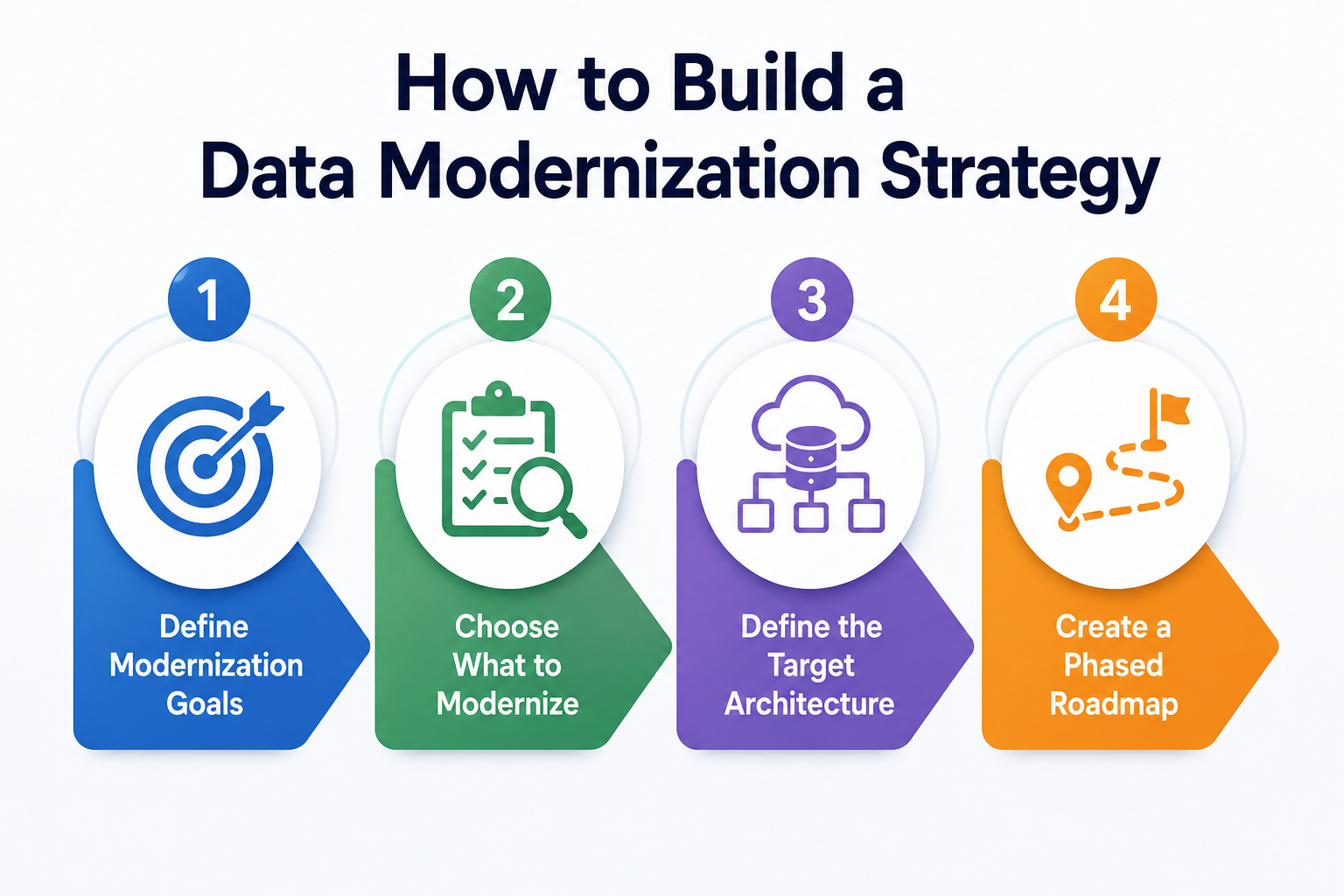
A data modernization strategy is the plan that decides what to modernize, in what order, and toward what target. Most failed projects skip this step and jump straight to tooling, which is why they stall partway through. A clear strategy keeps the work tied to business goals and prevents the effort from turning into an open-ended rebuild. The four steps below form the core of that plan.
Start by deciding what the modernization is meant to achieve for the business. Goals should be specific and measurable, such as cutting report times, reducing infrastructure cost, meeting a compliance requirement, or preparing data for AI. Vague aims like becoming data-driven give the project no way to measure success or know when it is done. Clear goals also settle disagreements later, since every decision can be checked against what the business actually needs.
Assess the current data environment and decide which parts to modernize first. This means auditing existing systems, data sources, and pipelines to find what is slowing the business down and what carries the most risk. Not everything needs to move, and some legacy systems are better archived than migrated. Prioritizing by business impact keeps early effort focused on the areas that return value soonest rather than spreading it thin across the whole estate.
Decide what the modernized environment will look like before any migration begins. This covers the choice of cloud platform, the data warehouse or lakehouse design, how pipelines will move data, and how governance and security will work. A defined target gives every migration a clear destination and prevents teams from making inconsistent choices as they go. Skipping this step is what leaves organizations with a new environment as fragmented as the one they left.
Break the modernization into phases rather than attempting it all at once. A phased roadmap sequences the work so each stage delivers something usable and reduces the risk of a single large failure. Each phase should have defined deliverables, a clear point where it is considered complete, and criteria for whether to proceed or pause. This approach keeps the business running throughout and lets the team adjust as they learn from each stage.
Most data modernization projects run into the same set of problems, and knowing them ahead of time is what separates a controlled migration from a stalled one. The challenges below are the ones that derail projects most often.
Legacy systems are usually tangled together in ways that are hard to unpick. Years of custom code, undocumented integrations, and business logic buried inside the system mean that moving one component often breaks another. Teams frequently discover these dependencies only after migration begins, when something downstream stops working. Mapping how systems connect before any data moves is the only reliable way to avoid these surprises.
Legacy data is often inconsistent, duplicated, or incomplete, and migration exposes all of it. Records that seemed fine in the old system turn out to have conflicting formats, missing fields, or duplicate entries that corrupt reporting once combined. Moving bad data into a new platform simply relocates the problem rather than solving it. Cleaning and validating data before migration adds time upfront but prevents flawed analytics later.
Moving data between systems is rarely a straightforward transfer. Schemas have to be mapped, formats converted, and large volumes moved without loss or extended downtime. Industry figures put the failure rate for migration projects between 60 and 80 percent, and most of those failures trace back to underestimating this complexity. A tested migration process with validation at each stage is what keeps data intact through the move.
Modernization changes where data lives and who can access it, which raises real security and compliance risks. Data in transit is exposed if not handled correctly, and access controls that worked on-premise do not map cleanly to the cloud. Regulations such as GDPR and HIPAA add requirements that must hold throughout the migration, not just after it. Building a clear data governance strategy into the project keeps data protected and compliant as it moves.
Modernization projects often cost more and take longer than planned. Cloud spending can rise unexpectedly when workloads are moved without optimization, and migration ties up skilled staff who are already stretched. Many of these overruns come from hidden cloud migration costs that surface only once the work is underway. Planning for these costs early and modeling them against expected savings keeps the business case realistic.
Modernization has to happen while the business keeps running, which is a constant source of risk. Systems being migrated are often the same ones people depend on daily, so downtime or data errors have immediate operational impact. A migration that takes systems offline for too long can cost more than the modernization saves. Phasing the work and running old and new systems in parallel during transition is what keeps disruption manageable.
Our data modernization process runs in six stages, each with a defined outcome before the next begins. This keeps the work controlled and the business running throughout, rather than betting everything on a single cutover. Here is how a modernization engagement moves from assessment to a running environment.
We start by auditing the current data environment to understand what exists and what is slowing the business down. This covers the systems in use, the data sources feeding them, the pipelines moving data, and the dependencies connecting everything. We also run an AI readiness audit where AI is a goal, so we know how far the data is from supporting it. The output is a clear picture of the estate and a prioritized list of what to modernize first.
We turn the assessment into a phased plan tied to your business goals. This defines what gets modernized in each stage, in what order, and what success looks like at every step. We sequence the work so early phases deliver usable results and high-risk systems are handled with the most care. The plan also sets the budget and timeline expectations before any migration begins, so there are no surprises partway through.
We define the target architecture before moving anything. This covers the cloud platform, the warehouse or lakehouse design, how pipelines will move data, and how governance and security will work in the new environment. A defined destination keeps every migration consistent and prevents the fragmentation that comes from making choices on the fly. We design for the data volumes you expect to reach, not just where you are now.
We execute the migration in the phases set out in the plan. Data is mapped, cleaned, and validated before it moves, and systems are rehosted, replatformed, or refactored based on what each one needs. We run old and new systems in parallel during transition so the business keeps operating while the move happens. Each phase is completed and confirmed before the next one starts.
We verify that migrated data and systems are correct and complete before anything goes live. This means checking data integrity against the source, confirming reports and pipelines produce the right results, and testing that systems perform as expected under real load. Nothing is signed off until it has been validated against the original environment. This is the step that catches problems before your users do.
We tune the modernized environment for cost and performance once it is running. Cloud workloads often need adjustment after migration to control spending and improve query speed, and we handle that tuning as part of the engagement. We also make sure your team knows how to run and monitor the new environment. The goal is a modernized data environment that stays efficient long after the migration is done.
Legacy systems rarely fail all at once. They slow reports, trap data, and turn every new request into a project, until the cost of keeping them running is higher than the cost of moving. The organizations that modernize early spend less and disrupt less than those that wait for a system to break first.
The work is manageable when it follows a clear strategy, moves in phases, and validates data at every stage. What derails projects is starting without a plan, not the difficulty of the migration itself. A modernization done in the right order keeps the business running while it happens and leaves you with a data environment that supports decisions instead of slowing them down.
Brilworks helps organizations plan and execute that move end to end. Our data modernization services cover the full path from assessment to a running cloud environment, with data integrity and business continuity treated as the priority throughout. If your systems are holding the business back, we can help you map what to modernize first and build a roadmap that gets you there without losing data or stalling operations.
Data modernization is the process of moving off legacy systems onto modern cloud-based platforms that support faster processing, better scalability, and advanced analytics. It covers the data itself, the data warehouse, the pipelines, and the architecture around them. The goal is a data environment that supports business decisions rather than slowing them down.
It depends on the size of the estate and how much is being modernized. A single warehouse migration can take a few months, while a full platform modernization across many systems can run a year or more. Most projects move in phases, so parts of the environment deliver value long before the whole program is complete. A proper assessment upfront is what produces a realistic timeline.
Cost varies with the number of systems, the volume of data, and how much needs to be redesigned rather than moved as is. The main drivers are migration effort, cloud platform spend, and the staff time the project ties up. Hidden costs often surface once cloud workloads go live, which is why modeling expected spend against expected savings early matters. A phased approach spreads the cost rather than front-loading it.
It does not have to, if the work is phased and planned around business continuity. The main risk is downtime on systems people depend on daily, which is why running old and new systems in parallel during transition is standard practice. Each phase is validated before the next begins, so problems are caught before they reach users. A single high-risk cutover is what causes disruption, not modernization itself.
No, and most organizations should not try to. Not every legacy system needs to move, and some are better archived than migrated. Prioritizing by business impact keeps early effort on the areas that return value soonest and reduces the risk of a large all-at-once failure. A phased roadmap lets you modernize the highest-priority systems first and continue from there.
You might also like

Hello, we are BRILLIAN’S. Trying to make an effort to put the right people for you to get the best results. Just insight !