Most companies start a modernization project by picking a new platform. Then they hit the real work, and the platform was never the hard part.
The hard part is the data itself. Years of it, sitting in systems that were built for a business that has since changed shape. Tables nobody fully documented. Fields that mean one thing in the sales database and something else in finance. Pipelines held together by a script one engineer wrote before they left. This is where most data modernization challenges actually live, and it is why so many of these projects run late, run over budget, or quietly stall halfway through.
The technology has never been more ready for this. Cloud warehouses scale on demand, and platforms like Snowflake and Databricks have made it far cheaper to store and process data at volume. The gap is not tooling. It is everything the tooling assumes you have already sorted out, like clean data, clear ownership, and a plan for moving without breaking what the business runs on today.
This blog walks through the challenges of data modernization that teams run into most often, from legacy systems and data silos to security, migration risk, and the skills gap. Then it covers how to work through each one, and where a structured data modernization services engagement fits into keeping an enterprise program on track.
What Is Data Modernization
Data modernization is the process of moving your data from old systems into modern architecture so it is easier to store, access, and use. In practice that means shifting off legacy databases and on-premise warehouses, and onto cloud platforms that can handle current data volumes and feed analytics, reporting, and AI.
It covers more than a change of storage. Most programs touch four things at once. The systems that hold the data, the pipelines that move it, the structure that organizes it, and the governance that keeps it clean and secure. Modernizing one without the others is how teams end up with a fast new warehouse full of the same messy data they had before.
The reason it matters is simple enough. Old data systems were built for smaller volumes and slower questions, and they struggle the moment a business wants real-time reporting or wants to run AI on its own data. Modern data architecture removes that ceiling, which is the whole point of taking the work on.
Key Data Modernization Challenges
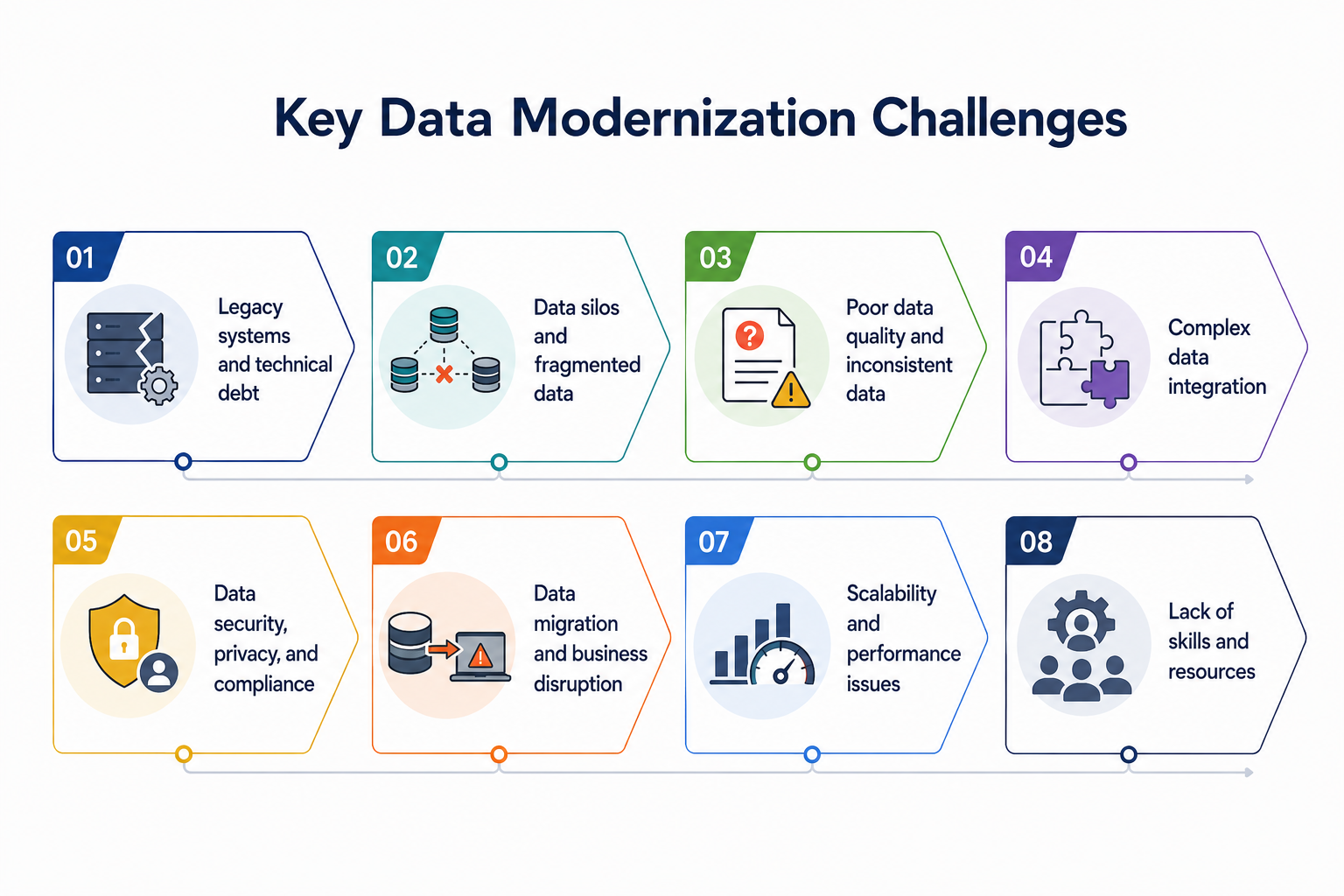
Modernization projects rarely fail on the technology. They fail on the conditions the technology inherits. These are the eight challenges of data modernization that slow teams down or stop them outright, roughly in the order they tend to surface.
1. Legacy systems and technical debt
Old systems are hard to modernize because they were never built to be moved. Documentation is thin, the original engineers are often gone, and business logic is buried inside the application code rather than written down anywhere. Every year of patches on top of that makes the system harder to untangle, which is why legacy technical debt is usually the first wall a team hits.
2. Data silos and fragmented data
Fragmented data is a problem because the same information lives in separate systems that do not talk to each other. Sales has its version of the customer, finance has another, and support has a third, none of them agreeing. Before you can modernize anything, you have to reconcile those copies, and that reconciliation is often the slowest part of the whole project.
3. Poor data quality and inconsistent data
Poor data quality is the challenge teams underestimate the most. Duplicate records, missing fields, and values formatted five different ways all move straight into the new system unless someone cleans them first. A modern warehouse does not fix bad data. It just gives you a faster way to run reports on numbers you cannot trust.
4. Complex data integration
Data integration gets complicated because a modern stack has to connect far more sources than the old one did. Databases, third-party APIs, SaaS tools, and streaming data all have to feed the same place in a consistent format. Each new source adds another connection to build and maintain, and the effort grows faster than most plans account for.
5. Data security, privacy, and compliance
Security and compliance get harder the moment data starts moving between systems. Data that sat behind one firewall is now traveling to the cloud, and regulations like GDPR and HIPAA still apply to every copy of it along the way. Getting access controls, encryption, and audit trails right during a migration is a real constraint, not a box to tick at the end.
6. Data migration and business disruption
Migration is risky because the business still has to run while the data moves underneath it. Move too fast and you break live reporting or lose records, and move too slowly and you run two systems in parallel for months, paying for both. Most of the horror stories in modernization trace back to a migration that was rushed or under-tested.
7. Scalability and performance issues
Scalability becomes a challenge when the new system meets real production load for the first time. A warehouse that felt fast in testing can slow down once concurrent users, larger datasets, and heavier queries hit it together. Designing for the volume you will actually reach, not the volume you have today, is what separates a system that lasts from one that gets rebuilt in two years.
8. Lack of skills and resources
The skills gap is the challenge that sits underneath all the others. Modern platforms need people who know cloud architecture, data engineering, and the specific tools you have chosen, and those people are expensive and hard to hire. Many teams start a modernization program with the staff they have, and that gap is often what stalls it halfway.
How To Overcome Data Modernization Challenges
You do not solve these challenges in parallel. You work them in order, because each step depends on the one before it. Here is the sequence that keeps an enterprise data modernization program from stalling.
1. Assess your current data environment
Start by mapping what you actually have, because most teams do not know until they look. Document every source system, every pipeline, and every place a critical report gets its numbers. This audit is tedious and it is the step people most want to skip. Skipping it is why projects discover a missing dependency three months in, when it is far more expensive to fix.
2. Prioritize modernization initiatives
Decide what moves first based on business value, not on what is technically easiest. A clear data modernization strategy ranks systems by impact and risk, so the work that matters most to the business gets done first. Trying to modernize everything at once is how budgets and timelines both blow out.
3. Improve data quality before migration
Clean the data before it moves, not after, because bad data in the old system becomes bad data in the expensive new one. Deduplicate records, standardize formats, and fill or flag the gaps while the data still sits in a system you understand. This is slow work and it saves far more time than it costs.
4. Adopt an incremental modernization approach
Move in stages rather than all at once, so the business keeps running while the data shifts underneath it. Migrate one system or one domain, confirm it works, then move to the next. A phased legacy data migration lowers the risk of breaking live reporting and gives you a rollback point at every step.
5. Design a scalable data architecture
Build for the data volume you will reach, not the volume you have now, because the load that feels fine in testing rarely matches production. Plan for concurrent users, larger datasets, and heavier queries from the start. Retrofitting scale into a system that was not designed for it usually means rebuilding it.
6. Establish data governance and security
Set the rules for access, quality, and compliance before the data moves, not after it lands. Define who owns what, who can see what, and how you track every copy as it travels between systems. Governance added at the end is governance that gets skipped under deadline pressure.
7. Choose the right technologies and platforms
Pick platforms that fit your team and your workload, not the ones with the loudest marketing. A well-run data warehouse modernization built on a platform your people can actually operate beats a more powerful stack nobody on staff knows how to run. Match the tool to the team you have, or to the team you can realistically hire.
8. Build internal skills and expertise
Close the skills gap deliberately, because the best architecture fails if no one can maintain it after launch. Train the team you have, hire for the gaps you cannot train, and bring in outside help for the parts that need experience you do not have yet. This is the step that determines whether the modernization holds a year later.
Data Modernization Best Practices
The steps above tell you what to do and in what order. These are the principles that keep a program healthy while you work through them, drawn from what separates modernization projects that finish from ones that stall.
-
Treat it as a business project, not an IT project: Modernization succeeds when the people who use the data help decide what gets moved and why. Run it purely from IT and you optimize the wrong systems first.
-
Migrate in small, reversible batches: Every stage should be small enough to test and undo. Big-bang cutovers are where the expensive failures happen, because there is no way back once they go wrong.
-
Validate data after every move, not at the end: Check that record counts and key values match the source as soon as each batch lands. Errors caught early are cheap, and errors found at go-live are not.
-
Keep the old system running until the new one is proven: Do not decommission anything until the replacement has handled real load and real reporting. Parallel running costs money, and it costs far less than discovering a gap after the old system is gone.
-
Document as you go: Write down the mappings, the decisions, and the known gaps while they are fresh. The team maintaining this in a year will not have the context you have now.
-
Measure against a baseline: Record query times, report accuracy, and cost before you start, so you can prove the modernization actually improved something. Without a baseline, you are guessing at whether it worked.
Conclusion
The hardest part of modernization is not choosing a platform. It is the state of the data you already have, and the order in which you deal with it.
Every challenge in this blog traces back to something that existed before the project started. Legacy systems nobody documented, data scattered across teams that never agreed, quality problems that migrate straight into the new warehouse if you let them. None of that gets fixed by the tooling alone. It gets fixed by auditing what you have, cleaning it before it moves, migrating in stages you can roll back, and making sure someone can run the result after launch.
So the honest takeaway is this. If your data is already reasonably clean and well understood, modernization is mostly an engineering exercise and it moves fast. If it is not, the cleanup and the governance are the project, and the platform is the easy part. Most teams are closer to the second case than they expect, and the ones who plan for it are the ones who finish.
If you would rather not work through that sequence alone, Brilworks runs data modernization services that cover the assessment, migration, and governance as one engagement. Either way, start with the audit. You cannot plan a modernization until you know what you are actually modernizing.