Last updated August 4, 2026
How Real-Time Data Pipelines Work (And When You Actually Need One)

7 mins read
Summarize with AI:


Data
AI
The Stack Underneath
A fraud alert that arrives ten minutes after the transaction is not an alert. It is a receipt.
That gap, between when something happens and when your system reacts, is the whole problem real-time data pipelines solve. Most data infrastructure answers questions about the past. It collects data all day, runs a batch job overnight, and hands you a report in the morning. Fine for a quarterly trend. Useless when a payment needs approving in 200 milliseconds.
Real-time data pipelines flip that model. Instead of collecting now and processing later, they handle each event as it arrives, a very different problem than the batch data pipeline development most teams start with. The data never sits still. No overnight window to catch mistakes, no pause to reprocess a bad batch.
That constraint changes every layer, how you ingest, how you process, how you survive a node dying mid-stream. Get it right and you act on events the moment they happen. Get it wrong and you inherit a system that is expensive, fragile, and still somehow slow.
Here's what this guide covers:
How real-time pipelines are structured
What low-latency processing actually buys you
Where these systems break
How to design them to survive failure
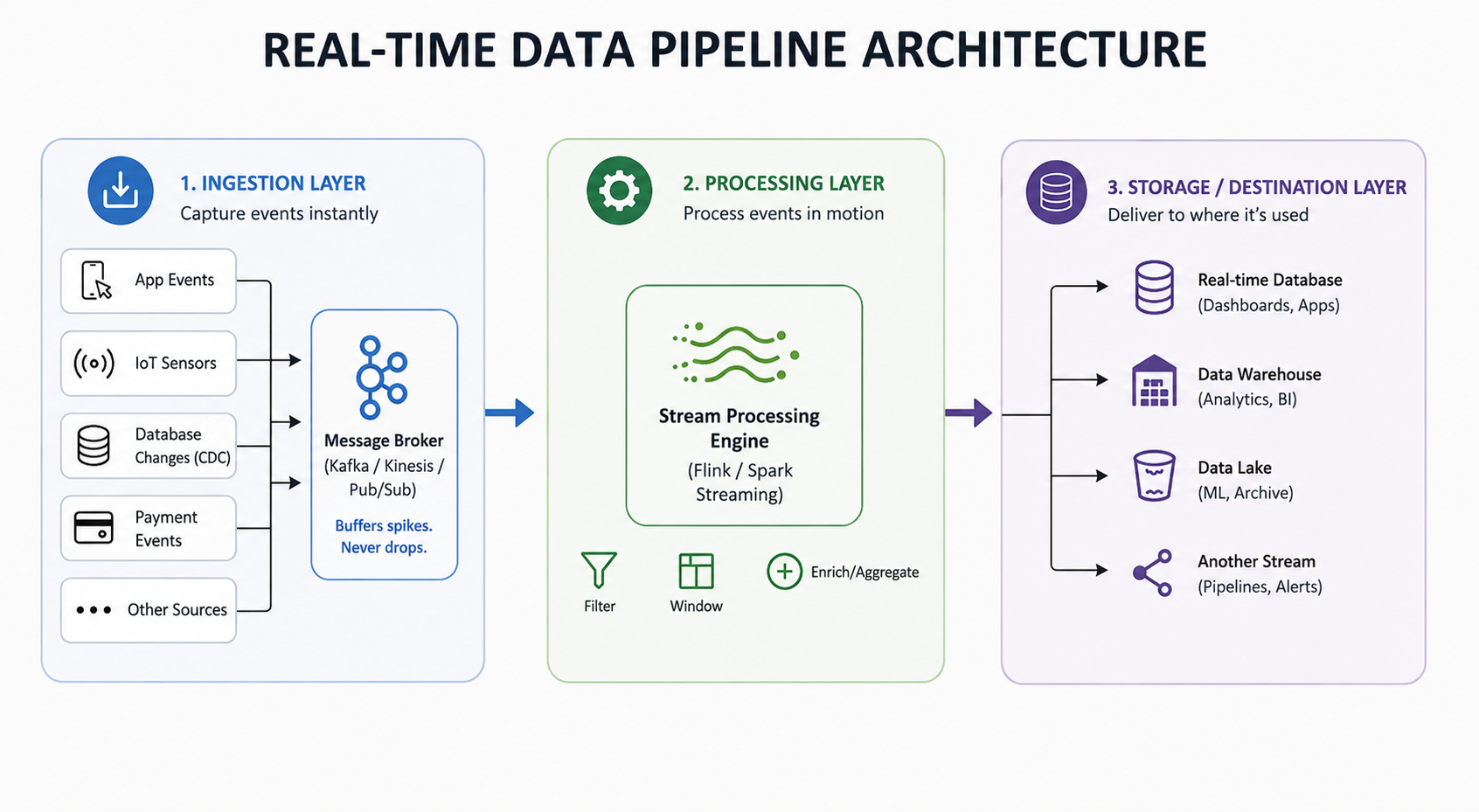
Real-time data pipeline architecture is the structural design that moves data from source to destination continuously, processing each event within milliseconds to seconds of its creation instead of waiting to batch it. It is not a faster version of batch processing. It is a different shape entirely, built around three layers that each handle data while it is still moving.
The batch world thinks in jobs. The real-time world thinks in flow. That distinction drives the whole data pipeline architecture, and it comes down to three pillars.
The ingestion layer captures events the moment they happen and hands them off without losing any. This is where data enters the pipeline, from app clicks, IoT sensors, database changes, payment events, and everything else generating records in real time.
The hard part is not speed. It is handling bursts without dropping data. Traffic is never smooth. A sale, a viral moment, a Monday morning login spike, and suddenly you are ingesting 10x the normal volume.
This is why most real-time systems put a message broker here as a buffer. Tools like Apache Kafka, Amazon Kinesis, and Google Pub/Sub sit between your sources and everything downstream, absorbing spikes so a slow consumer never blocks a fast producer.
One common source pattern worth naming: Change Data Capture (CDC). Instead of repeatedly querying a database to ask "what changed," CDC streams every insert, update, and delete out of the database transaction log as it commits. Your pipeline reacts to database changes without hammering the database to find them.
The processing layer transforms, filters, enriches, and aggregates each event as it flows through, without waiting for the full dataset to arrive. This is the engine of the pipeline, and it is where a Stream Processing Engine does the work.
Batch processing runs a transformation and then it is done. Stream processing never finishes, it holds a continuous computation open and applies it to every event that passes. That is the mental shift, and it is the same divide that separates ETL from ELT thinking at scale.
Engines like Apache Flink and Spark Structured Streaming handle the heavy lifting here: windowing (grouping events by time), joining two live streams, and keeping running state like a rolling 60-second average. Choosing the right engine is half the battle, and it depends on latency needs, state complexity, and what your team already runs, which is where a real look at your data pipeline tools pays off.
The storage or destination layer, often called the sink, is where processed data lands so something can use it. That "something" shapes everything about this layer.
Different destinations, different jobs:
|
Destination type |
What it feeds |
Example |
|
Real-time database |
Live dashboards, apps |
Apache Druid, ClickHouse |
|
Data warehouse |
Analytics, BI queries |
Snowflake, BigQuery |
|
Data lake |
ML training, cheap archival |
S3, Delta Lake |
|
Another stream |
Downstream pipelines, alerts |
Kafka topic |
Here is the catch most teams miss. A pipeline that ingests and processes in milliseconds but writes to a sink that can only accept a bulk load every five minutes is not a real-time pipeline. The sink has to keep pace with the flow, or the latency you fought for upstream disappears at the finish line.
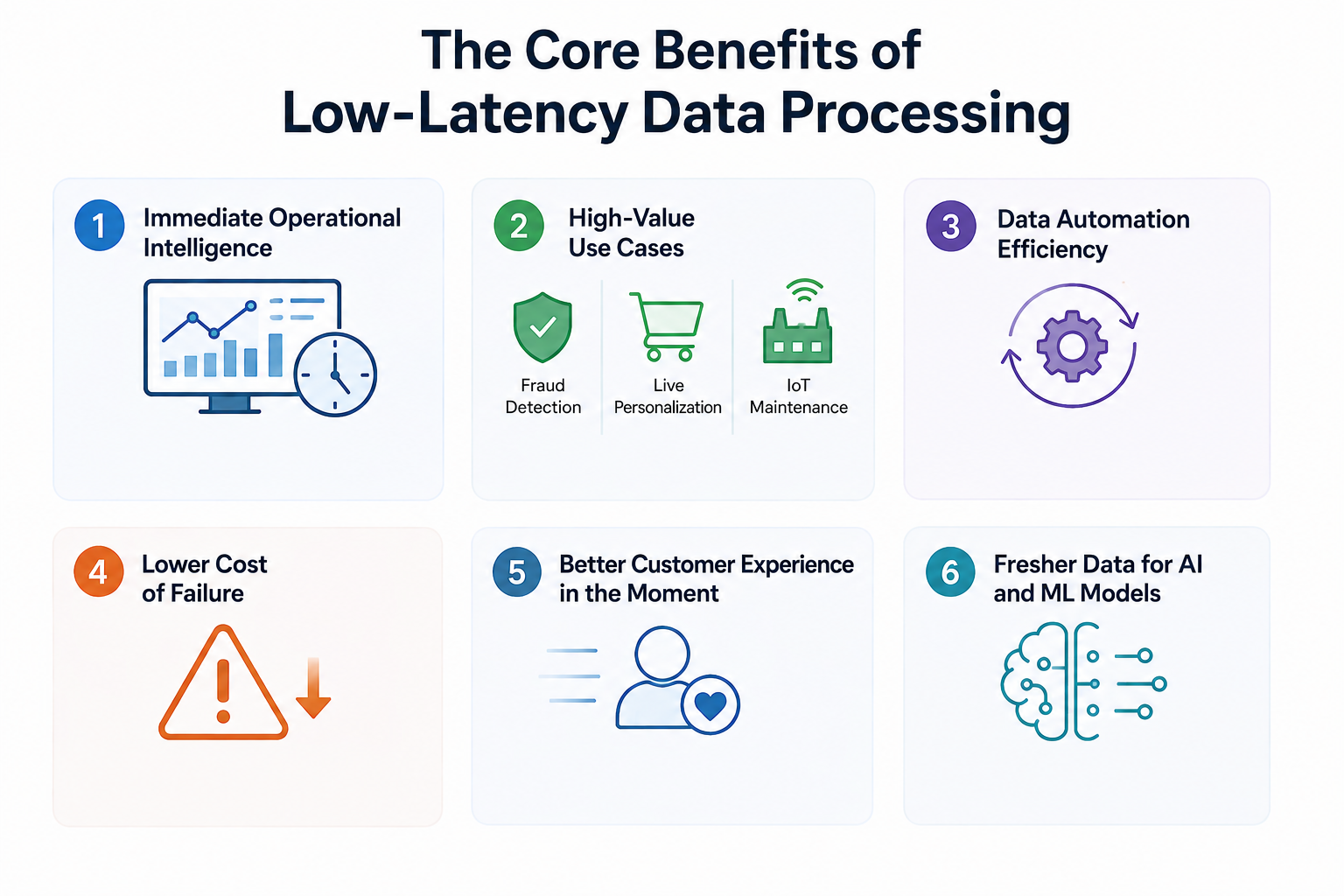
Low-latency data processing collapses the time from event to insight from hours down to milliseconds. Instead of analyzing what happened yesterday, you observe and react to what is happening right now. Six benefits make the case.
Low-latency processing cuts time-to-insight from hours to milliseconds. Operational teams stop working off yesterday's report and start acting on live telemetry, tuning system performance, catching market swings, and making infrastructure calls on current data instead of historical guesswork. The dashboard stops describing the past and starts describing the present.
Some operations cannot function on a delay. Real-time pipelines are the engine behind applications where a few seconds late means the outcome is already lost:
Real-time fraud detection: Financial networks score transaction patterns, device metadata, and geolocation streams in milliseconds to block a fraudulent charge before it clears.
Live personalization engines: E-commerce platforms track clickstreams as they happen, updating recommendations, discounts, and search results mid-session while the buyer is still on the page.
Predictive IoT maintenance: Manufacturing and logistics networks watch continuous sensor streams for temperature anomalies or vibration spikes, flagging equipment failure before the machine actually breaks.
Batch processing creates brutal infrastructure spikes, demanding heavy compute to crunch millions of rows overnight. Real-time pipelines smooth that curve by ingesting and processing continuously as data arrives. The steady incremental stream removes the overnight bottleneck, cuts idle time, and improves how efficiently the whole data stack runs.
Problems caught early stay small. A payment gateway timing out, a spike in failed logins, a sensor drifting out of spec, all of it costs less to fix while it is still happening than after it has propagated downstream. Real-time detection moves you from cleaning up damage to preventing it, and that gap between prevention and cleanup is usually the difference between a config change and an incident report.
The distance between what a customer does and what your system does about it defines the experience. A recommendation that shifts as someone browses, a price alert that fires the instant a threshold hits, a support flow that escalates the second a user gets stuck. None of these survive a nightly cycle. The event and the response have to sit close together in time, and low-latency processing is what keeps them there.
Models are only as current as the data feeding them. A recommendation model or a demand forecast trained and served on batch data is always reacting to a slightly older version of reality. Streaming features into the model as events land keeps predictions aligned with live behavior, which matters most for anything that has to respond to what a user or a system is doing right now.
That said, low latency is not free. Streaming infrastructure costs more to run and operate than a nightly batch job, and plenty of workloads genuinely do not need it. If your reports are read once a day, real-time buys you nothing. The benefit only shows up when the speed of your reaction changes the outcome.
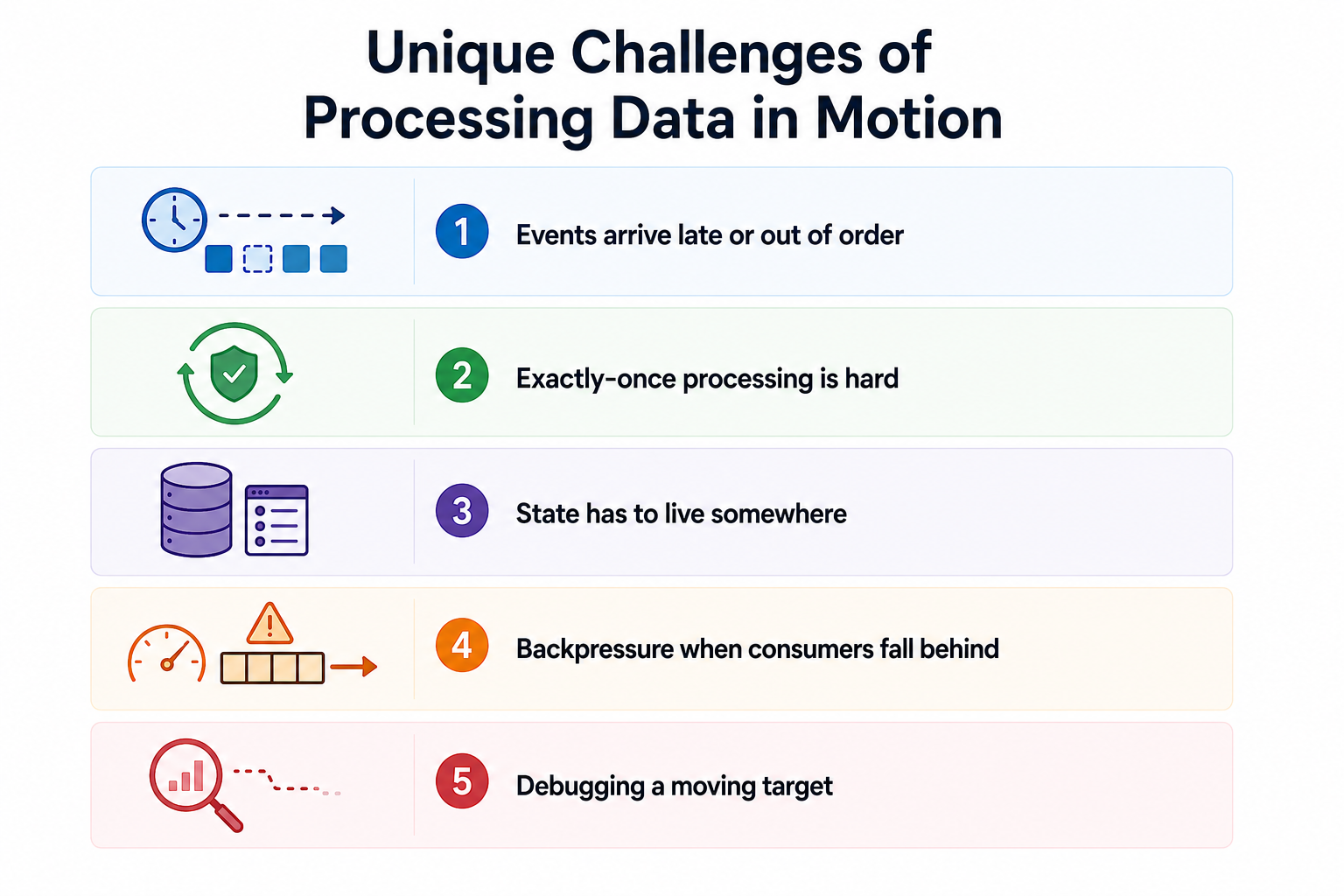
Processing data in motion is hard for one reason. The data never stops and never waits, so every problem you could fix at your leisure in batch becomes something you have to handle live, while more data is still arriving. Here is where these systems actually break.
In a stream, events do not politely queue up in the order they happened. A mobile app goes offline in a tunnel and dumps twenty minutes of events when it reconnects. A network hiccup delays one message behind others sent after it. Now your pipeline has to answer a hard question: is this event just late, or is it never coming? Wait too long and you add latency. Do not wait long enough and you compute a 60-second average that is missing a third of its data.
If a node crashes mid-stream, did that payment event get processed or not? Reprocess it and you might charge someone twice. Skip it and you might lose the transaction entirely. Getting every event processed once, not zero times, not twice, is one of the hardest guarantees to build, and it is why serious data pipeline tools invest so heavily in checkpointing and offset tracking.
Batch jobs are stateless. They start, run, finish, forget. Stream processing has to remember, a running count, a 5-minute window, the last known value per user. That state grows, has to survive restarts, and has to stay consistent even as events pour in. Managing it is a real operational cost that batch systems simply never pay.
When a downstream consumer processes slower than the producer sends, data piles up. Left unhandled, memory fills, and the whole pipeline falls over. The system needs a way to signal upstream to slow down, or a buffer big enough to absorb the lag without losing anything. This is the failure mode that turns a small slowdown into a full outage.
A batch job that fails can be rerun on the same input. A stream cannot. The data that caused the bug already flowed through and is gone, which makes reproducing the exact conditions genuinely difficult. You are debugging something that only existed for a moment, and that alone makes real-time systems more expensive to operate than their batch equivalents.
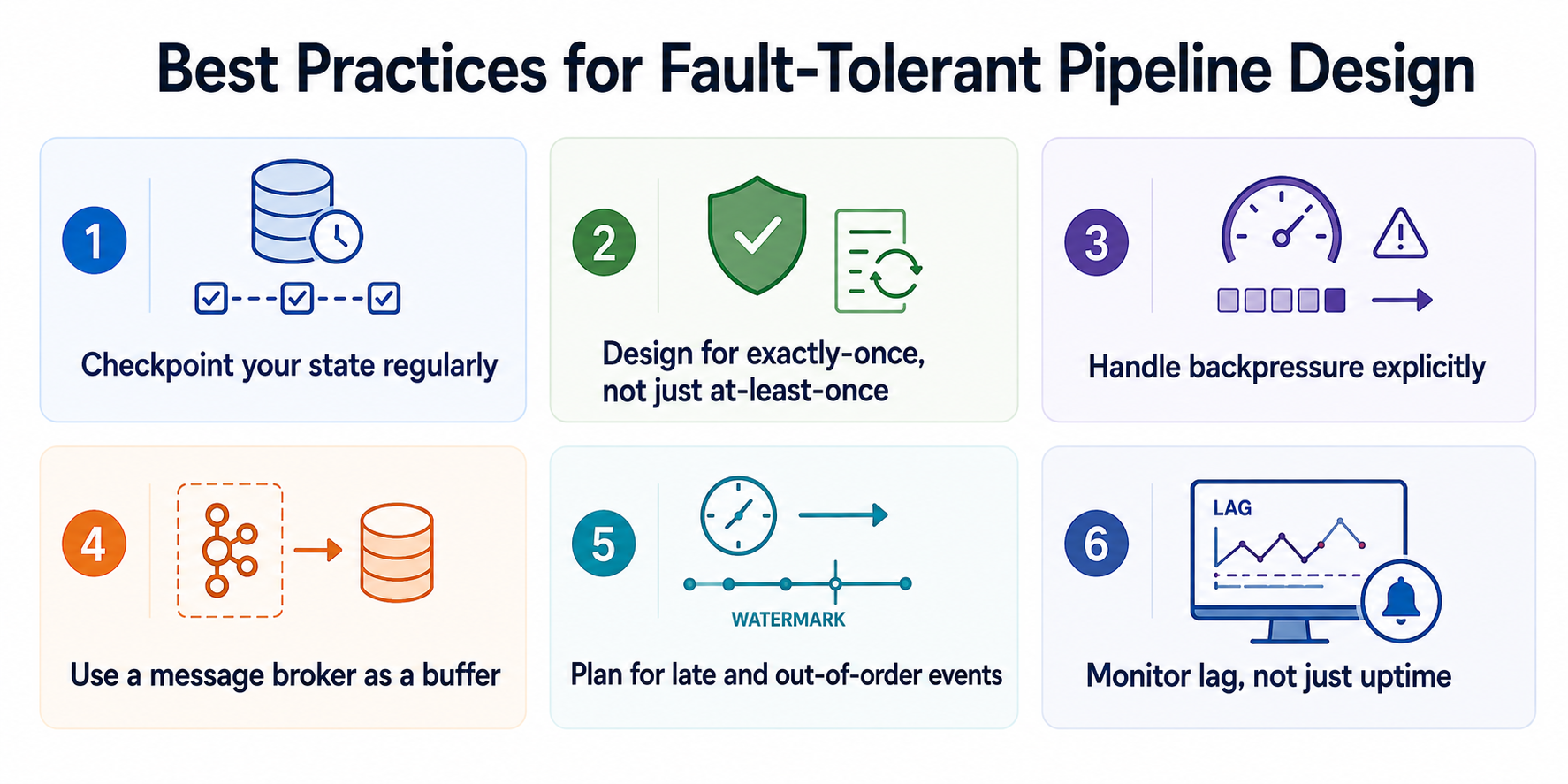
Fault-tolerant pipeline design means building a system that keeps running correctly when parts of it fail, not if they fail. Nodes crash, networks drop, consumers stall. The practices below assume all of that will happen and design around it.
Save the processing state at fixed intervals so a crashed job restarts from the last checkpoint instead of from zero. Without checkpointing, a node failure means replaying everything or losing in-flight state entirely. Engines like Flink build this in, but you still own the tuning. Checkpoint too often and you add overhead; too rarely and you lose more work on every crash.
Decide early what a duplicate costs you. At-least-once delivery is easier to build but can process the same event twice, which is fine for a page-view counter and a disaster for a payment. Where duplicates matter, combine idempotent writes with offset tracking so replaying an event produces the same result as processing it once. Cheaper to design in now than to reconcile double-charged customers later.
Assume a downstream consumer will fall behind, and decide what happens when it does. A message broker like Kafka absorbs the lag as a buffer, giving slow consumers room to catch up without dropping data or crashing producers. The alternative is memory filling silently until the whole pipeline falls over. Pick the behavior on purpose instead of discovering the default during an outage.
Put a durable broker between stages rather than wiring producers straight to consumers. It decouples the two, so a slow or failed consumer never blocks ingestion, and events survive on disk if a downstream stage dies. This one structural choice does more for resilience than almost anything else in the pipeline, which is why it shows up in nearly every serious real-time data pipeline architecture.
Set an explicit policy for how long you wait for stragglers before closing a window. Watermarks let the engine track event time and decide when a window is complete enough to emit, balancing latency against completeness. There is no perfect setting here. You are choosing how much lateness to tolerate, and that call should be deliberate, not left to a default.
A real-time pipeline can be fully "up" and still badly broken. The signal that matters is consumer lag, how far behind real time your processing has fallen. Alert on lag crossing a threshold, because that is what tells you the pipeline stopped keeping pace before your users do.
Real-time data pipelines are not a faster batch job. They are a different way of building, where data is processed in motion and every layer is designed around failure instead of surprised by it.
The decision to build one comes down to a single question. Does reacting in milliseconds instead of hours change the outcome? For fraud detection, live personalization, and IoT monitoring, it clearly does. For a report someone reads once a day, it clearly does not. Match the architecture to how fast your reaction actually needs to be, and you avoid paying streaming's real operational cost for a benefit you were never going to use.
Get the fundamentals right, durable ingestion, stateful processing, exactly-once guarantees, and a sink that keeps pace, and you get a system that acts on events the moment they happen and holds up when a component fails.
If you are weighing whether real-time is the right call for your stack, or need help designing one that survives production, our data pipeline development team can help you scope it before you build.
A batch pipeline collects data over a period and processes it all at once on a schedule, while a real-time pipeline processes each event within milliseconds to seconds of it arriving. Batch is cheaper and simpler and fits reporting that can wait. Real-time costs more to run but lets you act while an event is still happening, which is what fraud detection, live personalization, and IoT monitoring need.
Real-time usually means end-to-end latency from milliseconds to a few seconds, not literally instant. The exact target depends on the use case. Fraud scoring may need sub-100-millisecond decisions, while a live dashboard refreshing every couple of seconds is real-time enough. The point is that the reaction happens fast enough to change the outcome.
Most real-time pipelines combine a message broker for ingestion, a stream processing engine for transformation, and a low-latency sink for storage. Common choices are Apache Kafka, Amazon Kinesis, or Google Pub/Sub for ingestion, Apache Flink or Spark Structured Streaming for processing, and destinations like ClickHouse, Druid, or Snowflake depending on what consumes the data.
Change Data Capture streams every insert, update, and delete out of a database's transaction log as each change commits, instead of repeatedly querying the database to find what changed. It lets a real-time pipeline react to database changes the moment they happen without adding query load to the source system, which makes it a common ingestion pattern for streaming architectures.
Only if reacting in milliseconds instead of hours changes the outcome. If your reports are read once a day or your decisions can wait until tomorrow, a batch pipeline is cheaper and easier to operate. Real-time earns its higher cost when speed of reaction has direct business value, such as blocking fraud, personalizing a live session, or catching equipment failure before it happens.
You might also like

Hello, we are BRILLIAN’S. Trying to make an effort to put the right people for you to get the best results. Just insight !