Last updated September 28, 2026
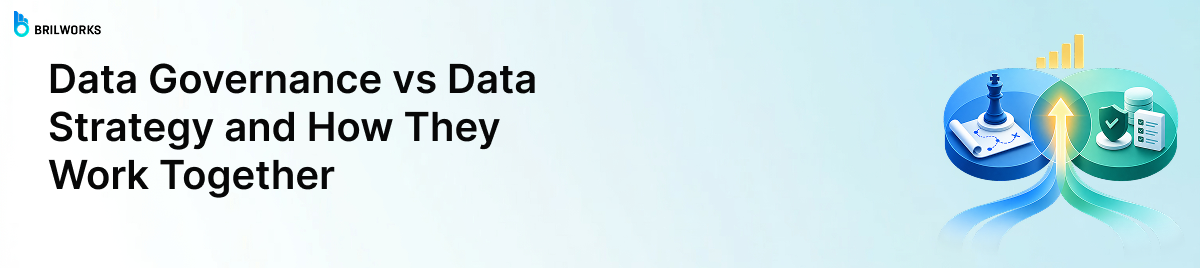
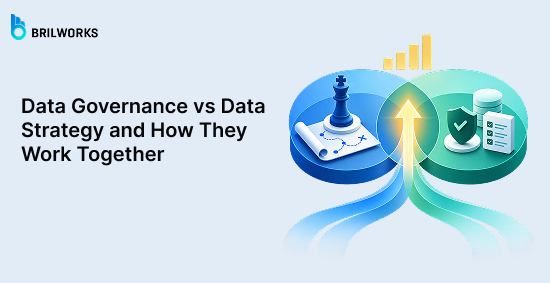
Data Governance vs Data Strategy and How They Work Together

6 mins read
Summarize with AI:


Data
AI
The Stack Underneath
The data governance vs data strategy question usually comes up after a program has already stalled. You spend six months building a data catalog, assigning stewards, and writing access policies for every domain. Then finance asks for trusted margin data to support a pricing decision. The tables they need were never in scope.
Data governance and data strategy break down in different ways without each other. Governance built without a strategy protects data nobody has prioritized. Strategy written without governance promises outcomes on data nobody trusts. Both mistakes are common. Neither is quick to undo.
This guide breaks down data strategy vs data governance across goals, scope, roles, policies, and business outcomes. It also covers data governance vs data management, a comparison that often gets tangled up with this one. From there, it walks through how the two work together and how to align governance with your strategy.
A data strategy is the plan that ties an organization's data to its business goals. It sets which outcomes data should support, which data those outcomes depend on, and what the business needs to build to deliver it. At the enterprise level, an enterprise data strategy usually covers two to three years and gets revisited as priorities change.
A working data strategy answers five questions.
Which business decisions or products should data improve first?
Which data domains do those priorities depend on?
What architecture, platforms, and pipelines are needed to deliver that data?
Which roles and skills does the team need?
How will the business measure whether it worked?
Most teams structure those answers with a data strategy framework, which turns them into pillars, owners, and a sequenced roadmap. In practice, the strategies that stall are the ones that list goals without naming the data behind them. A goal like "improve customer retention" goes nowhere until someone identifies the churn, usage, and support data it needs.
For this comparison, scope is what matters. Data strategy decides what data should do for the business. The rules for how that data is owned, accessed, and kept accurate come from data governance.
Data governance is the set of rules, roles, and processes that decide how an organization's data is owned, accessed, and kept accurate. Strategy points data at business goals, and governance makes sure that data can be trusted once it gets there. Most programs cover five areas.
Ownership assigns a named person to each data domain, so finance owns the definition of net revenue and nobody else redefines it.
Classification marks which data counts as sensitive, such as customer PII.
Access sets who can view, edit, or share each dataset.
Quality defines the standard data must meet before a report or model relies on it.
Retention and compliance decide how long data is kept and which regulations, like GDPR or HIPAA, apply to it.
Together, these areas form a data governance framework, which keeps the rules consistent as more teams and systems touch the same data. The weak spot is usually scope. A framework can look complete on paper and still miss the data the business depends on most. That tends to happen when teams govern whatever is easiest to catalog. A retailer might have strict access rules on its HR records while the inventory data behind every pricing decision has no owner at all.
Data strategy and data governance share the same data, the same stakeholders, and often the same budget. That overlap is why teams blur them. The differences show up in five places, and each one changes who does the work and how success is judged.
Data strategy aims to create business value from data. Data governance aims to make that data reliable and safe to use. A typical strategy objective reads like "reduce churn by using product usage data to flag at-risk accounts." A typical governance objective reads like "every customer record has one owner and one agreed definition of an active customer." The first describes what the business wants to gain. The second decides whether anyone can believe the numbers behind it.
Data strategy looks across the whole business, while governance works one domain at a time. A strategy picks the few data areas worth investing in over the next two to three years and deliberately leaves the rest for later. Governance goes deep on the domains in front of it, down to individual fields, access rights, and quality rules.
Customer data shows the difference clearly. The strategy asks whether that data should power a churn model, a pricing engine, or a support dashboard first. Governance asks who owns the customer table, which fields hold PII, and why the same customer appears three times in the CRM. Same data, very different questions.
Data strategy is owned by senior leadership, while governance is spread across owners and stewards throughout the business. In most enterprises, the split looks roughly like this.
Chief Data Officer or CIO sets the data strategy and secures budget for it
Governance council approves policies and settles disputes between domains
Data owners are accountable for a specific domain, such as finance or customer data
Data stewards handle quality checks, definitions, and access requests day to day
Data engineers and analysts build the pipelines and platforms both sides depend on
In many mid-sized companies, one person ends up owning both strategy and governance. That works while the data estate is small. Once audit deadlines arrive, governance work tends to eat the time meant for strategy, which is usually the point where [building a data team] with separate owners becomes necessary.
Data governance produces policies, while data strategy produces priorities. Governance output is operational. It includes classification standards, access approval workflows, quality thresholds for critical tables, and retention schedules that map to regulations.
Strategy output sits a level higher. It is a ranked list of use cases, a target architecture, an investment plan, and the order in which all of it gets delivered.
Problems start when either side does the other's job. A strategy that writes detailed policies becomes too rigid to change when priorities shift. A governance team that sets its own priorities ends up protecting datasets no business initiative actually uses.
Data strategy is judged by business results, and governance is judged by trust and reduced risk. Strategy success shows up as measurable gains (a pricing model that lifts margin, a forecast cycle cut from weeks to days, or broader [data-driven decision making] across teams). Governance success shows up as fewer conflicting reports, faster audit responses, and fewer access incidents.
Governance outcomes are also harder to see. When governance works, nothing visibly happens, and that makes it harder to fund. Governance budgets are much easier to defend when they are tied to a strategy goal, such as trusted revenue data for a pricing initiative.
Data strategy sets the direction, and data governance makes the data behind it trustworthy enough to use. In a working setup, the two run as one continuous loop.
Strategy picks the priorities, such as a pricing model or a faster financial close.
Governance scopes its work to the domains those priorities depend on. Those domains get owners, quality rules, and access policies first, and everything else waits.
Stewards report back on what they find, including missing fields, conflicting definitions, or data that can't legally be used for the planned purpose.
Strategy adjusts. The roadmap either funds the fix or moves the use case back until the data can support it.
The step that turns priorities into a governance plan is a data governance strategy. It decides which domains get governed first and to what standard, based on what the business strategy needs.
A lender planning a credit risk model shows how the loop plays out. The strategy names the model as a priority for the year. Governance then finds that income data sits in three systems with three different definitions, and the customer consent terms don't cover model training. Strategy pushes the launch back a quarter and funds the consolidation work. Without that loop, the model would have shipped on data the legal team would later block.
In most cases, strategy should lead. The exception is a business facing an audit or a regulatory deadline, where basic controls over sensitive data can't wait for a finished strategy. Even then, it pays to keep governance narrow until the strategy catches up, so the program doesn't grow around data nobody has prioritized.
Data governance sets the rules for data, and data management carries them out. Governance decides that every customer record needs one owner, a valid email, and restricted access to PII. Management is the engineering and operations work that makes those rules hold in real systems, through pipelines, validation checks, backups, and access controls on the database itself.
The data governance vs data management question gets pulled into this comparison because all three terms describe work on the same data. The clearest way to separate them is by the question each one answers. Strategy asks what data should do for the business. Governance asks what rules the data must follow. Management asks how the data is stored, moved, and maintained so those rules actually hold.
In smaller teams, the same data engineers often handle management and a good share of governance. That setup works as long as someone on the business side owns the definitions. Engineers can enforce a rule about what counts as an active customer, but finance and sales should be the ones deciding it.
When governance and strategy drift apart, the symptoms are easy to spot. Governance teams spend their time on data no initiative uses. Strategy teams launch projects on data nobody has checked. Alignment fixes both problems through a few deliberate steps.
Start with the strategy's top priorities. Pick the two or three initiatives the business cares about most this year. Governance that tries to cover every domain at once usually stalls before it protects anything useful. If your strategy lists ten priorities, it needs trimming before governance can align to it.
Map each priority to the data it depends on. A pricing initiative might rely on product, transaction, and competitor data. Those domains become the first scope of your data governance strategy. Regulated data like health records or payment details is the exception, since it needs baseline controls regardless of where it sits on the roadmap.
Assess where those domains stand today. A quick read against a data maturity model shows whether a domain needs basic ownership first or only tighter quality rules. You can skip a formal assessment when the gaps are already obvious, such as a domain with no owner at all.
Set controls in proportion to the use case. A dashboard used in a weekly review needs lighter controls than a model that approves credit. Match quality thresholds and access rules to what breaks if the data turns out to be wrong. Getting this calibration right takes experience, and teams doing it for the first time often bring in data governance consulting at this stage.
Measure governance against strategy outcomes. Track whether governed data is actually speeding up the initiatives it supports. Useful measures include the time it takes to deliver trusted data for a new use case, the number of conflicting reports on priority metrics, and how often teams manually override a model's output. Generic maturity scores tell leadership very little.
Review both on the same cadence. Hold a quarterly review where strategy owners and governance leads work from the same priority list. The underlying data governance framework rarely needs to change. What changes is which domains it covers and how strictly.
Expect the first mapping to be wrong in places. Teams usually discover dependencies halfway through, such as a pricing model that also needs returns data nobody listed. Treating the first quarter as a draft and planning for one rescope keeps the program from stalling when that happens.
Data strategy should lead, and data governance should follow its priorities. Strategy decides which outcomes data needs to support. Governance makes the data behind those outcomes trustworthy, starting with the domains your top initiatives depend on. Running them as separate programs is how companies end up with governed data nobody uses and strategic projects built on data nobody trusts.
For most teams, the next step is small. Take the two or three priorities in your current strategy and list the data domains each one depends on. Then check whether those domains have named owners and quality rules today. If the strategy itself is still unclear, that is the gap to close first. Enterprise data strategy consulting can help define the priorities your governance program should be built around.
Yes, data governance is usually one component of a broader data strategy. The strategy sets which business outcomes data should support, and governance keeps the data behind those outcomes reliable, secure, and compliant. Most enterprise data strategies treat governance as a core pillar alongside architecture, analytics, and talent.
Data strategy should usually come first. It tells governance which data domains matter most, so governance effort goes where the business needs it. Governance built without a strategy tends to spread across every dataset and stall before it protects anything important. The exception is a company facing an audit or regulatory deadline, where basic controls over sensitive data need to start right away.
A Chief Data Officer or CIO usually owns the data strategy and its priorities. Data governance is shared across a governance council, business data owners for each domain, and data stewards who manage quality and access day to day. In mid-sized companies, one senior leader often oversees both.
Yes, and many companies do. Without strategic priorities, though, governance teams tend to focus on whatever data is easiest to catalog rather than the data that drives revenue or risk. The result is well-documented data that few business initiatives actually use.
A retailer's data strategy might set a goal of using sales and inventory data to optimize pricing across its stores. Data governance would then assign an owner for pricing data, define what counts as a valid transaction, and restrict who can edit price records. The strategy decides that pricing is the priority. Governance makes sure the pricing data behind it can be trusted.
You might also like

Hello, we are BRILLIAN’S. Trying to make an effort to put the right people for you to get the best results. Just insight !