Most data strategies die in a slide deck. The vision is sound, the goals are clear, and then nothing moves, because there's no structure connecting the strategy to the systems, people, and decisions that actually run on data.
This guide breaks down what a data strategy framework is, the components it needs, how to build one step by step, and what a working example looks like in practice.
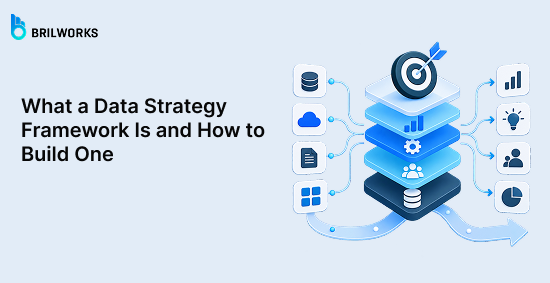
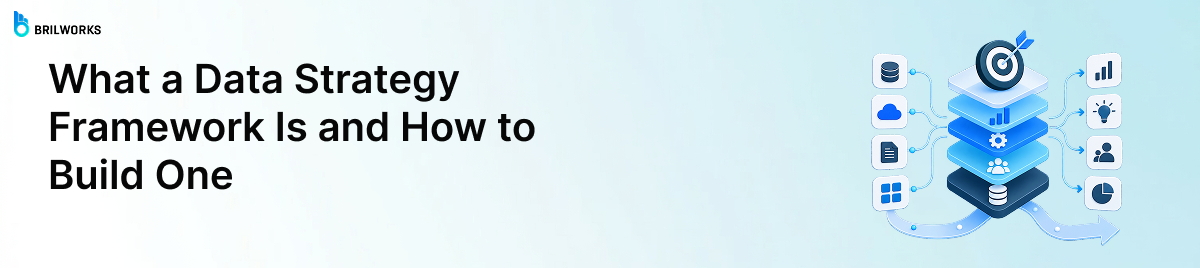
A data strategy framework is the structure that turns your data strategy into something you can actually build. It breaks the strategy into defined components, business goals, architecture, governance, people, so each one has an owner and a plan instead of sitting as a bullet on a roadmap.
A framework is not the strategy itself. The strategy says where you want to go with data. The framework is how you organize the work to get there. Think of the strategy as the destination and the framework as the operating structure that keeps every team moving toward it.
It usually covers a few core areas. Business alignment, data architecture and technology, governance and quality, and the people who own and use the data. Each area connects to the others, so a gap in one shows up as a problem in another. Weak governance shows up as data nobody trusts. No clear ownership shows up as pipelines nobody maintains.
Get the framework right and the strategy becomes executable. Get it wrong and you're back to a slide deck.
What Are the Key Components of a Data Strategy Framework?
A data strategy framework holds together only if its parts are defined. Miss one and the whole thing leans. These are the six components that make a framework work, and how each one connects to the rest.
1. Business Goals and Data Objectives
Every data strategy component starts with a business goal, not a data goal. Faster reporting, lower churn, tighter compliance, whatever the business is actually trying to move. Data objectives then translate those goals into what your data has to do to support them. Skip this and you build capability nobody needs.
2. Current-State Data Assessment
You can't plan a target state without knowing where you're starting. A current-state assessment maps what data you have, where it lives, how good it is, and who touches it. Most teams overestimate their maturity here. Running an AI readiness audit and a data quality assessment gives you an honest baseline instead of a guess.
3. Data Architecture and Technology
Architecture is the component that decides whether everything else is even possible. It covers how data is stored, moved, and served, from your cloud data engineering setup to the pipeline architecture that keeps it flowing. Decisions like data lake versus data warehouse belong here, because they shape cost and capability for years.
4. Data Governance and Quality
Governance defines who can do what with which data, and quality defines whether that data can be trusted. The two travel together. A data governance framework sets the rules, and a data quality framework keeps the data clean enough to act on. This is a deep area on its own, so treat this as the framework-level view and go deeper when you build it out.
5. People, Roles, and Responsibilities
A framework runs on people, not documents. This component names who owns data, who stewards it, and who's accountable when it breaks. Data stewardship matters most here, because unowned data is the fastest way to lose trust in a system. Without clear roles, governance is just a policy nobody enforces.
6. Data Culture and Adoption
The last component is the one most frameworks forget. A framework only works if people actually use the data instead of routing around it. Culture is the habit of reaching for data before opinion, and adoption is whether your teams trust the outputs enough to act. You can build perfect architecture and still fail here.
How to Build a Data Strategy Framework
Skip the framework and you get motion without direction. Teams buy tools before they know the problem, governance gets written after the data's already a mess, and six months in you're rebuilding what you shipped. Data strategy implementation fails in the sequence, not the ambition. Build it in this order.
1. Define Business Goals
Start with what the business is trying to achieve, before you touch a single data question. Most teams skip past this because tools and pipelines feel like progress, while goal-setting feels like a meeting. So the goals stay fuzzy, and every decision downstream has nothing solid to measure against.
The difference shows up fast. "Become data-driven" gives the team a year of dashboards nobody uses. "Cut churn by 15% this year" gives every data decision a test it either passes or fails. The second one also hands you a stakeholder, because someone in the business already owns that number and now has a reason to care whether the data work lands. Goals this specific are what keep a framework alive when budgets tighten.
2. Identify Critical Data Needs
Once the goals are set, work out what data you actually need to hit them. This is the step that keeps you from collecting everything and using nothing. For each goal, trace back to the data that would move it, then check whether you already capture that data or need to start.
The honest part is admitting what you can ignore. Not all data is worth managing, and treating every source as critical is how storage bills climb while insight stays flat. A goal around churn needs clean customer and usage data, not every log your systems have ever produced. Narrow it on purpose.
3. Assess the Current Data Environment
Now measure the gap between what you need and what you already have. This is where most teams flatter themselves, because the org chart says the data is owned and the reality says otherwise. A real assessment looks at your sources, their quality and freshness, who actually owns each one, and the systems holding it together.
That last part is where legacy setups bite. Old pipelines and undocumented tables carry modernization challenges that don't show up until you try to build on them. Assume the picture is worse than it looks on paper. It usually is.
4. Identify Data Gaps and Priorities
With the assessment done, name the gaps and rank them, because you can't fix everything at once and shouldn't try. Some gaps block a business goal outright. Others are just friction you've learned to live with. The ranking is what separates a framework from a wish list.
Prioritize by business impact first, then by dependency, since some gaps have to close before others can even be attempted. A messy dashboard is irritating and can wait. A broken pipeline feeding financial reports is a fire, and it goes to the front of the line. Effort matters too, because a couple of early wins buy you the credibility to tackle the hard ones.
5. Define the Target Data Architecture
This step decides what you're building toward, and it's the hardest part to change once it's set. Target architecture covers how data is stored, how it's processed, and how it gets served to the people who need it. Design for where the business is heading, not where it sits today, because ripping out architecture later is expensive and slow.
The big platform calls live here, including decisions like Databricks versus Snowflake that shape cost and capability for years. Just as important is how the pieces fit together, so pipelines, storage, and analytics tools act like one system instead of parts bolted on over time.
6. Establish Governance and Ownership
Governance built late is governance ignored, so set the rules while the architecture is still taking shape. That means baking ownership in rather than bolting it on after the data's already sprawling. The core questions are simple to ask and easy to keep dodging:
-
Who can access which data, and under what conditions
-
Who owns each data domain, and who's accountable when it breaks
-
What quality bar data has to clear before anyone acts on it
Answer these while you're building and governance becomes part of the system. Answer them later and it becomes a policy document nobody follows.
7. Build the Data Strategy Roadmap
The roadmap turns the framework into a sequence of dated, owned initiatives. A good data strategy roadmap orders the work so dependencies come first and nothing critical waits on something that hasn't been built yet. Foundational work and migrations get sequenced early, not squeezed in wherever there's a gap.
The test for every item on it is boring but strict. It needs an owner rather than a committee, and a date rather than a quarter labeled "later." A roadmap without those two things isn't a plan. It's a list of intentions.
8. Define KPIs and Success Metrics
If you can't measure it, you can't defend the budget for it. Every initiative on the roadmap should tie to a metric that traces back to the business goals from step one, so the framework can prove it's working instead of just looking busy. Good metrics tend to be specific and a little boring:
-
Time to insight, or how fast a question becomes an answer
-
Data quality scores, tracked over time rather than checked once
-
Adoption rates, since data nobody uses is data nobody funds
-
Cost per query or pipeline, so spend stays honest as you scale
Pick a handful that matter and watch them. A dashboard of forty metrics is just noise wearing a suit.
9. Implement and Monitor the Strategy
Implementation is where the framework meets reality, and reality pushes back. The mistake here is treating the framework as a document you finish and file. It's a system you run, and it drifts the moment you stop paying attention.
Roll out in phases instead of all at once, so a bad assumption costs you one initiative rather than the whole program. Watch the metrics from step eight and act on what they show. Then keep adjusting as the business shifts under you, the same way a data modernization strategy keeps evolving long after the first migration ships.
Data Strategy Framework Example
Theory only goes so far. Here's the framework applied to one company, start to finish, so you can see how the pieces connect in practice.
Take a mid-sized logistics company. Deliveries are growing, but so are complaints, and leadership can't tell whether the problem is routing, warehouse delays, or driver capacity. The data exists. It's just scattered across a dispatch system, a warehouse tool, and a pile of spreadsheets nobody trusts.
-
Business goal: Cut late deliveries by 20% this year. That's the number everything else answers to. The operations director owns it, which means the data work has a stakeholder from day one.
-
Critical data needs: Hitting that goal needs clean delivery timestamps, route data, and warehouse dispatch times. Everything else, and there's a lot of it, gets set aside. The customer feedback logs are interesting but don't move the number, so they wait.
-
Current-state assessment: The audit finds the real problem fast. Delivery times are logged in three systems that don't agree with each other, and no one owns the discrepancy. Data quality, not data quantity, is the blocker.
-
Gaps and priorities: Two gaps matter. There's no single source of truth for delivery status, and there's no owner for the data. Both go to the top of the list, because every downstream analysis is worthless until they're fixed.
-
Target architecture: The company consolidates the three systems into one cloud warehouse, with pipelines feeding it on a schedule instead of by hand. Nothing exotic. The point is one trusted place for delivery data, not a rip-and-replace of every tool they own.
-
Governance and ownership: A data management strategy assigns clear ownership. Operations owns delivery data, warehouse leads own dispatch data, and there's a defined quality standard for what "on time" even means, since that was ambiguous before.
-
Roadmap and metrics: The rollout runs in phases. Consolidate the data first, then build the reporting, then layer on prediction. Success is tracked on one primary metric, late-delivery rate, plus data quality scores to confirm the foundation is holding.
Six months in, the company can finally see that most late deliveries trace to one regional warehouse, not routing at all. That insight was impossible before, not because the data didn't exist, but because nothing connected it. The framework is what connected it.
Final Thoughts
A data strategy framework isn't the thing that makes your data valuable. It's the thing that makes the data you already have usable, by giving every piece an owner, a purpose, and a place in the plan.
The companies that get this right aren't the ones with the most data or the fanciest tools. They're the ones that started with a business goal, mapped the data to it, and built the structure in the right order. Goals first, architecture and governance next, roadmap and metrics to hold it together. Skip the sequence and you get the slide deck that never ships.
If your own strategy is stuck between the vision and the execution, that gap is usually structural, not strategic. Closing it is the core of what our enterprise data strategy work does, turning the plan into components your teams can actually build and measure.