Last updated September 16, 2026
What Is Enterprise Data Strategy? A Complete Guide

9 mins read
Summarize with AI:


Data
AI
The Stack Underneath
Your company has a data warehouse. It has dashboards, a BI tool, probably a lake sitting next to the warehouse, and a few analysts who know their way around SQL. And yet when the CEO asks a simple question, something like which customer segment actually drove last quarter's growth, three people give three different numbers. Everyone trusts their own report. Nobody trusts the shared one.
This is the gap an Enterprise Data Strategy is meant to close. Most teams don't have a data problem in the sense of not having enough of it. They have too much of it, spread across systems that were bought at different times for different reasons, owned by nobody in particular. The tools work fine on their own. What's missing is the plan that decides how data gets collected, governed, stored, and turned into something the business can act on with confidence.
An Enterprise Data Strategy is that plan. It connects your data to actual business goals, sets the rules for who owns what, and gives you a way to grow toward advanced analytics and AI without rebuilding everything two years from now.
This guide walks through what an Enterprise Data Strategy is, why it matters, the components it's built from, and how to actually build one, including the framework, the maturity model, and the governance questions most teams get stuck on.
An Enterprise Data Strategy is the plan that defines how your organization collects, stores, governs, and uses data to meet its business goals. It sits above any single tool or platform and decides what all of them are working toward.
It is not a data platform. It is not your warehouse, your lake, or the BI tool your analysts open every morning. Those are the machinery. The strategy is the set of decisions that tells the machinery what to do, who is responsible for each part, and how data moves from the systems that generate it to the people who need to act on it.
Think of it as the layer that connects two things that usually live apart. On one side, the business goals, revenue targets, customer retention, faster product decisions. On the other, the raw data scattered across your CRM, your product database, your finance system, and a dozen spreadsheets. Without a strategy, those two sides never quite meet. Data gets collected because collecting it felt responsible, not because anyone knew what question it would answer.
A real strategy works backward from the questions the business needs answered. It sets the rules for data governance so ownership is clear and definitions are consistent. It shapes the data architecture so information can actually flow instead of getting trapped in silos. And it accounts for the people and the culture, because the best-designed pipeline still fails if nobody trusts the output or knows how to use it.
The scope is what makes it enterprise-wide rather than departmental. A marketing team can build its own reporting stack and call it a data strategy, but that only fixes marketing. An Enterprise Data Strategy covers every function, sets shared standards across all of them, and stops each department from quietly building its own version of the truth.
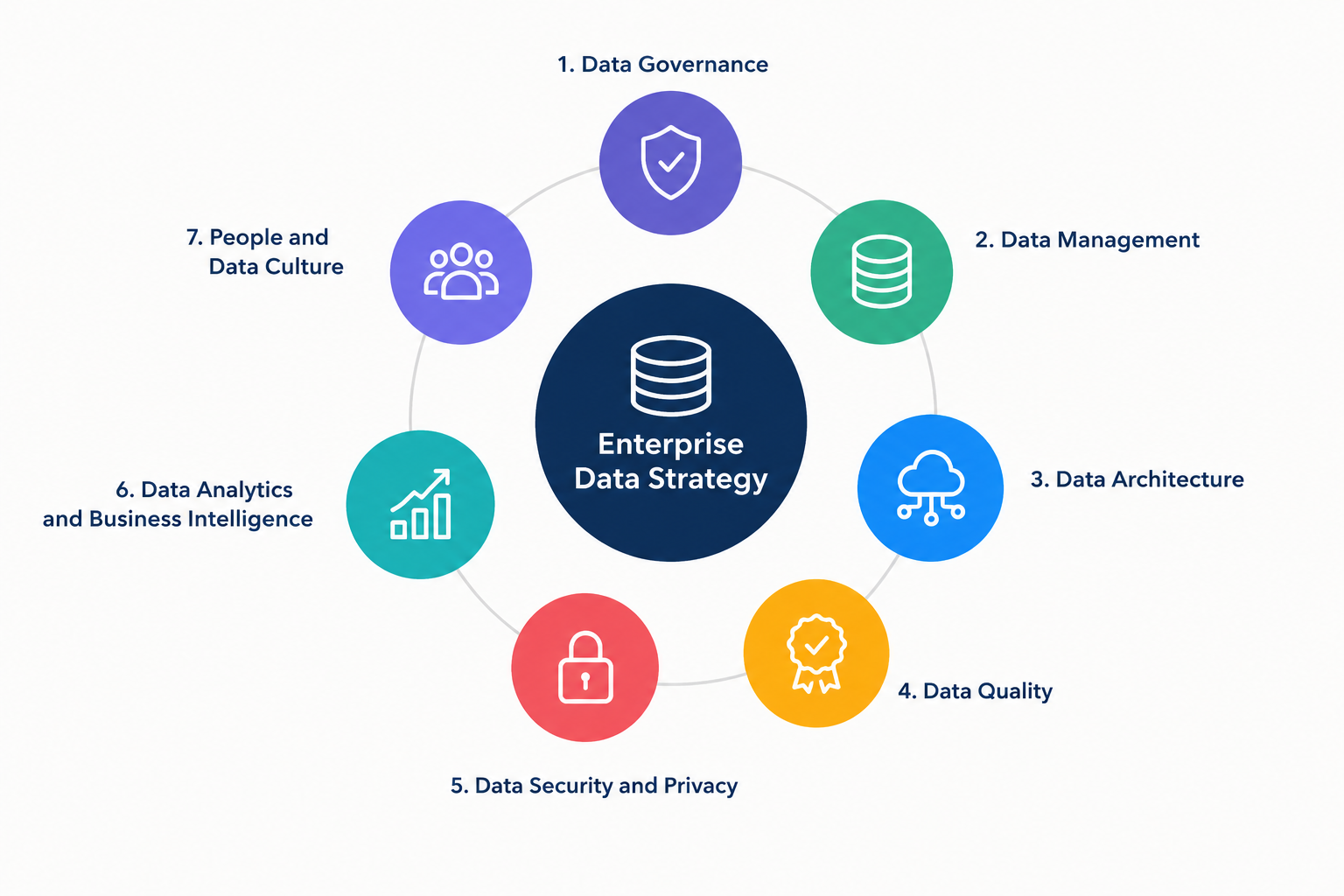
An Enterprise Data Strategy is built from seven parts that have to work together. Each one covers a different question, from who owns the data to whether anyone trusts it, and a gap in any single component tends to show up as a problem somewhere else. Here is what each part does and why it earns its place.
Data governance is the set of rules that decides who owns data, who can access it, and what each term officially means. It answers the question most reporting fights come down to, which is whose number is right. Strong data governance fixes definitions once so that revenue means the same thing in the finance report and the sales dashboard. Skip it and every team builds its own version of the truth.
Data management is the day-to-day work of collecting, storing, integrating, and maintaining data across its life. A data management framework gives this work a repeatable structure instead of leaving each team to invent its own process. It covers where data lands, how it gets cleaned, and how it stays usable as volume grows. Without it, data accumulates faster than anyone can make sense of it.
Data architecture is the technical design that decides how data moves and where it lives. It covers your warehouses, lakes, and the pipelines connecting them, and it determines whether information can actually flow between systems or stays trapped where it was created. The choice between a data lake and a data warehouse sits inside this component. Get the architecture wrong and every downstream analytics effort inherits the constraint.
Data quality is whether the data is accurate, complete, and current enough to trust. It is the component people notice only when it fails, usually in the form of a report nobody believes. A data quality framework sets the checks that catch bad data before it reaches a dashboard. The honest part here is that quality is never finished, because new data arrives with new problems every day.
Data security and privacy is the component that controls who can see sensitive data and keeps you compliant with regulations like GDPR and HIPAA. It covers access controls, encryption, and the audit trail that proves who touched what. This is the part most teams treat as a legal checkbox until a breach or an audit turns it into the only thing that matters. Build it into the strategy from the start rather than bolting it on later.
Data analytics and business intelligence is the layer that turns stored data into answers people can use. This is where business intelligence development lives, in the dashboards, reports, and models that the rest of the business actually sees. Every other component exists to feed this one. If the analytics layer produces answers nobody acts on, the strategy has failed no matter how clean the pipeline underneath it is.
People and data culture is whether your organization knows how to use data and chooses to. It is the least technical component and the one that quietly decides whether the other six matter. You can build perfect governance and a flawless pipeline, and it still fails if managers keep making calls on gut feel and ignore the dashboard. Culture is slower to change than any system, which is why it belongs in the strategy and not in an afterthought.
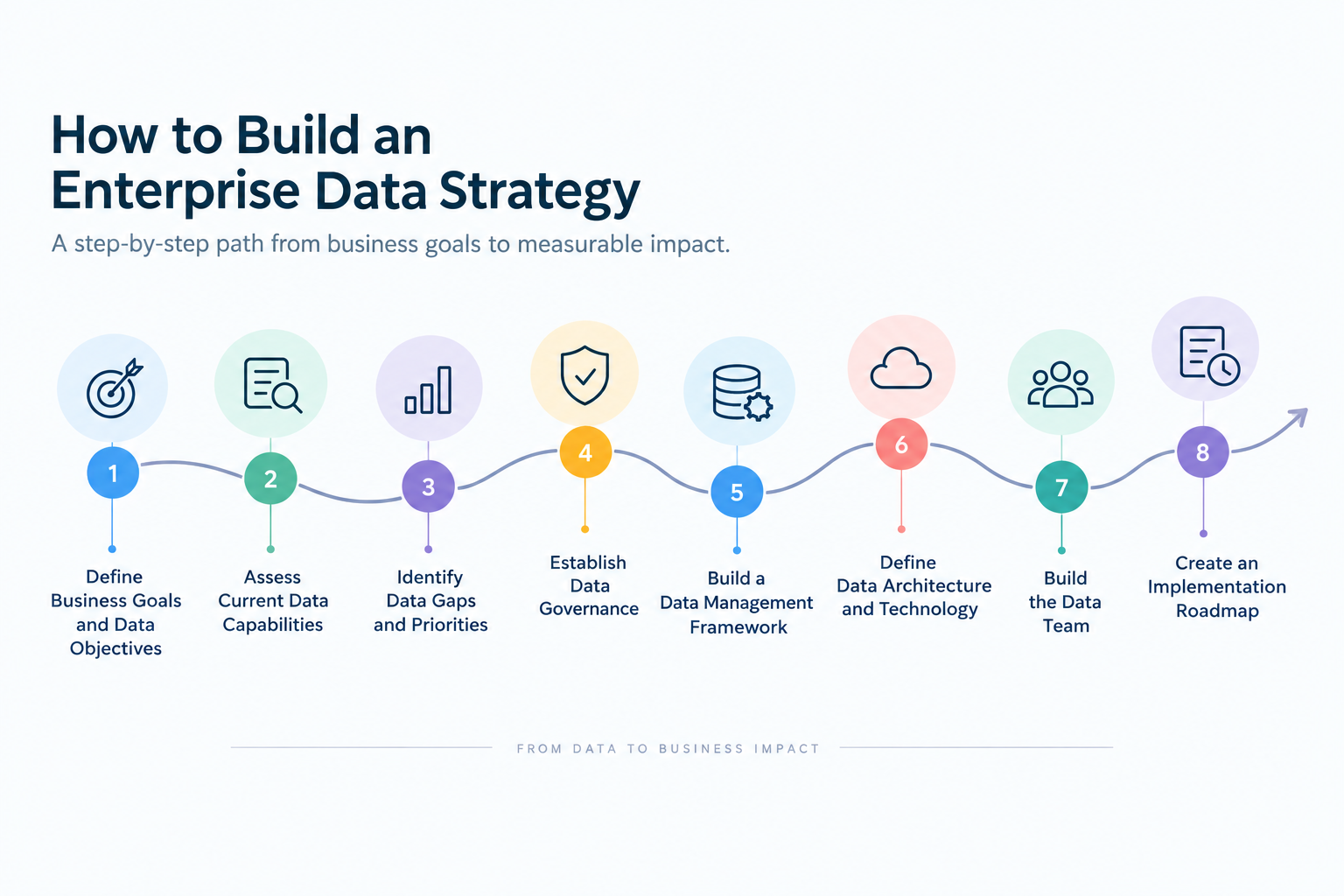
Most teams build a data strategy by buying tools first and deciding what they're for later. They stand up a warehouse, add a BI tool, hire an analyst, and only then ask what business question any of it was supposed to answer. The result is expensive infrastructure that produces reports nobody trusts. The order matters more than the tooling, so build an Enterprise Data Strategy in this sequence.
Start with the decisions the business wants to make better, not the data you already have. The job of this step is turning vague ambitions into objectives you can attach a number and a data source to, because a goal you can't measure tells you nothing about what data to collect.
|
Vague ambition |
Measurable data objective |
|
Understand our customers better |
Identify at-risk accounts 30 days before renewal to cut churn |
|
Improve marketing |
Attribute revenue to channel to reallocate the bottom 20% of spend |
|
Make faster decisions |
Cut month-end reporting from 9 days to 2 |
|
Grow the business |
Forecast demand by SKU to reduce stockouts below 5% |
Take an honest inventory of what you have before you plan what to build, because most teams overestimate the state of their data until they measure it. A structured data quality assessment is what turns assumptions into a real baseline. Check each of these.
Every system that holds business data, including the spreadsheets that quietly run a department
Who owns each data source, or whether anyone does
Completeness, accuracy, and freshness of the critical datasets
How data currently moves between systems, and where it gets stuck
The skills and tooling your team has now, measured against what the strategy will need
Compare where you are against where your business goals say you need to be, then rank the gaps by the value of the decision each one blocks. Not every gap is worth closing. Some data is nice to have and will quietly consume a quarter of engineering time for a report someone opens twice, while a single missing customer view might be the thing standing between you and any reliable churn prediction.
The discipline here is saying no. A gap that blocks a revenue-critical decision beats five that would merely be interesting to close, and trying to fix everything at once is the most common reason data strategies collapse in year one. The team burns its early credibility on breadth instead of delivering one visible win. Rank ruthlessly, close the top few, and leave the rest documented for a later phase.
Decide ownership, access, and definitions before you build anything on top of the data, because this is the step that determines whether anyone trusts the output later. It's also the one teams most want to skip, since it's political rather than technical, and there's no satisfying tool to buy that makes it go away. Assign a named owner to every critical data domain, a person and not a committee, so there's someone accountable when a definition is disputed.
And most reporting fights are really definition fights in disguise. Two teams argue over whose revenue number is right when the real problem is that they never agreed what revenue counts. Settle those definitions once, write them down, and the arguments stop. Governance done early is a set of decisions. Governance done late is a cleanup project, and it always costs more to retrofit trust than to build it in from the start.
Put a repeatable structure around how data moves so every team stops inventing its own path, which is how you end up with the same customer record stored four incompatible ways. A data management framework defines the standard route once and makes it the default, from the moment data arrives to the moment it's retired.
Ingestion, where data enters from source systems on a defined schedule or stream
Validation, where it's checked against quality rules before it goes anywhere
Transformation, where it's cleaned and shaped into a consistent structure
Storage, where it lands in the warehouse or lake by an agreed model
Retention and archival, where you decide what to keep, for how long, and what to delete
Choose the systems now, because now you know what they need to do. Design how data will move and where it will live first, then pick tools to fit that design, since choosing a platform like Databricks or Snowflake before the earlier steps is how teams pay for capabilities they never switch on. The core storage decision usually comes down to three options.
|
Option |
Best for |
Trade-off |
|
Data warehouse |
Structured data, fast BI and reporting |
Rigid schema, costly for raw or unstructured data |
|
Data lake |
Raw, varied data at low storage cost |
Needs strong governance or it becomes a swamp |
|
Lakehouse |
Mixed reporting and exploratory work in one system |
Newer stack, more to manage and tune |
Match the people to the strategy you've designed, whether that means hiring data engineers and analysts or upskilling the team you already have. A strategy with no one accountable for running it is a document, not a strategy. Be honest about what your organization can realistically staff and retain, because an architecture your team can't operate is worse than a simpler one it can.
This is also where you decide what to build in-house versus bring in through a partner. The skills to design a data platform and the skills to run it day to day are not always the same, and hiring for both at once is slow and expensive. Start with the roles that unblock your highest-priority gaps, lean on a partner for the specialist work you can't yet staff, and grow the team as the roadmap earns its next phase.
Turn the strategy into a phased plan with milestones and owners, and resist the big-bang rollout, because when it fails it takes the whole program's credibility with it. Sequence the phases so an early one delivers a visible win tied to a revenue-critical decision, since that win is what funds everything after it.
|
Phase |
Focus |
Milestone |
|
Phase 1 |
Governance and one high-value use case |
Agreed definitions live, first trusted dashboard shipped |
|
Phase 2 |
Core architecture and management framework |
Standard pipeline running for priority data domains |
|
Phase 3 |
Team build-out and second use case |
Roles filled, analytics extended to a new function |
|
Phase 4 |
Scale and optimize |
Framework applied org-wide, roadmap reassessed |
A data strategy framework is the structure that organizes the components into a repeatable model, so a strategy is something you can follow and reuse rather than reinvent for each initiative. It arranges the parts into six layers that build on each other, and skipping any one leaves a gap the others can't cover. The full layer-by-layer breakdown is covered in our guide to the data strategy framework.
The top layer that sets direction, defining what the business is trying to achieve so every data decision below it has something to serve.
The rules for ownership, access, and definitions that keep data trustworthy and consistent across every team using it.
The operational layer that handles how data is collected, integrated, and maintained across its life, keeping it usable as volume grows.
The technical design deciding how data moves and where it lives, from pipelines to storage, so information flows instead of getting trapped.
The roles, skills, and workflows that put the strategy into practice, since the structure only works if people know how to run it.
The tools and platforms that store the data and turn it into answers, chosen to fit the architecture rather than the other way around.
A Data Maturity Model is a way to place your organization on a scale from ad hoc data handling to fully optimized, so you know where you stand before you decide where to go next. It matters because the right first move depends entirely on your starting point, and a company still fighting spreadsheets needs a different plan from one tuning an established platform. The five stages below are covered in depth in our guide to the Data Maturity Model.
Initial: Data is scattered, undocumented, and handled differently by every team, with no shared ownership and reporting built manually each time it's needed.
Developing: Basic tools and processes appear, but they're inconsistent across departments, and data quality still depends on who happens to be doing the work.
Defined: Standards, ownership, and governance are documented and followed, so data means the same thing across teams and reporting starts to be trusted.
Managed: Data quality and processes are measured and actively controlled, and the organization can rely on its data for decisions rather than double-checking it.
Optimized: Data is a strategic asset feeding advanced analytics and AI, with processes that improve continuously rather than only when something breaks.
These two terms get used interchangeably, and that confusion is exactly why teams end up with one and assume it covers the other. They're related but they answer different questions, and you need both. The short version is that strategy sets the direction and governance sets the rules that keep you on it.
Data governance is the set of rules, roles, and standards that control how data is owned, accessed, and defined across the organization. It answers who is responsible for each dataset, who can use it, and what each term officially means, so that the same metric doesn't carry three different definitions across three teams. Governance is the operational discipline that keeps data trustworthy day to day, and it's covered in depth across our data governance frameworks guide.
A data strategy is the plan that connects your data to business goals and decides what the organization is trying to achieve with it. It sets priorities, defines objectives, and determines where to invest, working backward from the decisions the business needs to make. Where governance is about control and consistency, strategy is about direction and outcomes.
Strategy without governance produces ambitious plans built on data nobody trusts, and governance without strategy produces well-controlled data that serves no clear business purpose. They work as a pair, the strategy pointing at where the business wants to go and governance making sure the data underneath is reliable enough to get there. In practice you build them together, letting the strategy set the priorities and governance enforce the standards those priorities depend on.
An Enterprise Data Strategy is not a tool you buy or a platform you stand up. It's the sequence of decisions that connects your data to what the business is actually trying to do, and the reason it's worth the effort is simple. Every dashboard, pipeline, and hire you invest in without it inherits the same problem, which is that nobody agrees on what the numbers mean or who owns them.
The honest part is that this work is slow, and the hardest steps are the least technical ones. Getting leadership to agree on definitions and ownership takes longer than provisioning any warehouse, and no vendor can do it for you. Most teams that stall don't stall on the architecture. They stall on the governance and the culture, because those can't be bought.
If your data is spread across systems that were never designed to talk to each other, or trapped in legacy platforms that made sense a decade ago, that gap is where a strategy pays off first, and modernizing those older systems is usually the earliest concrete move. The practical next step is to figure out where you sit on the maturity model, because that tells you which of the eight steps to start with rather than trying to do all of them at once. If you'd rather not map that alone, this is the work our enterprise data strategy team does with companies day to day.
A data strategy is the broader plan that connects data to business goals and decides what to invest in and why. A data governance strategy is one part of it, the rules for ownership, access, and definitions that keep data trustworthy. You need the strategy to set direction and governance to enforce the standards that direction depends on.
It depends on where you start on the maturity model, but most organizations see the first useful results in three to six months by focusing on one high-value use case rather than a full rollout. A complete enterprise-wide strategy usually takes twelve to eighteen months to mature, and the governance and culture work tends to take longer than the technical build.
Ownership sits with leadership, typically a Chief Data Officer or an equivalent data leader, because the strategy requires authority across departments to set shared standards. Individual data domains then get named owners who are accountable for their part. A strategy with no clear executive owner rarely survives contact with competing departmental priorities.
Yes, though the scale differs. A smaller company doesn't need enterprise-grade tooling, but it does need the same core decisions about goals, ownership, and definitions, ideally before data problems compound. Setting the strategy early is far cheaper than untangling silos and conflicting definitions after years of ad hoc growth.
Start by defining the business decisions you want data to improve, not by auditing your data or choosing tools. Naming five to ten concrete decisions the strategy should support tells you which data actually matters and prevents the common mistake of collecting data with no clear purpose.
You might also like

Hello, we are BRILLIAN’S. Trying to make an effort to put the right people for you to get the best results. Just insight !